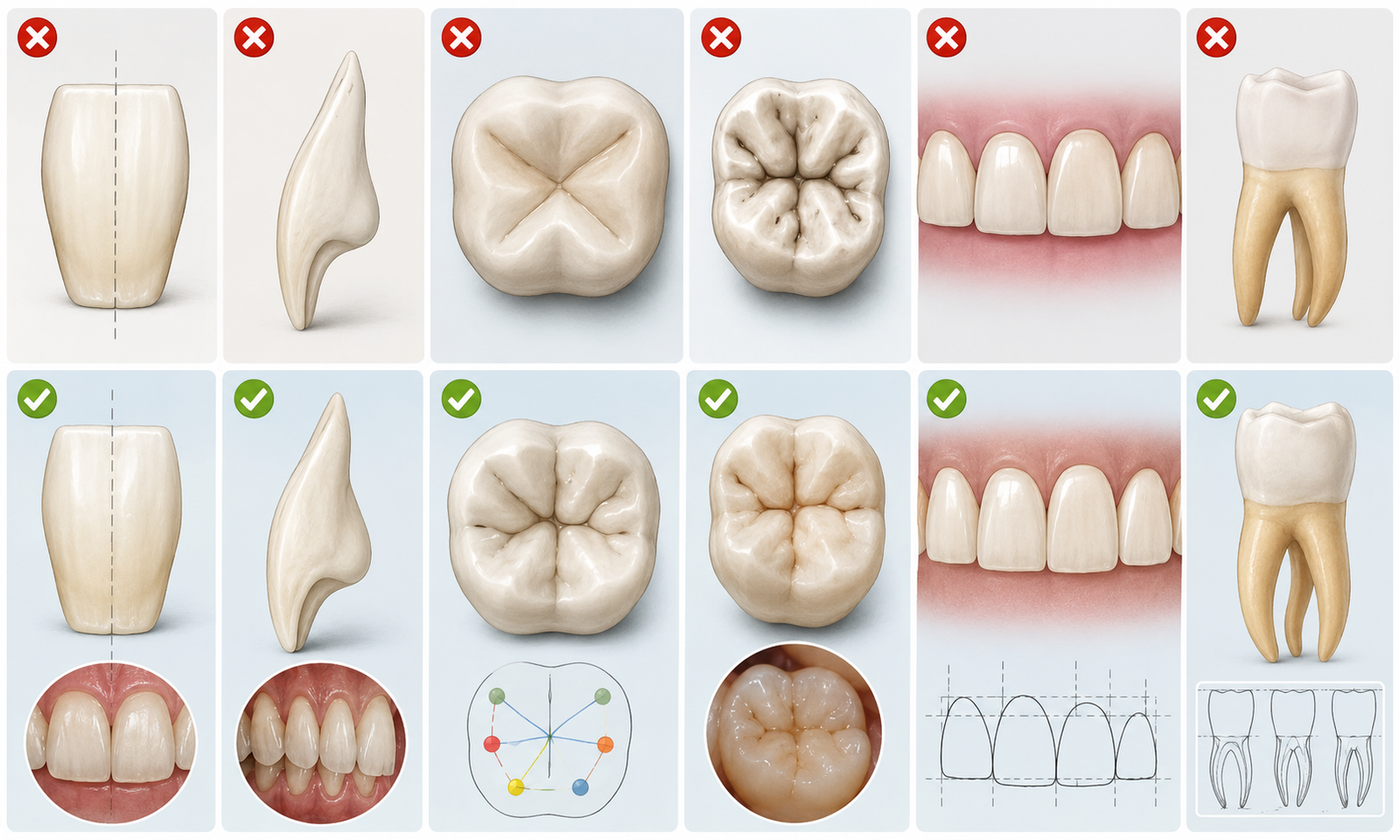
Tooth morphology is one of the bases which is of significance in the study of Dental Anatomy. Students need this knowledge in the restoration procedures, understanding occlusion, tooth identification and the reproduction of natural tooth form in clinical practice which is applied by young professionals in their restorative procedures. But learning dental anatomy isn’t necessarily a simple process. Visualizing the structure of teeth, recalling the position of anatomical landmarks, and turning knowledge into skills are challenging problems for many learners.
Dental anatomy knowledge is vital to the development of confidence in the student throughout their preclinical lab sessions and in the clinical clinic. However, there are some regular pitfalls that stall progress and foster frustration when it comes to learning. Early diagnosis of these problems and the use of appropriate study strategies can make learning easier and more productive.
In this article, we will go beyond examining the most common error students encounter in learning tooth morphology and offer practical strategies to enhance comprehension, accuracy and hand skill.
Tooth morphology
Morphology is related to the shape, form, dimensions and morphological features of teeth. Every tooth has a particular function, such as cutting, tearing, and grinding of food. Their knowledge is critical to the fields of restorative dentistry, prosthodontics, orthodontics, oral surgery, occlusion analysis, etc. Make an attempt to recreate the ‘tooth shape’ of the natural teeth in restorations as much as possible
- Achieve balanced occlusion
- Determine the diagnosis and treatment plan
- Have knowledge of the ways the jaw works during movement.Know functional jaw movements.
- Enhance appearance and masticating ability
- Ensuring occlusal and error-free restorations
- Due to its clinical relevance, students should not memorize and obtain a spatial orientation of tooth form.
The following are common problems that students may encounter with the study of tooth morphology
Having trouble seeing the tooth in 3 dimensions
The ability to recognize teeth as three dimensional structures is one of the main challenges in usage of form terminology. Teeth are frequently shown in a flat diagram in textbooks, and it is difficult for students to visualize the full tooth.
Students might know the anatomy of each surface, but might not be able to appreciate how they relate to each other to form a whole anatomical structure. This occurs more explicitly during wax-up, carving or preparation of crowns.
You can avoid this mistake by
Pupils should learn about teeth in a variety of different ways, not just looking at one image. Dental models, when rotated, and removed teeth can help a great deal with developing spatial comprehension.
Helpful techniques include:
- Using 3D tooth models
- Combining occlusal, buccal, lingual, mesial and distal views.
- Repeatedly take the same kind of cues from different angles
- Making comparisons between right and left counterparts
Using computer-generated 3-D models of human anatomy.Digital 3-D Anatomy Software Practice. To use physical models to reinforce visual memory and to be able to relate theory to practical anatomy.
Memorize without understanding
Students often try to remember cusps, ridges, grooves and fossae, but fail to understand their function. Therefore, information is easily forgotten after examination. Learning the morphology of the tooth becomes easier for students if they are able to relate the teeth with their functions. For instance, the cusps on canine teeth are prominent, because they are used to tear prey; molars have wider occlusal surfaces for grinding.
How to Avoid This Mistake
Rather than memorizing, students should ask the why, how or what questions:
- Why is the shape of this cusp the shape that it is?
- Which way does this ridge bend the chewing motion?
- Why is it that molars are broader than incisors?
- What are the functions of contact areas in protecting periodontal tissues?
Form/Function associations result in better retention and clinical reasoning. When you are studying the shape of a tooth and forget to take into account the occlusal plane you are overlooking the occlusion!
Some learners will just learn the individual teeth without realizing that it is a system of occlusion. This can cause improper restorations and misunderstandings about the mastication. There is a close relationship between tooth morphology and occlusion. Jaw movement is emphasized by cusps, grooves and ridges which define the way the upper and lower teeth fit together.
Occlusion may cause:
- Improper cusp placement
- A restoration with no anatomy (no teeth).
- Occlusal interferences
- Reduced chewing efficiency
- Temporomandibular discomfort
But how to not make this mistake?
Students should be split into groups of two opposing arches and examine the interdigitations of teeth during function.
Useful strategies include:
- Experiences using articulated models
- Studying intercuspation patterns
- To learn about centrics and eccentrics.
- Having a handle on these “regular cusp” relationships.
- Matte sealing both arches at the same time.
Students will learn how to occlude and make their restoration more functional and anatomical.
Looking Outside the Box.
One of the frequent errors is omission of marginal ridges, line angles, developmental grooves and cusp inclines. Someone who is new to caricature often overfunctions the shape of the teeth, and has a tooth that is not anatomically correct. Small details can be unimportant but have consequential esthetic and functional roles.
How NOT to Make This Mistake
Pupils should be taught to pay close attention to detail. Natural teeth can be compared to their own wax-up or carvings and missing anatomical features can be discovered.
Helpful habits include:
- Utilizing magnification during the practice session(s).
- Taking good photos of teeth.
- Repeatedly pointing to anatomical landmarks
- Providing more time for the shark to get to know the body and engage in gentle carving rather than brutal reduction.
- Carefully reading critique from your teacher
Detail gives a realistic and functional look to restorations.
Hand Dexterity difficulties when waxing and carving.
Many pupils have only a theoretical knowledge of the teeth and only achieve a good impression of them in theory. Fine motor control, patience and precision are needed for waxing and carving. Less experienced students tend to lose a lot of material, skew the teeth or miss the gum line symmetry. Overall, manual dexterity can be greatly enhanced with practice and repetition.
Good practice for students will be supported through:
- Having daily short sessions of carving.
- Proper use of instrument grips
- Takes time to do things slowly while training
- Focusing on tooth anatomy step-by-step
- Reliably matching work with reference models on a regular basis
Patience is essential. Once consistency & accuracy gear up, speed will follow.
Over- depending on memorization charts
Charts and flashcards are great learning tools; relying too heavily on them can hinder the development of deeper understanding. Students may learn merely to memorize names of teeth and characteristics without identification of actual tooth structures.
This makes it difficult to recognise teeth clinically and requires the student to have to reproduce it in laboratory sessions. There is a difference between memorizing and understanding—memorize for understanding and not the other way around.
Students should match up the charts and with:
- Sketching exercises
- Tooth identification drills
- Practical waxing sessions
- Clinical case discussions
- A comparison of teeth through pairs.
Active learning is a powerful learning method that helps champion long-term retention compared to passively memorizing it.
Confusing Similar Teeth
With similar teeth, it’s a big challenge in order to distinguish them, particularly for the newbies. It can be difficult to tell the difference between maxillary and mandibular premolars the first time they both show up at the same time, or between central incisors. When they are making errors they usually use the general shape instead of the generalising feature characteristics.
How to avoid this error
Pupils should be taught to recognise special characteristics in a systematic way.
For example:
- Review number and size of cusps
- Observe root curvature
- Compare crown proportions
- Analyze occlusal outlines
- Study contact areas include positions;Study contact areas have positions;
It may also help to make comparison tables with likestype teeth to use for better recognition.
Inconsistent Study Habits
Constant reinforcement is needed for tooth development. Students are sometimes very diligent during the examination preparation, but do not remember afterwards. Since dental anatomy is more than just a mental skill, it affects the learning process when it’s practiced haphazardly.
How to avoid this mistake
Be consistent rather than long study sessions at random times. Good habits to the study process are:
- Evaluate each of the teeth one after another.
- Practicing sketching regularly
- Revisiting previous wax-ups
- Watching anatomy demonstrations
- Venting to test identification skills once every 7 days
Spending short time periods on memory work creates a stronger memory and helps to build confidence over time.
Not using multiple learning resources.
Some students exclusively read only notes or textbooks. But, when students use multiple learning approaches to study tooth morphology, it is easier to make sense of morphologies.
How To Miss This Trick
Students are encouraged to utilize a variety of teaching materials such as:
- Dental anatomy atlases
- 3D visualization software
- Laboratory demonstrations
- Instructional videos
- Peer discussions
- Physical tooth models
Various resources support in several sensory ways, thereby enhancing comprehension and memory.
Comparing Progress With Others
Students at the dental school are discouraged by the practice of comparing their carving and/or waxing skills with their peers. This can decrease self-assurance and motivation. Each person has a unique skill for developing dental anatomy. Some students learn faster than others in handling tasks, and some need more repetitions.
How to avoid this mistake.
Students do not need to compare their results with other students – they should improve their own performance over time.
Helpful approaches include:
- Following the child’s progress via photos
- Properly storing old wax-ups for reference.
- Establishing reasonable improvement objectives.
- Making allowances for errors in learning.Tolerating failure.
- Away from negative feedback from teachers
A person becomes confident with continuous practice and introspection.
Neglecting Instructor Feedback
Errors made by some learners do not give the learners space time to fully analyze Instructor Corrections. Feedback is one of the most important tools in the pedagogical toolbox in terms of education in the preclinical field.
Do not do the following:
Each time a student goes to the lab, modifications should be noted and made.
Useful methods include:
- Keeping a running tally of errors
- Asking clarifying questions
- Examiner’s work on corrected models
- Repeating difficult exercises
- To make a checklist for development.
When feedback is given consistently, learning can be advanced much quicker.
How to Master Tooth Morphology
Use Active Recall
Regular self-testing should replace note taking and be used as a way to drive self-learning.
Examples include:
- Using memory to make a drawing
- Labeling anatomical structures
- A great question: How to identify teeth with no references?
- Explaining morphology aloud
It is easier for long-term retention to work when compared to passive review.
Practice Visualization Skills
It is very important to try and visualize during dental anatomy.
Students can develop their spatial sense in the following ways:
- Visualising tooth models in your head.
- Drawing a sketch of the transparent outline of a tooth
- Comprehending digital 3D anatomy software programs.
- Stakeholders’ views on the issues at hand.Multiperspective observations of teeth.
The exercises help to bring theory into practice.
Form Incremental Waxing Habits
Good waxing is done over a period of time and with care, rather than by rushing and pushing the shapes.
Students should:
- Draw primary contours first
- Add cusps gradually
- Use a La Pinta SCAFFolding™ to carefully refine grooves and ridges.
- Verify symmetry continuously
- Check occlusion regularly
The structure helps to increase accuracy and decrease error rates.
Integrate Theory With Clinical Relevance
Students make better learning if they understand the impact of morphology on actual clinical procedures.
Connecting anatomy with:
- Crown restorations
- Occlusal adjustments
- Prosthetic design
- Orthodontic planning
- Periodontal health
Adds more context or relevance to the subject; makes it easier to remember.
Be patient while learning dental anatomy.
Teaching the shape of teeth is a slow process, combining science with art and processes. How do and how should children learn they make mistakes?How should children come to understand that they get things “wrong”? Each miscarved tooth and each “wax up” failure is an opportunity to gain insight into observation, precision, and critical thinking.
Those that are patient, practise regularly and use the feedback positively stand to benefit greatly with time. The study of dental anatomy can’t be learned overnight, but a lot of work will go into getting ready for successful clinical outcomes.
Conclusion
Knowing the morphology of the tooth is a complex and extremely rewarding part of dental anatomy. Three dimensional visualization, occlusion, manual dexterity, memorisation and anatomical detail, are three general areas where students often have difficulties. The lack of success with these can be overcome with consistent practice, engaging approaches to learning, and an understanding of tooth function.
The blend of theory and practical work allows the learner to develop and deepen his/her knowledge and skills. Observation skills are developed, to dentistry learning it is applied in functional context – which enhances learning – and feedback from the instructor is heeded. A successful understanding of tooth morphology will lead to better restorations, endodontics, and improved occlusion management, which will result in increased confidence in clinical dentistry.