Not all cabinet systems are solving the same problem.
Big-box cabinetry is built for convenience: fast shipping, standardized sizing, acceptable finishes, and price points designed for broad appeal. Traditional RTA brands improve on cost efficiency by making assembly easier, but most still inherit the same compromises—commodity materials, generic proportions, interchangeable styles, and construction methods optimized more for packaging than permanence.
MidModCabs was built from a different premise entirely.
Rather than asking how to make cabinetry cheaper or faster, the company asks a more architectural question: how do you make a kitchen feel intentional, enduring, and materially honest—without defaulting to the cost and delays of full custom millwork?
That distinction matters.
For homeowners restoring period homes, architects designing warm modern interiors, or renovators trying to avoid the visual sameness of mass-market kitchens, cabinetry is not a background purchase. It is the defining spatial system of the room.
MidModCabs positions itself outside the typical RTA conversation by offering architect-designed, American-made wood cabinetry built specifically around Mid-Century Modern principles: clean geometry, disciplined proportions, authentic materials, and structural integrity that rivals many custom shops.
This is not “better flat-pack.” It is a fundamentally different design category.
Why Most “Modern” Cabinets Still Miss the Point
A flat slab door alone does not make a kitchen Mid-Century Modern.
The market is crowded with products labeled “modern,” but most are simply simplified cabinet fronts applied to otherwise generic systems. The proportions feel off. Grain direction is inconsistent. Hardware placement is treated as an afterthought. Material selections often prioritize trend over longevity.
Authentic Mid-Century Modern design is much less forgiving. The aesthetic depends on restraint. Every reveal, alignment, proportion, and finish carries more visual weight because there is nowhere for bad decisions to hide.
MidModCabs was designed around that reality.
Instead of adapting a broad cabinet catalog to appear modern, the entire system is architect-led from the outset. Cabinet proportions, panel geometry, finish selections, and layout logic are all developed to support a cohesive MCM vocabulary rather than mimic one.
This creates a noticeably different result.
The kitchen feels composed rather than assembled. Warm rather than decorative. Minimal without feeling sterile. That difference is subtle in product photos and obvious in built space.
The Construction Difference Is Not Cosmetic
Many RTA cabinet brands compete primarily on visual style, but the more important distinction is hidden in the box construction. This is where most of the category reveals its limitations.
Budget RTA systems are commonly built around particle board or MDF with cam-lock hardware as the primary assembly method. These systems are optimized for shipping efficiency and quick consumer assembly, but they introduce familiar long-term issues: loosening joints, cabinet drift, loss of squareness, water vulnerability, and structural fatigue over time.
MidModCabs rejects that model entirely.
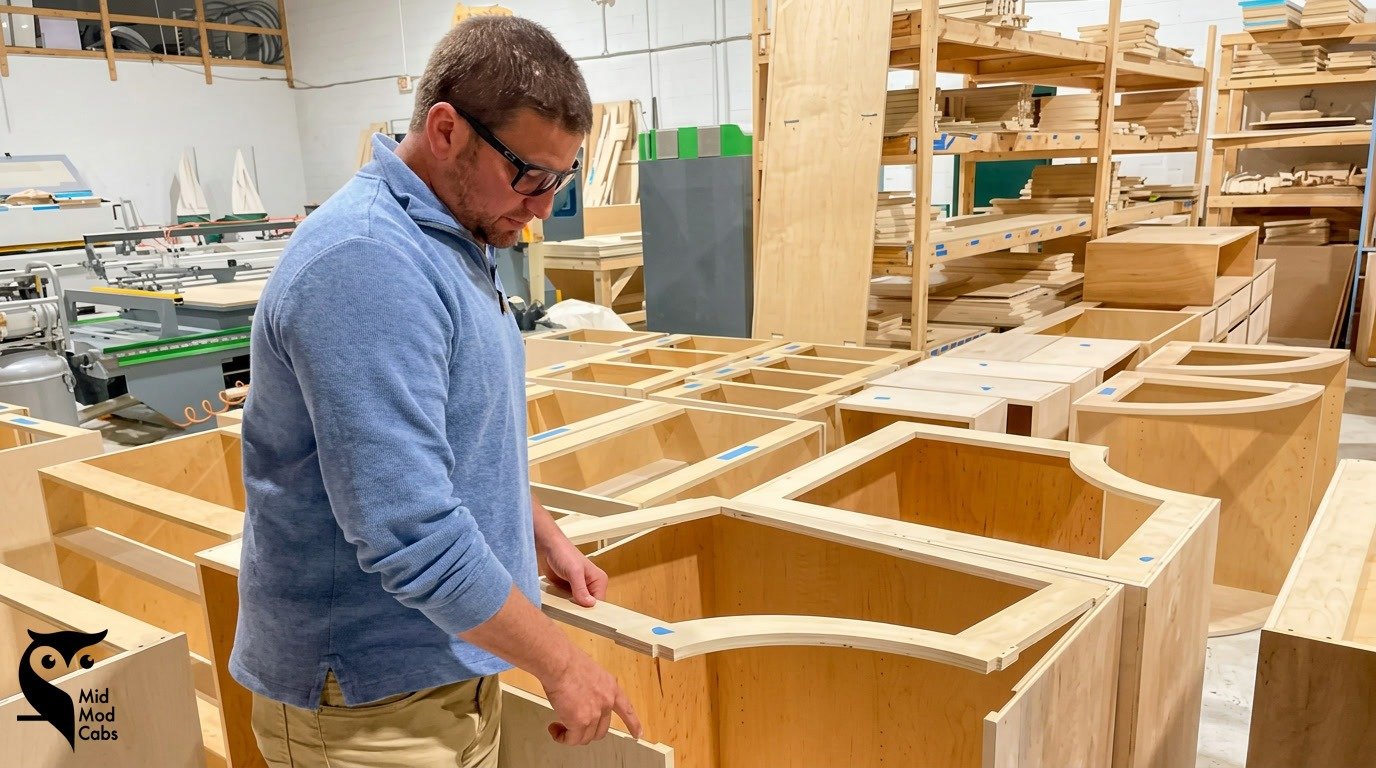
Their cabinet boxes are built from furniture-grade plywood, which offers significantly greater dimensional stability, moisture resistance, and structural performance than particle board alternatives.
But materials are only part of the story. The more important differentiator is joinery.
Why Joinery Is the Real Reason MidModCabs Performs Differently
Joinery is one of the least discussed and most consequential aspects of cabinetry. It determines whether a cabinet behaves like furniture—or like packaging.
Most flat-pack systems rely on cam-lock hardware because it simplifies mass production and speeds up consumer assembly. The tradeoff is long-term structural compromise.
MidModCabs takes a fundamentally different approach through traditional woodworking methods designed for permanence:
• Dado joinery creates grooved channels that lock cabinet panels into precise alignment, improving structural strength and long-term squareness.
• Rabbet joinery reinforces panel intersections with increased surface contact, resulting in tighter connections and better load distribution.
• Glue and screw reinforcement adds mechanical and adhesive stability beyond what cam-lock systems can provide, reducing loosening over time.
• Furniture-grade plywood construction works in tandem with this joinery system, creating cabinet boxes with greater rigidity, moisture resistance, and dimensional stability.
Together, these details create a cabinet system that assembles square, stays square, and performs more like built millwork than conventional RTA cabinetry.
This is why MidModCabs can confidently offer a lifetime guarantee in a category where many brands still optimize for shipping efficiency over structural longevity.
Not Custom. Not Commodity. A More Strategic Middle Ground.
Traditional custom cabinetry can deliver exceptional results, but often at a cost structure and timeline that makes it impractical for many projects. Long lead times, design fees, fabrication schedules, and installation coordination can quickly compound into a major budget escalation.
At the opposite end, big-box solutions reduce friction but often introduce another kind of cost: aesthetic compromise.
MidModCabs occupies a more strategic middle ground.
It offers the design discipline and material integrity typically associated with custom work while preserving the efficiencies of a refined RTA system.
This positioning is particularly relevant for projects where design matters but budget discipline still exists: thoughtful renovations, architect-led remodels, period home updates, and “forever kitchen” investments where short-term savings are not the only metric.
The value proposition is not about finding the cheapest route to new cabinets. It is about avoiding the false economy of replacing, upgrading, or regretting a cheaper decision later..
Built for People Who Care How Things Are Made
There is a growing divide in the home renovation market.
Some consumers want immediate solutions at the lowest possible cost. Others are becoming increasingly selective about construction quality, sourcing, longevity, and design coherence.
MidModCabs is unapologetically built for the second group.
Its U.S.-based manufacturing allows tighter quality control, more consistent production standards, and closer alignment between design intent and execution. That domestic oversight matters, particularly in a category where finish inconsistency, poor packaging, and tolerance issues remain common pain points.
More importantly, the company’s design philosophy is inherently aligned with sustainability through durability.
The most sustainable cabinet is often not the one marketed most aggressively as eco-conscious. It is the one that does not need replacement. Plywood construction, durable finishes, and structurally robust joinery all contribute to that longer lifecycle.
This is sustainability expressed as permanence, not branding language.
A Better Investment Starts With Better Questions
Kitchen cabinetry is one of the largest financial and visual decisions in any renovation. Yet most buying decisions are still framed too narrowly around door style, finish color, and upfront price. Those are incomplete metrics.
The more important questions are architectural:
• How should this kitchen function in the space you actually have?
• What visual language should the cabinetry establish?
• What material and construction system makes sense for a 15- to 25-year horizon, not a 3-year one?
• And what is actually possible when design constraints are approached intentionally rather than generically?
That is where MidModCabs becomes relevant.
It is not simply an alternative to big-box cabinets or another entry in the premium RTA market. It is a more deliberate cabinetry system for projects where design integrity and long-term performance both matter.
The next step is understanding what your space can actually become when cabinetry is treated as architecture, and not inventory. That conversation starts simply—with a 15-minute fit call, a design consultation built around your layout, priorities, and possibilities.