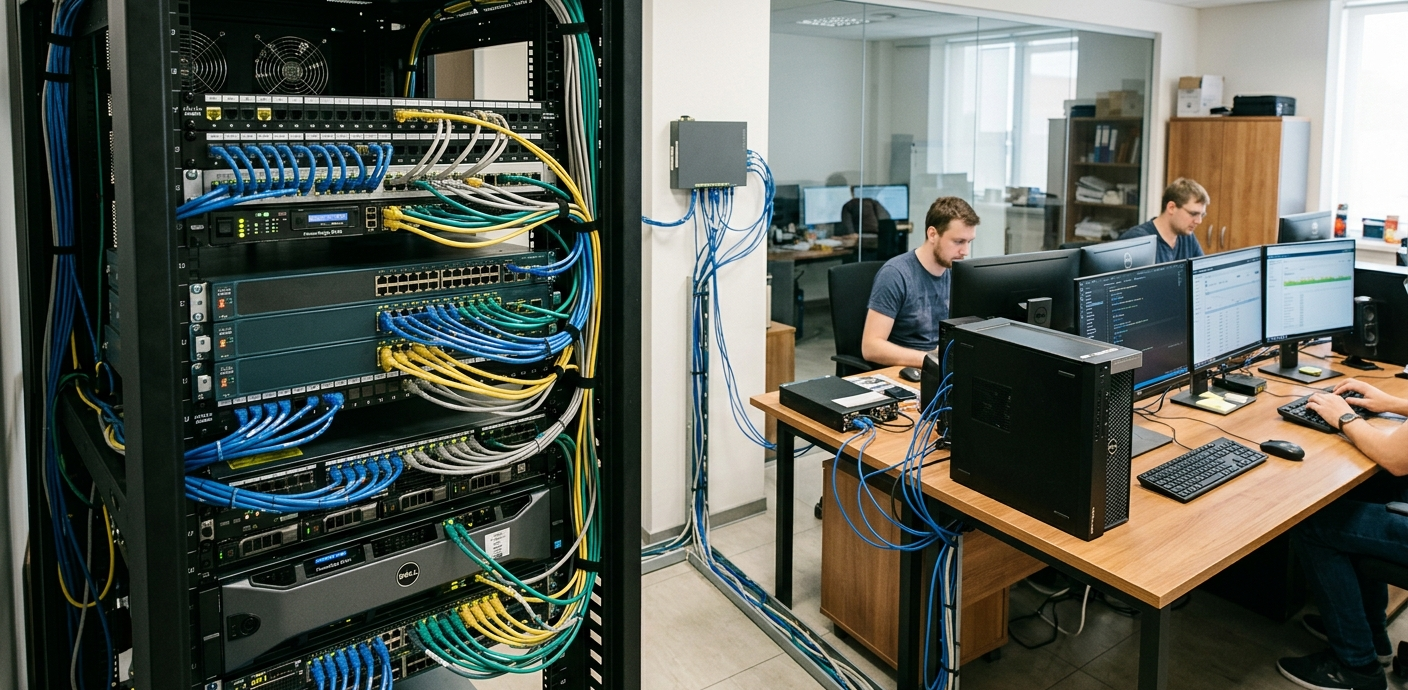
In the era of digitalization, networks are the backbone of communication, data sharing and resources management. The setup of devices and connections, known as network topology, significantly influences efficiency, reliability, and scalability, whether it’s at an office, university, or a large corporate campus. Network topology is not only a way to link computers together, it will determine the way data moves, how easy it is to maintain the network and how well it can withstand failures. Network administrators and students can both use the knowledge of various network topologies to make informed decisions that maximize network performance and minimize cost.
In this article, we are going to look at 4 main topologies: Bus, Star, Ring and Mesh. All of these topologies have distinct features, advantages and disadvantages and are appropriate to use in certain situations. Understanding these configurations enables businesses and IT experts to design networks that are optimised for performance, fault tolerance, and scalability.
What is meant by network topology?
The topology of a network is the physical or logical layout of the network and how the devices (nodes) and connections (links) are arranged. Simply put, it’s the answer to the question: “How do devices in a network communicate?” Physical topology has to do with the actual topology of the cables, routers, switches, and other networking equipment. Logical topology is the arrangement of data flow through the network, regardless of its physical connections.
The selection of the right topology is essential as it directly affects network performance, reliability, scaleability, maintenance efforts and costs. For instance, a sub-optimal network could suffer from data bottlenecks, frequent downtimes, or sub-optimal resource usage. On the other hand, if the network is designed correctly, communication will flow easily, faults will be identified quickly and can be expanded when required.
Note also that network topologies may be hybrid, combining two or more topologies to take advantage of the best aspects of each while avoiding the drawbacks. For example, a large company might implement a star and mesh network for central management and redundancy for key devices.
Bus Topology
Structure and Function
One of the oldest and simplest configurations of a network is called bus topology. This involves having one main communication line, or backbone, connecting all devices together. Every node (computer, printer, or server) is directly attached to the bus using a tap or drop line and data is sent along this common medium. Usually termination resistors are installed at both ends of the bus to avoid signal reflection and keep the transmission quality.
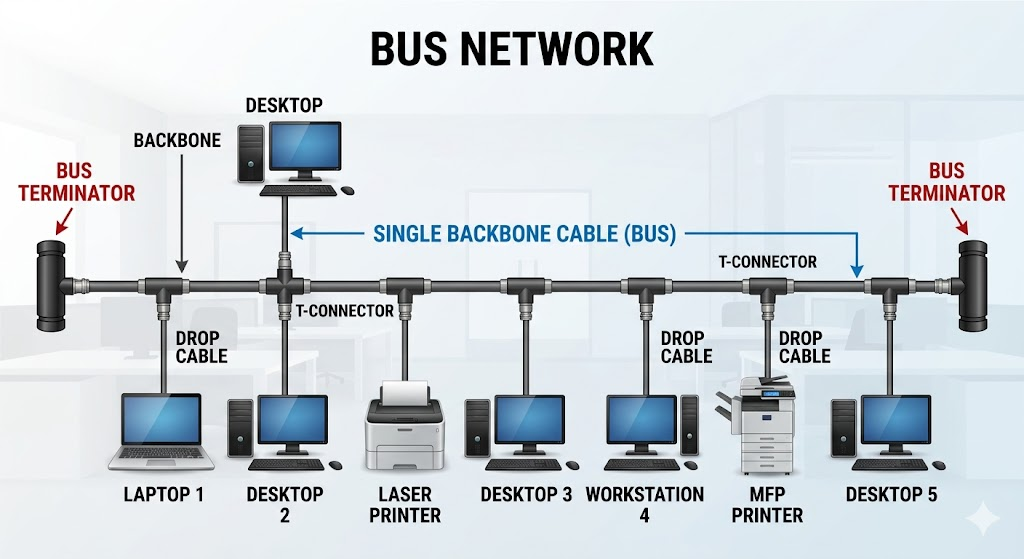
The following are the benefits of bus topology:
The simplest and least expensive network topology is bus topology. It has low initial setup cost because the number of cable required is quite less as compared to other topologies. Easy to install for small networks, it’s perfect for labs, classrooms or temporary installations. Moreover, the addition of new devices is relatively simple: a new node can be connected to the main bus without having a significant impact on the existing network.
The other benefit is that it can be used in linear network structures. Bus topology is particularly useful for small scale networks with limited and well known data transfers, where there are no complicated routing mechanisms. Because of its simple design, it can also be easily troubleshot, allowing administrators to examine the primary cable to identify potential issues.
Bus Topology has a number of disadvantages. There are drawbacks to Bus Topology.
Although this is a simple topology, there are many limitations to it. Scalability is one of the main disadvantages. As the number of devices increases, data collisions will increase in frequency, which will make the network less efficient. This is because all the nodes have to share the same communication line, and when the nodes send their messages at the same time, it may interfere with each other.
Another issue is fault tolerance. If the main bus cable fails, then the entire network could go down, and it can be difficult to determine which node the failure occurred in. Also, if the network is larger, network maintenance can be a hassle because the single backbone has to be kept up and running, otherwise the whole network will be down.
Typically, bus topology works well for small, low-volume networks, but isn’t the best option for today’s high-reliability and scalable organizations.
Star Topology
Structure and Function
A well-used network topology that connects every node to a central hub, switch, or router is called the star topology. Each device is connected to the central node in this setup, and all data passes through the central node to the desired recipient. The central hub serves as a traffic controller, efficiently managing the flow of data and preventing collisions.
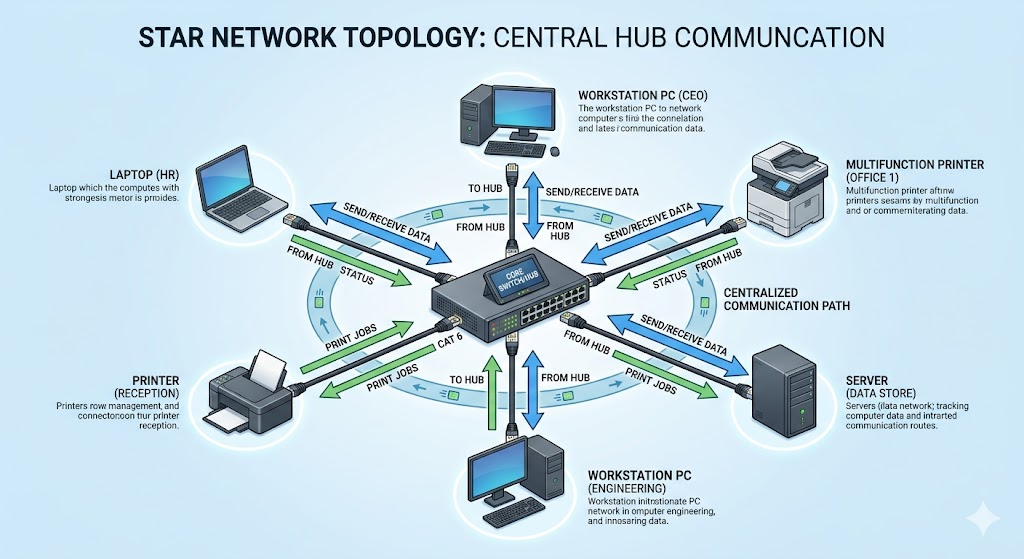
The benefits of the Star Topology: The Star Topology has its benefits:
The main advantage of the star topology is its high fault tolerance. Every node is separately linked to the central node, therefore, if one device or link fails the remaining devices or links will not be affected. The downtime will only affect the node directly affected by the failure.
Another advantage of the Star topology is that it makes network administration and troubleshooting easier. Network administrators can easily detect and isolate problems at a node level without impacting network performance. Moreover, the performance is higher than that of the bus topology as each device can have its own dedicated connection, thus reducing the chances of collision.
The other benefit is scalability. Star topology lends itself to the growth of a network in a business, school, or enterprise, since adding or removing nodes is easy and doesn’t have to disrupt the other devices.
Star Topology Disadvantages:
Although the star topology has its benefits, it does come with limitations. There is a single point of failure in the central hub. Should the hub fail, the network stops functioning altogether. Further, individual cables are needed for every node, which could escalate the overall expense of cabling, particularly in bigger networks with numerous gadgets.
The capacity of the central hub also can limit the star topology. Traffic can become too much in the hub, causing delays and congestion in data transfer. Modern switches and routers can overcome this limitation, but network designers must keep this in mind for high-traffic networks.
Ring Topology
Structure and Function
A ring topology is a networking arrangement in which every device is linked to just two other devices creating a loop for data transfer. The data can flow in one direction (unidirectional) or both directions (bidirectional) around the ring until it arrives at its destination. These nodes serve as repeaters, boosting the signal strength to ensure data integrity throughout the network.
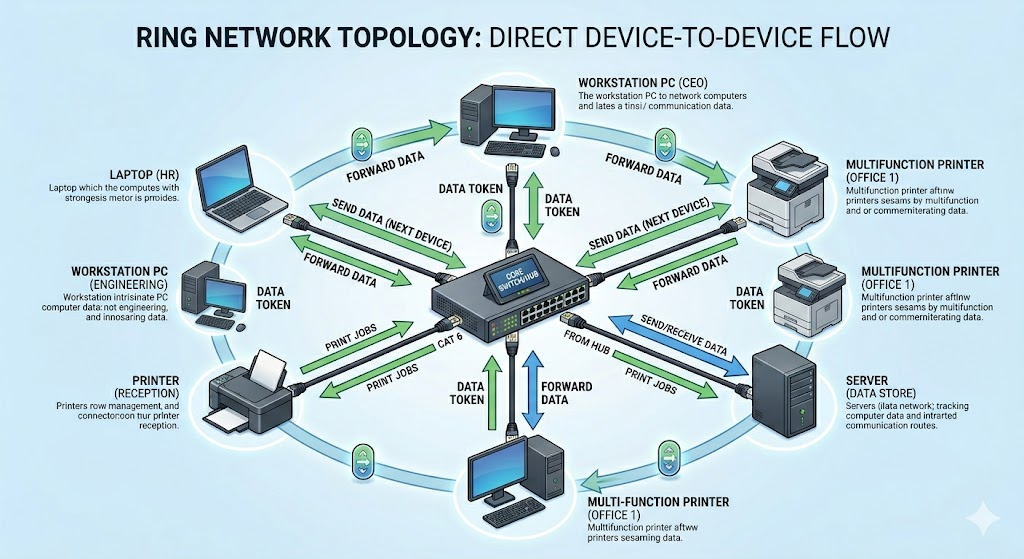
The advantages of this are as follows:
There are a few good advantages to ring topology. Data can be transmitted in an organized and predictable way in the structured pathway, unlike the case with bus topology. This makes it suitable for networks where orderly data transmission is of critical importance.
One of the benefits is that it is fast enough for medium sized networks. Data is processed in a sequential manner from node to node, so that each device can effectively receive and pass packets. Another advantage of ring topology is that it can be achieved using fiber optic cable, which offers high-speed data transmission over distances without signal loss.
Disadvantages of Ring Topology: Ring Topology Disadvantages:
But, disadvantages of ring topology are its lack of fault tolerance, especially. If they fail or break, the network will be down as well, unless it is a Dual Ring or Redundant configuration. Another problem with maintenance is that faults need to be carefully identified and isolated by examining the ring structure.
Scalability is another disadvantage. The adding and removing of devices is complex, it could involve temporarily breaking the ring and causing a network down time. This makes ring topology more popular in small and medium sized networks or environments, as opposed to enterprise networks.
Mesh Topology
Structure and Function
Mesh topology is a very connected network where every node is linked to many other nodes. In a full mesh, each one of the devices has a dedicated link to all of the other devices, and in a partial mesh, only some nodes are connected to other nodes. This redundancy provides multiple routes for data to flow, making it more fault-tolerant and reliable.
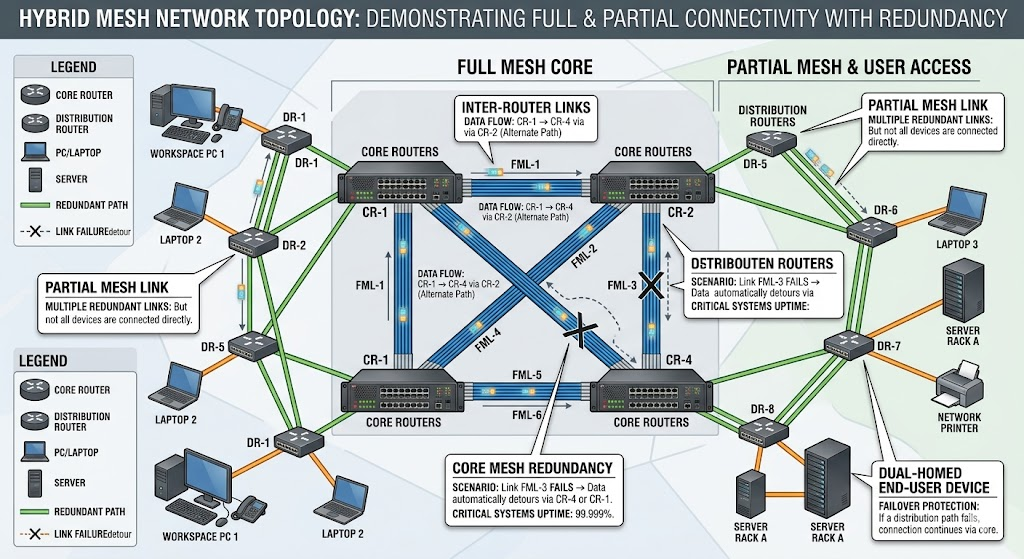
The pros of Mesh Topology include the following:
Mesh topology is known for its strength and ability to withstand failures. When a link or device goes down, the data is rerouted through other links or devices and network performance is not significantly impacted. This makes mesh topology suitable for settings where reliability is paramount, like data centres, financial institutions and industrial automation systems.
This is another advantage that is not to be overlooked. Multiple dedicated links decrease network congestion and data can be transmitted simultaneously on different links. Another advantage of mesh topology is that it can be expanded over time, particularly in the case of partial meshes where new devices can be connected without disrupting the current network that much.
The disadvantages of Mesh Topology:
Even though it has several advantages, the topology is costly and complex. Full mesh networks are costly and difficult to manage since they involve a number of network interfaces and a large number of cables. Installation and maintenance are more difficult, more complicated than star or bus topologies; each node that is added must have several connections.
Small networks might not require mesh networks, as redundancy and HA are not required. In such instances, simpler topologies such as star or bus can provide adequate performance at lower costs.
Explain how networks can be designed in different topologies. Compare network topologies.
Comparing these topologies side by side will help make the decision about the appropriate topology:
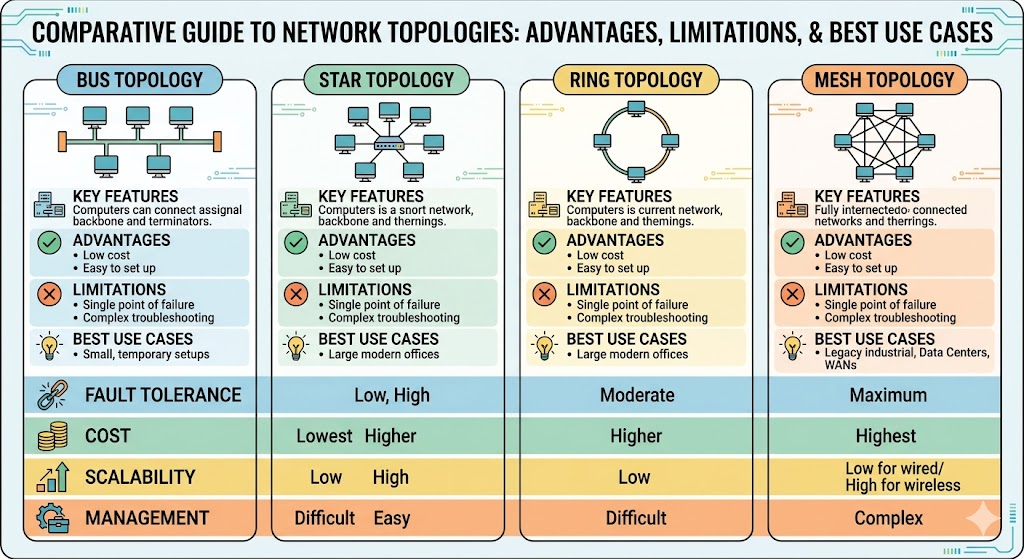
| Topology | Advantages | Limitations | Best Use Case |
| Bus | Easy to install, inexpensive, and straightforward | Low scalability, high collision risk and single point of failure | Small networks, temporary setups |
| Star | Fault-tolerant (except hub), easy to manage, scalable | The higher cost of cabling and failure of the central hub | High-speed internet networks for offices, schools and businesses |
| Ring | Anticipated data flow. Efficient for moderate traffic | First time failure, difficult to grow | Small and medium networks, fiber networks |
| Mesh | Very reliable, fault tolerant, good performance | Costs are high and the set up and maintenance requirements are complex | Systems: Critical systems, data centers, industrial networks |
Conclusion
Knowing about various network topologies is a vital part of network design to ensure effective, reliable, and scalable networks. There are advantages and disadvantages to each topology: bus, star, ring and mesh. The main advantage of bus topology is that it is simple and cost-effective, while the star topology has the feature of being fault-tolerant and easy to manage; the ring topology has the characteristic of orderly data transmission, and the mesh topology has the characteristic of high reliability and redundancy.
Before deciding on a topology, network designers should carefully analyze the performance, scalability, fault tolerance, and cost. Mixing various topologies also called hybrid is becoming more common in today’s IT infrastructures where the advantages of each topology are matched with mitigations. Understanding network topology principles allows organizations and students to ensure smooth communications, strong connectivity, and prepare for future changes.