Introduction
The accuracy of interaction between teeth surfaces that are in contact plays a crucial role in the efficiency of the human masticatory system. These surfaces are mainly on the back of teeth, and they are formed anatomically to resist and distribute forces produced during chewing. The nature of their structure is critical in ensuring functional harmony in the oral cavity, as their structure consists of cusps, fossae, grooves and marginal ridges.
To determine the dynamic of occlusion, it is essential to examine how the anatomical structures relate to each other. Cusp-fossa relationships are of great importance, determining the location of the encounter between opposing teeth, determining its functionality in the mastication process. Singularly aligned, these relationships lead to an efficient allocation of the forces, reduce wear, and long-term dental stability.
Anatomy of Occluding Tooth Surfaces
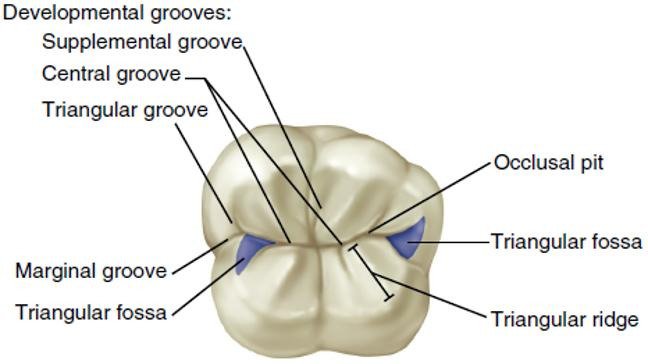
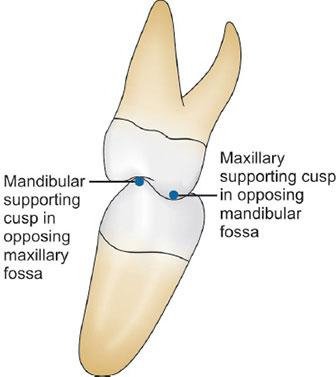
The Roles of Cusps and their functions.
Cusps refer to raised areas on the grinding surfaces of teeth especially in the premolars and molars. They can be functional (supporting) cusps and non-functional (guiding) cusps:
- Most of the forces on the occlusal ridges are carried by functional cusps (lingual cusps of the teeth in the maxilla and buccal cusps of the teeth in the mandible).
- Non-functional cusps help in steering food over food in the process of chewing and holding to good occlusal relationships.
The shape and orientation of cusps are important. The smallest displacement may result in an imbalance of forces that may cause discomfort or structural damages.
Fossae and Grooves
Fossae are depressions that around the dentures take opposing cusps on occlusion. They become the major points of contact when forces are exchanged and eliminated. Grooves, in their turn, serve as food escapes, and overabundance of pressure is avoided during the process of mastication.
Marginal Ridges
The edges of the occlusiveness surfaces are adorned with marginal ridges which are fundamental in supporting the integrity of teeth and contact with adjacent teeth. Aligning of marginal ridges properly will guarantee smooth change in the interstitial teeth and will also ensure continuity of the dental arch.
Understanding Cusp-Fossa Relationships
One of the core ideas of occlusal harmony is cusp interacting with fossae. These connections can be seen to dictate the relationships in which teeth contact one another during functional movements.
Every functional cusp fits in a respective fossa of the opposite tooth in a well balanced dentition. This pattern enables the forces to be guided along the long axis of the tooth, which is structurally ideal.
The kind of Occlusal Contact.tCusp-to-fossa contact: Excellent in the distribution of forces..Cusp-to-marginal ridge contact: Found in normal dentition but can be a focus of stress in an irregular dentition..Although both types of contacts are natural, cusp-fossa relationships are usually viewed as more stable, and capable of inflicting less wear or trauma..
Cusps are elevated points on the occlusal surfaces of teeth, particularly prominent in premolars and molars. They are categorized into functional (supporting) and non-functional (guiding) cusps:
- Functional cusps (lingual cusps of maxillary teeth and buccal cusps of mandibular teeth) bear the majority of occlusal forces.
- Non-functional cusps assist in guiding food during chewing and maintaining proper occlusal relationships.
The morphology and positioning of cusps are critical. Even slight deviations can lead to uneven force distribution, potentially causing discomfort or structural damage.
Fossae and Grooves
Fossae are concave depressions that receive opposing cusps during occlusion. They serve as key contact points where forces are transferred and dissipated. Grooves, on the other hand, act as pathways for food escape, preventing excessive pressure buildup during mastication.
Marginal Ridges
Marginal ridges form the boundaries of occlusal surfaces and play an essential role in maintaining tooth integrity and interproximal contact. Proper alignment of marginal ridges ensures smooth transitions between adjacent teeth and contributes to the continuity of the dental arch.
Understanding Cusp-Fossa Relationships
A central concept in occlusal harmony is the interaction between cusps and fossae. These relationships determine how teeth contact each other during functional movements.
In a well-balanced dentition, each functional cusp occludes into a corresponding fossa of the opposing tooth. This arrangement allows forces to be directed along the long axis of the tooth, which is structurally optimal.
Types of Occlusal Contact.
- Contact point: cusp-to-fossa: Ideal to distribute forces most effectively.
- Cusp-to-marginal ridges contact: It is normal in normal dentition but can cause stress when improperly aligning.
Both types of contacts are natural but, cusp-to-fossa relationships are more stable, less likely to cause wear or trauma.
Marginal Ridge Alignment and Its Importance
Marginal ridges have to be horizontally oriented to adjacent teeth so that they are sure enough to provide sufficient occlusal performance. When misaligned it can cause:
- Food impaction
- Periodontal issues
- Uneven occlusal forces
- Greater risk of tooth fracture.
In a case where marginal ridges are well aligned, a stable platform is provided on which good mastication can take place and the periodontal structures that surround it are guarded.
Biomechanics of Occusals.
Force Distribution
The forces created can be very high during chewing, up to several hundred newtons. These forces are distributed evenly at various تماس points by designing the occluding surfaces to form a uniform distribution.
Important principle: The direction of the forces must be along the long axis of the tooth. This reduces the load to supporting tissues like the periodontal ligament and alveolar bone.
Importance of Tooth Morphology
There is nothing casual about the anatomy of teeth, they are biomechanically optimized. Cusps are shaped into fossae so that they fit into the jaw and stabilize the jaw when closing them and to avoid the lateral movement.
Dynamic Occlusion
Occlusion does not just remain, it is also in continuous motion during activities like chewing and talking. With correct occluding surfaces it is possible to make easy transitions between:
- Centric occlusion
- Lateral movements
- Protrusive movements
Any disturbance in these motions may result in dysfunction even in the memory of temporomandibular joint (TMJ) disorders.
Pathological Wear Prevention.
Possible etiology of Abnormal Wear.
- Malocclusion
- Habits that are parafunctional (ex. bruxism)
- Improper restorations
- Cusps or ridges that are not in balance.
Proper Occlusion: Protective Role.
In the case of cusp-fossa relationship and marginal ridge position:
- There is equal distribution of forces.
- Friction is minimized
- Less stress is caused on the surfaces of teeth.
- Survival of enamel is maintained.
Poorly aligned occlusion on the other hand can lead to:
- Attrition (tooth-to-tooth wear)
- Abrasion (mechanical wear)
- Abfraction (cervical lesions as a result of stress)
Clinical Significance in dentistry.
Restorative Dentistry
Dentists have to recreate natural occlusal anatgy when an occlusion of fillings, crowns, or braces is placed. Lack of this may cause disruption in occlusal harmony and give way to complications.
Prosthodontics
The attainment of appropriate cusp-fossa relationship in prosthetic design is vital in the attainment of comfort, functionality and durability.
Orthodontics
The goal of orthodontic treatment is to align aesthetically and to provide good occlusion. This involves adjustment of cusp positioning and to properly align marginal ridges.
Occlusal Adjustment and Endodontics.
Occlusal adjustments could be performed after the root canal treatment to avoid overloading of the treated teeth.
The Connection of Anatomy and Biomechanics.
A synergistic relationship between the anatomical structure and closed loop mechanism lies at the heart of comprehending occlusion. The teeth are made to:
- Make the most of the food decomposition.
- Reduce the pressure on supporting structures.
- Stability in jaw motions.
The significance of this relationship is that natural tooth anatomy should be maintained at any cost.
Functional Harmony
There is a harmonious work of all components of teeth, muscles, joints, and ligaments to attain a stable occlusion. The failure of one system may impact on the other.
Adaptive Capacity
To a certain degree, the human dentition can be able to adjust to slight changes. Nonetheless, this flexibility can be easily distorted by large variations in perfect occlusion and consequently malfunction.
Contemporary ways of Occlusal Analysis.
Development in dental technology has enhanced our capacity to examine and reproduce the dynamics of the occlusions:
- Real-time force distribution measurement is achieved by digital systems of occlusal analysis.
- The CAD/CAM technology and 3D imaging enable restorations to be precisely designed.
- Articulators are used to simulate jaw movements to enhance treatment planning.
The tools can assist clinicians to obtain more precise and predictable results.
Conclusion
Occluding tooth surfaces are biological engineering masterpieces that are made to address complex functional requirements with great efficiency. These elaborate curves of cusps, fossae, and marginal ridges serve to guarantee even distribution of the forces of masticary to protect the tooth and the structures supporting it.
At the heart of this system, there are cusp-fossa relationships that give this system stability and direct occlusal contacts. When properly aligned to the marginal ridge, they constitute the base of a स्वस्थ and functional occlusion.
Dental professionals have to understand these anatomical and biomechanical concepts in a profound manner. In restorative procedures, in orthodontic therapy, or in preventive care, it is necessary to ensure the integrity of occluding surfaces in the long-term oral health.
Finally, anatomy and biomechanics are connected, not only in theory but also in practice, as connection has direct clinical implications, contributing to patient comfort, functional outcomes, and quality life.