Introduction
Financial statement ratio analysis is necessary in the comprehension of performance and status of any business. Nonetheless, raw numbers do not reveal the entire picture. Analysts use ratio analysis, a strong tool that reduces complex financial information to similar and usable conclusions to make significant interpretations.
In the simplest form, financial statement interpretation entails making an analysis of correlations among the values in the financial statements such as the income statement, balance sheet, and the cash flow statement. This ensures that the stakeholders such as investors, managers, creditors and the regulators make good decisions regarding the financial health of a company and its future.
In the article, we shall identify the financial statement ratio analysis in details with regard to liquidity, profitability and efficiency ratios. We are also going to look at the real life applications and inherent constraints of financial information, which will prepare you with the instruments that you will require to effect critical financial analysis.
Understanding the Financial Statement Analysis
Financial statement ratio analysis refers to the process of reviewing and assessing the financial reports of a company in order to make more economic decisions. It is an activity of comparing the data with the time, industry standards or competitors.
Ratio analysis is one of the most common strategies in the process that converts financial data into important measures. To get a more in-depth analysis of methods and applications, take a look at more about using financial statements in real life situations.
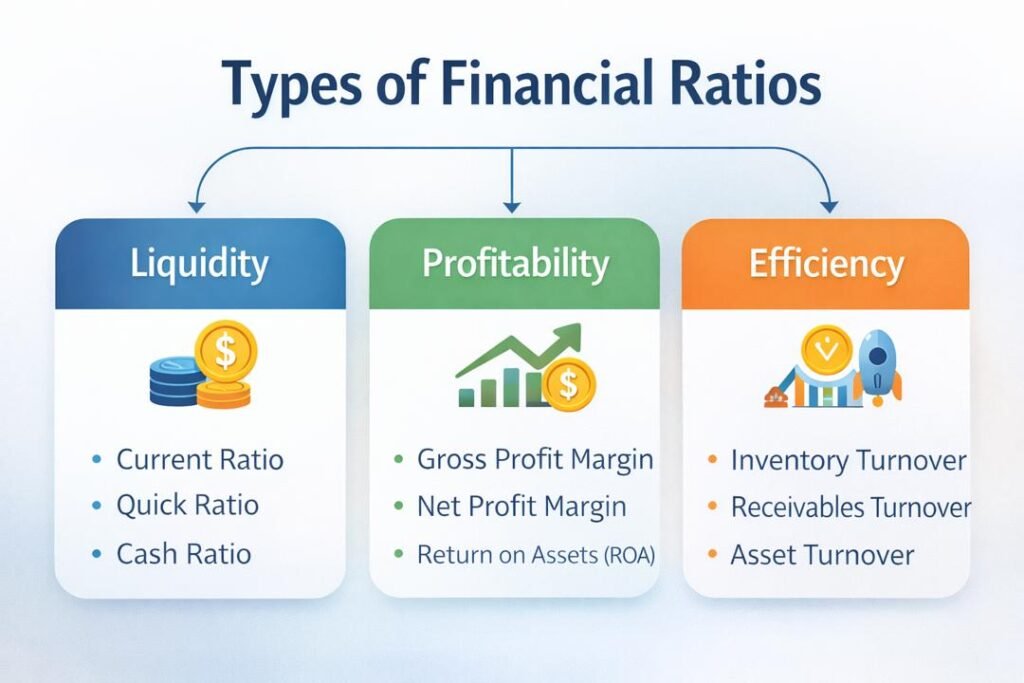
Ratio analysis is widely divided into three large groups:
- Liquidity ratios
- Profitability ratios
- Efficiency (or activity) ratios
All categories present distinct information about various issues in a business.
Liquidity Ratios
Liquidity ratios are used to estimate the capability of a company to pay off its immediate debt. These ratios are essential to the creditors and suppliers who desire to determine whether a business will be able to meet its debts as they become due.
1. Current Ratio
The current ratio is a comparison of current assets and current liabilities:
Current Ratio = Current Assets/Current Liabilities.
A ratio above 1 means that the company possesses a greater number of assets than liabilities within the short run meaning it is financially stable. Nevertheless, a too high ratio could be a sign of underutilized resources.
2. Quick Ratio (Acid-Test Ratio)
This ratio does not include inventory in current assets but only on the most liquid ones:
Quick Ratio = (Current Assets less Inventory)/ Current Liabilities.
It has a higher liquidity test, particularly to businesses that do not have inventory that can be readily changed to cash.
3. Cash Ratio
The cash ratio is used to determine the capacity of a company to settle its debts through cash and cash equivalents:
Cash Ratio = Cash and Cash Equivalents/Current Liabilities.
This is the strictest liquidity ratio and it is especially significant in the case of financial uncertainty.
Importance of Liquidity Ratios
Liquidity ratios help:
- Evaluate short-term financial health.
- Determine creditworthiness
- Determine possible cash flow issues.
They are however not to be studied in isolation as they do not give you an idea of how profitable or efficient they are.
Profitability Ratios
Profitability ratios measure the capacity of a company to bring in earnings in reference to revenue, assets, or equity. These are especially significant ratios to investors and the management.
1. Gross Profit Margin
Gross Profit Margin = Gross Profit/ Revenue x 100.
The ratio indicates the efficiency of a company in the production of goods in relation to sales. The greater the margin, the greater the control costs.
2. Net Profit Margin
Net Profit Margin = Net Profit/ Revenue x 100.
This is a measurement of total profitability net of all expenses, including the payment of taxes and interest. It is the capability of the company to turn revenue into real profit.
3. Return on Assets (ROA)
ROA = Net Income/Total Assets.
ROA is the use of the assets of the company to generate profit.
4. Return on Equity (ROE).
ROE = Net Income/ Equity of shareholders.
This is the ratio that determines the rate of returns on the investments made by shareholders and is another important indicator to the investors.
5. Operating Profit Margin
Operating Margin = Operating Profit/ Revenue x 100.
This is a ratio that pays attention to the core business activities and not the non-operating revenue and expenses.
Importance of Profitability Ratios
Profitability ratios help:
- Evaluate business performance
- Attract investors
- Guide management decisions
They are crucial to sustainability in the long-term because continuous profitability is an indicator of a good business.
Efficiency Ratios
Efficiency ratios evaluate the effectiveness of the company in the use of assets and the management of the business. They are also referred to as activity ratios.
1. Inventory Turnover Ratio
Inventory Turnover = Costs of Good Sold /Average Inventory.
This ratio shows the rate of sales and replacement of inventory. Greater ratio will indicate effective inventory control.
2. Receivables Turnover Ratio
Receivables Turnover = Net Credit Sales/Average Accounts Receivable.
It is used to determine the efficiency of a company in collecting their payments.
3. Payables Turnover Ratio
Payables Turnover = Cost of Goods Sold/average accounts Payable.
This is an indication of the speed at which a company is paying its suppliers.
4. Asset Turnover Ratio
Asset Turnover = Revenue/Total Assets.
This ratio is used to determine the efficiency with which a company utilizes its assets in order to come up with sales.
5. Working Capital Turnover
Working Capital Turnover = Revenue/ Working capital.
It evaluates the effectiveness of using working capital by a company to finance sales.
Importance of the Efficiency Ratios
Efficiency ratios help:
- Improve operational performance
- Identify inefficiencies
- Optimize resource utilization
They are finding application especially in the management of the company and the planning of operations.
Real-life Applications of Ratio Analysis.
Ratio analysis is critical in the process of decision-making among various stakeholders.
1. Investment Decisions
Ratios are used by investors to analyze potential investment. Profitability ratio such as ROE and net profit margin are used to identify the worthiness of investing in a company.
2. Credit Analysis
To determine the capability of repayment of loans to the lenders, liquidity ratios are used. Having a high current ratio would enhance the chances of borrowing.
3. Performance Evaluation
Ratio analysis is used by the management to track performance over a period of time. The comparison of ratios in periods will assist in determining trends and improvement areas.
4. Benchmarking
Organizations use their ratios in comparison with an industry average to assess their performance against other companies.
5. Strategic Planning
Ratio analysis aids a decision making in such areas as:
- Cost control
- Pricing strategies
- Investment planning
6. Early Warning Signals
Ratios can point at the potential issues, e.g. the decreasing profitability or liquidity problems and help businesses to take the right action early.
Limitations of Ratio Analysis
Although the ratio analysis is useful, there exist a number of limitations that should be used to interpret financial statements.
1. The data is historical in nature
Financial statements are made on the basis of the previous data, which could not be a good reflection of the present or future situation. Consequently, ratio analysis is not always accurate in forecasting performance in the future.
2. Accounting Policies Differences.
Different accounting practices can be applied by companies and thus it becomes hard to make comparisons. For example:
- Different depreciation methods
- Inventory valuation techniques
These variations may be used to give false ratios and give misleading conclusions.
3. Lack of Context
Ratios do not give us a full picture. There are external forces that have to be taken into consideration including the economic conditions, market trends and industry dynamics.
4. Window Dressing
Financial statements may be manipulated to reflect a better picture and this is referred to as window dressing. This has the ability to skew ratios and mislead users.
5. Ignores Qualitative Factors
Ratio analysis does not pay attention to qualitative issues like:
- Management quality
- Brand reputation
- Employee satisfaction
These aspects have the potential to affect the performance of a company.
6. Industry Differences
The standards and benchmarks of different industries vary. What may be a good ratio in one industry can be a bad ratio in another.
7. Overreliance on Ratios
Using ratios alone may give wrong conclusions. They are to be utilized with the other analytical tools and techniques.
Combining the Ratio Analysis with other Tools
Ratio analysis needs to be supplemented with other methods of analysis, including:
- Trend analysis
- Common-size financial statements
- Cash flow analysis
- Economic and industry analysis.
With the combination of these techniques, analysts will be able to have a more detailed picture of the state of a company.
Best Practices of effective financial analysis.
In order to extract the most benefit out of ratio analysis, the following best practices can be considered:
- Apply more than one ratio: Do not use one ratio, a combination of the ratios may create a balanced picture.
- Compare with time: Compare trends to determine improvements or downfalls.
- Comparative with industry standards: Compare with industry averages or competitors.
- Know business environment: Take external forces and business dynamics.
- Check the accuracy of data: Financial statements should be accurate and not manipulated.
Conclusion
Financial statement ratio analysis is a very important skill of an individual in business, finance or investment. More specifically, ratio analysis offers a systematic and effective method of explaining complicated financial information. Analyzing liquidity, profitability, and efficiency ratios, the stakeholders will have a good understanding of the financial stability and performance of the company in the market.
Nonetheless, a very potent tool as it is, ratio analysis also has its limitations. It is based on historical data, it is prone to differences in accounting and it is not able to capture qualitative factors hence should be used with caution. To have a detailed analysis, it is necessary to include the ratio analysis with other financial and contextual assessment techniques.
Finally, the art of financial statement interpretation will allow making decisions, planning finances, and understanding the business performance better. As an investor, manager, student, or any other person, building this skill will allow you to make informed and strategic decisions in a more complex financial world by critically analyzing financial information.
Get more well researched information about Financial Statement Ratio Analysis here.