Abstract
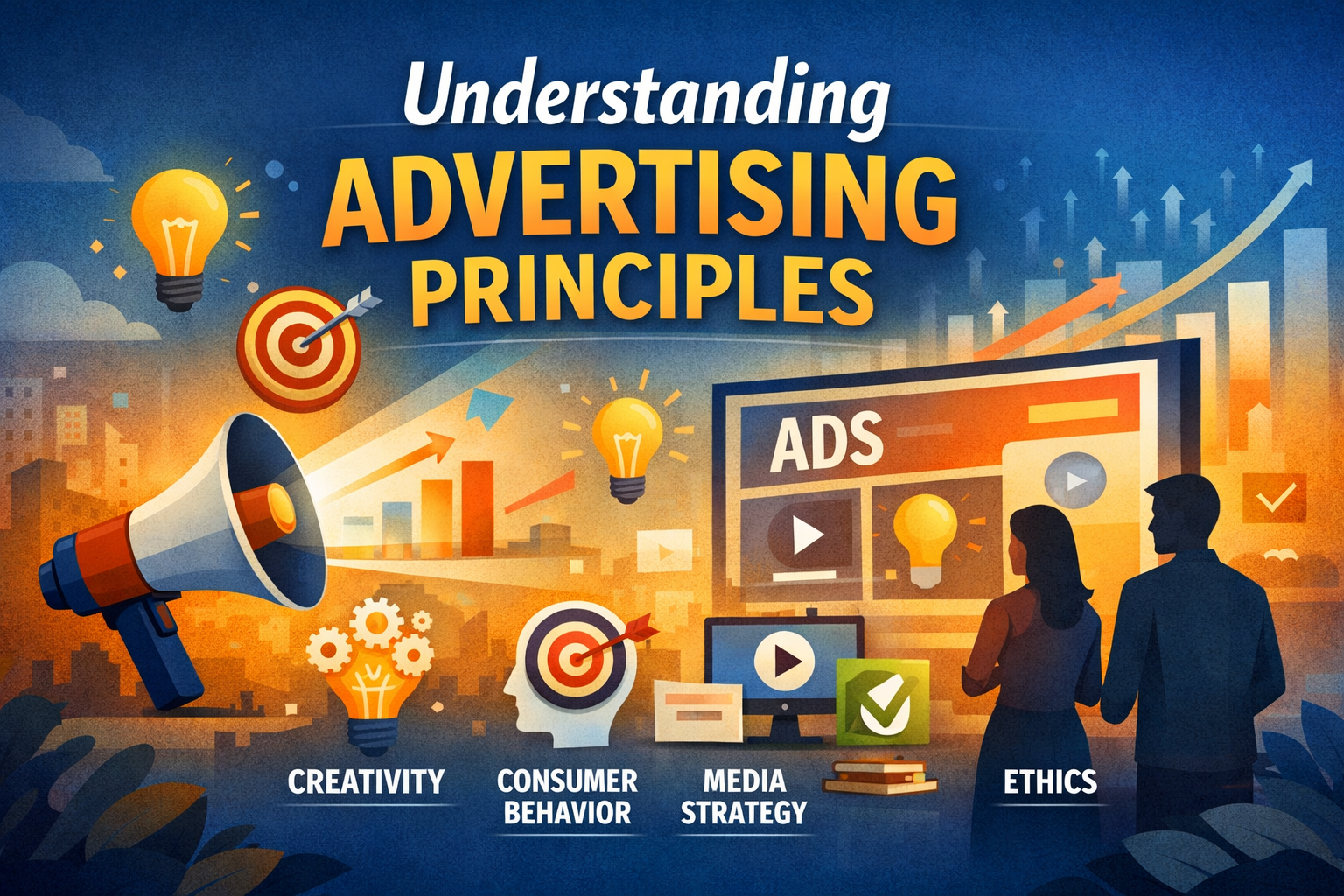
Modern day communication has made advertising to be a fundamental pillar in the way organizations relate with consumers and to influence the behavior of the market. This paper presents advertising as a scholarly and professional field, gives clear definitions, explores ground-breaking concepts, and describes the main principles of this field. Basing the proposed study on the existing theoretical frameworks and industry practices, the study references a conceptual approach to examining the purpose of advertising in bridging the gap between businesses and audiences. The research shows that successful advertisement combines creativity, planning, and ethics in order to create engagement and brand value. The article finds that the primary concern to scholarly research and practice in advertising is to comprehend advertising at the underlying level.
Keywords: Advertising, Marketing Communication, Consumer Behavior, Brand Strategy, Media Planning, Persuasion.
Introduction
In the modern world, advertising is an important part of consumer-based society as it affects their preference, determines cultural standards, and promotes the economy. Since the old print media to the digital media, advertising has become a high-profile field that involves creativity in conjunction with strategic thinking.
The idea of advertising as an academic and professional discipline underlines the duality of it. On the one hand, it is learned in educational establishments as a subject, which is based on research and theory. Conversely, it is a professional practice which involves practical skills, innovation and flexibility.
This paper gives an overall introduction to advertising principles in terms of identifying the key components of advertising, analyzing the principles behind advertising, and discussing how advertising helps in aiding communication between companies and consumers.
Literature Review
Advertising as a subject has gained immeasurable academic knowledge over the years. According to Kotler and Keller (2016), advertising is any paid presentation and promotion of any idea, goods or service by an identified sponsor non-personally. This definition stresses the organized and deliberate quality of advertising.
Belch and Belch (2021) touch upon the importance of integrated marketing communications (IMC), in which advertising is combined with other promotional instruments to provide steady messages. Their writing dwells upon how communication can be effectively attained by coordination.
Percy and Elliott (2012) concentrate on the psychological dimension of the advertising taking into consideration the effect of the messages on consumer behavior and attitude. They explain that consumer perception is an important concept that is important to formulate effective campaigns.
Also, Hackley (2010) discusses advertising as a cultural and social phenomenon, stating that it does not only mirror, but also influences the values that are considered in the society. This view strengthens the assumption that advertising is not only commercial.
Conceptual Review
Definition of Advertising/ Advertising Principles
Advertising could be described as a strategical communication process whereby messages are created and messages are being delivered in an attempt to publicize products, services and ideas. It is usually sponsored and distributed via different media.
Key Elements of Advertising
- Advertisement comprises of a number of vital elements:
- Advertiser: The person or organization that advertises a product or service.
- Theme: The message that is to inform or to convince.
- Medium: The channel through which the message will be conveyed (e.g. TV, social media)
- Audience: The group that was to be exposed to the message.
- Advertising vs. Other Communication Medias.
Advertising is non-personal and the sponsor is in control unlike in the case of PR or personal selling. This will enable uniformity in the message but will not enable close interaction with the audience.
The Essentials of Advertising
Persuasion and Influence
At the most fundamental level, advertising is supposed to persuade. It is an appeal to the emotions and rationally persuade consumer attitudes and their desired activities.
Clarity and Simplicity
Good advertisement conveys clear and short messages. Messages that are too complicated may bewilder the audience and cause a loss in effectiveness.
Consistency
Stability in communication assists in creating brand equality and reliability. Brand recognition is enhanced by repeated exposure to the same message.
Creativity and Innovation
Creativity plays a crucial role in attracting attention as well as brand differentiation in competitive markets. Creative solutions make things easier to remember and experience.
Ethical Responsibility
Advertising should meet the ethical standards and not contain false information or infringe the rights of the consumers. Moral standards lead to credibility in the long run.
Theoretical Framework
AIDA Model
AIDA model (Attention, Interest, Desire, Action) AIDA model is a model, which explains the process that consumers go through as they respond to advertisement. It provides a structured message designing approach.
Hierarchy of Effects Theory
This theory states that consumers move through cognitive, affective and behavioral processes before making a decision on whether to purchase a product or not. Advertising is involved at every point.
The Elaboration Likelihood Model (ELM)
ELM was initially created to describe the labeling of the impact of various elements of the assessment of consumers of various products.
ELM explains how persuasive messages are processed by individuals through the central and peripheral routes. This model will help the advertisers to tailor messages according to the engagement of the audience.
Methodology
The theoretical methodology used in this article is qualitative because such data relies on the secondary data sources in the scholarly literature, textbooks, and industry magazine. The theoretical background of the advertising is provided by synthesising theoretical views and practical to provide the methodology.
Findings
Advertising Seals the Gaps in communication
Advertising plays a very significant role in ensuring the business and the consumers are well connected as it assists the organizations to communicate the value propositions effectively.
It is Working Strengthens Performance
Advertising is optimally used through other marketing communication methods, which are consistent and provide reinforcement of messages.
Centric Approaches to consumers work better
These campaigns that put into consideration the needs, preferences and behavior of the consumer have greater chances of success.
Confidence is built through Ethical Advertisement
The transparency and honesty of the advertisement also contributes towards creating a long term relationship with the consumers.
Discussion
The findings show the sophistication of advertising as both applied and theoretical science. It has succeeded in its operations through a blend of strategic planning, innovative implementation, and ethics.
Advertising provides an academic platform under which an individual will be able to communicate processes involved in communication and consumer behavior. At the career level, a career man should be flexible on the prevailing market conditions and technologies.
The application of such theories as AIDA and ELM demonstrates how well-planned strategies can be implemented to enhance the efficiency of a message. In the meantime, the creativity role also justifies the need to practice innovation.
Advertisement suffers the drawbacks of audience mistrust and information overload. One would have to be real and pertinent, to answer these problems.
Conclusion
Advertising is a dynamic and essential sphere that is at the centre of modern-day communication. People will be able to enjoy its contribution to business and society through knowing ultimate advertising principles, definitions and concepts.
Professionalization and academicization of positioning advertising would provide a point of departure to pursue the more advanced strategies and practices. The combination of theory and practice in the subject matter will be critical to its success as the subject continues to develop.
References
Belch, G. E., & Belch, M. A. (2021). Advertising and promotion: An integrated marketing communications perspective (12th ed.). McGraw-Hill.
Hackley, C. (2010). Advertising and promotion: An integrated marketing communications approach. Sage Publications.
Kotler, P., & Keller, K. L. (2016). Marketing management (15th ed.). Pearson.
Percy, L., & Elliott, R. (2012). Strategic advertising management (4th ed.). Oxford University Press.
ResearchGate. (2019). Advertising discipline in higher education. Retrieved from https://www.researchgate.net/publication/336137054_Advertising_discipline_in_higher_education