Abstract
PR is a crucial factor in defining organizational identity, communication control, and trust among various audiences. This paper discusses the importance of Public Relations in any organizational environment such as corporate organisations, government agencies/organizations, non-governmental organisations (NGOs) and learning institutions. It emphasizes the adaptation of PR strategies to fit various objectives, expectations of the stakeholders and communication issues. Using pertinent theories and real-world examples, the research shows that PR can never be a universal operation but a flexible field of study developing depending on the environment. The results support the universality of PR as a tool of strategic communication that is indispensable in the sustainability of organizations and their interactions with the community.
Keywords: Public Relations, PR strategies, corporate communication, stakeholder engagement, organizational communication.
Introduction
In the contemporary globalized and information stipulated society organizations are under the watchful eyes of the population. Regardless of their size and type, whether it is a profit-making or a mission-driven organization, they should be able to communicate its values, missions, and activities in a way that ensures relevancy and credibility. PR is the communication linkage between organisations and their stakeholders which creates understanding and trust between them.
PR is not just media relations but includes strategic communication planning, reputation management, crisis communication and stakeholder engagement. Since organizations are different in their purpose and structures, they also require different communication. Thus, PR strategies have to be carefully designed to correspond to certain organizational goals and expectations of the audience.
To understand the practical approaches more thoroughly, numerous specialists study systematic PR strategies, which are the most important approaches described in the modern practice of communication.
The article under discussion examines importance of Public Relations and the working mechanism in any organization and why it is a universally critical role.
Literature Review
The change in PR has been immense over the decades as simple publicity models have been replaced with complex strategies of communication. The four models of PR developed by Grunig and Hunt (1984) press agentry, public information, two-way asymmetrical and two-way symmetrical continue to be central in the determination of how organizations deal with their publics.
According to Cutlip, Center and Broom (2006), the very nature of PR is that of relationship management, claiming that relationships between organizations and their stakeholders need to be mutually beneficial in order that the organization survives and flourishes. In a similar way, Ledingham and Bruning (1998) provide the relational view of PR, which attributes important importance to trust, openness, and involvement as the necessary conditions of successful communication.
The latest research shows that PR works differ greatly in industries. As an illustration, corporate PR is more about the brand image and profitability, whereas the PR of the government is more about the openness and responsibility to the people (Doorley and Garcia, 2015). NGOs are more concerned about advocacy and awareness, but universities are concerned with its image and involvement with stakeholders (Waters, 2011).
Conceptual Foundations of PR in Organizations
Understanding PR in Context
The role of PR is not a fixed role but rather one that is changing on the basis of the mission, the audience and the environment in which the organization operates. Its core functions – communication, reputation management, and stakeholder engagement are the same, however, the way they are implemented differs.
PR and its important aspects in industries.
- Audience segmentation
- Message framing
- Media selection
- Feedback mechanisms
- Planning of crisis communication.
These are the aspects, which underlie PR strategies related to the sector.
Theoretical Framework
Excellence Theory
The Excellence Theory which is developed by Grunig assumes that successful PR helps to achieve organizational success when it is strategic, symmetrical, and integrated in management decision-making.
Stakeholder Theory
According to the Stakeholder Theory proposed by Freeman (1984), organizations need to take into consideration the needs of all the stakeholders, and not only the shareholders. PR is very essential in harmonizing these interests by communicating.
Situational Theory of Publics
This theory elucidates the reaction of the various publics related to the communication depending on the degree of their awareness and participation. It assists the organizations to make messages customized.
Methodology
The article assumes a qualitative method of analysis, relying on the available literature, case studies, and theoretical models to analyze PR practices of various organizations types. PR strategies and their effectiveness are compared and contrasted to determine their similarities and differences.
Findings: Importance of Public Relations in Various Organization
PR in Corporate Organizations
PR is very critical in corporate organizations as it helps them achieve brand recognition, customer attraction, and investor trust.
Key Functions
- Brand image management
- Crisis communication
- Media relations
- Corporate social responsibility (CSR) communication.
Strategic Adaptation
It is common practice in corporations to have proactive PR policies where storytelling, brand placement, and online connection are involved. As an example, the social media sites are employed to make the brands more human and enable direct communication with customers.
Challenges
- Negative publicity management.
- Maintaining transparency
- The coping with rapidly transforming digital landscapes.
Public Relations in Government Institutions
Government PR is concerned with enlightenment of the citizens, advocacy of policies, and transparency.
Key Functions:
- Communication information to the masses.
- Policy communication
- Communication in crisis and emergencies.
- Public engagement
Strategic Adaptation
Government PR is more focused on clarity, accuracy and accessibility. The communication should be inclusive and be comprehensible to various people.
Challenges:
- Public distrust
- Political bias perceptions
- Managing misinformation
PR in Non-Governmental Organisations (NGOs)
NGOs rely on PR to create awareness, solicit funds and promote social cause.
Key Functions:
- Advocacy campaigns
- Donor communication
- Community engagement
- Awareness creation
Strategic Adaptation
NGOs tend to apply emotionally attractive stories and grassroots forms of communication. The use of social media and narratives are important in gathering support.
Challenges:
- Limited resources
- Competition for attention
- Maintaining credibility
PR in Schools and Colleges(Educational Institution)
PR in educational institutions helps the institution to recruit students, create image, and communicate with the stakeholders like parents, alumni and faculty.
Key Functions:
- Communication with students during recruitment.
- Reputation management
- Alumni relations
- Internal communication
Strategic Adaptation
Universities and schools tend to concentrate on highlighting the success, the research, and life on campus via the digital platform.
Challenges:
- Controlling image of the institutions.
- Issues to deal with crises (e.g., strikes, controversies).
- Finding the balance between academic and promotional messaging.
Discussion
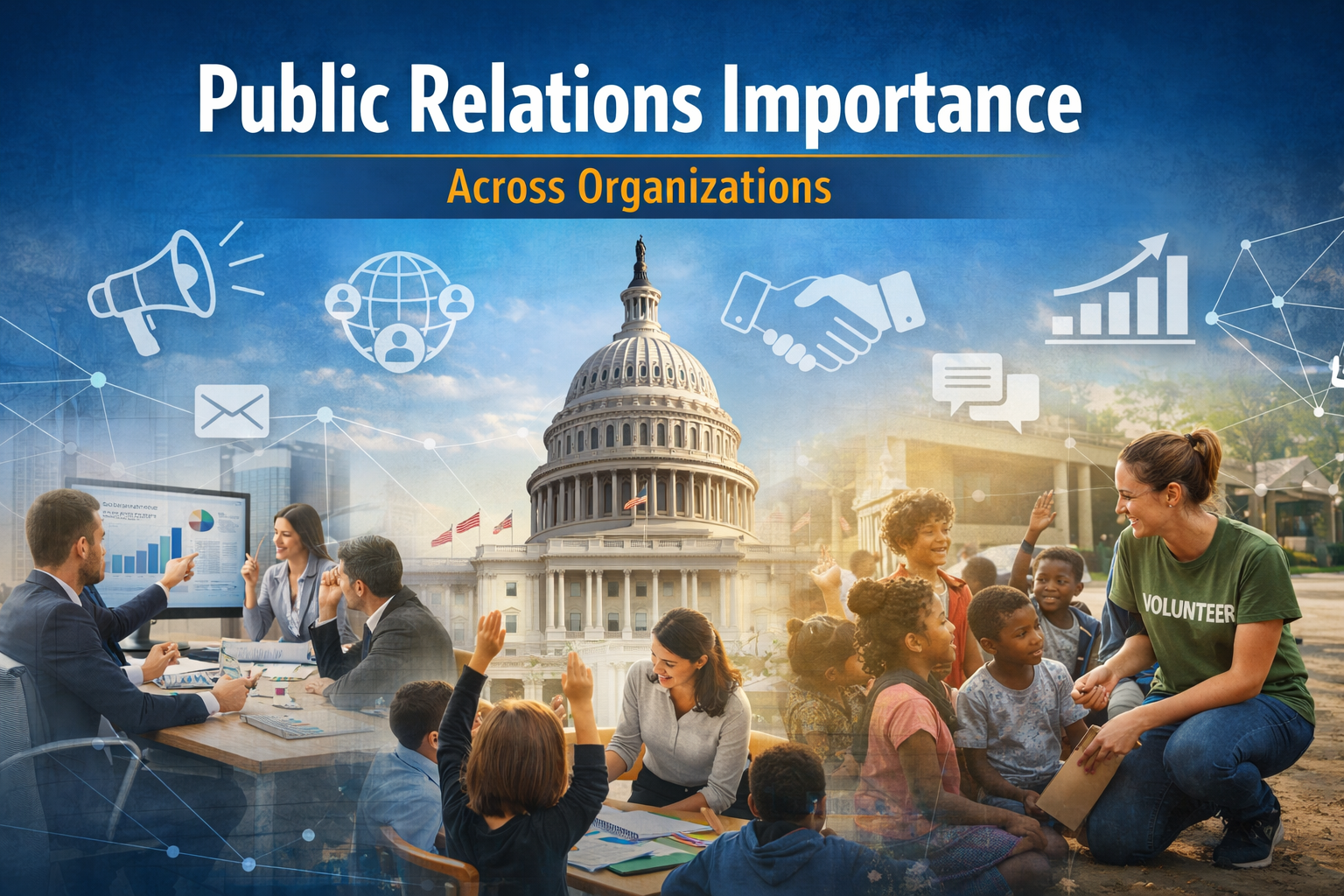
The discussion indicates that PR has a universal role, which is relationship creation as well as communication control but its implementation in different types of organizations differs greatly.
Corporate PR is based on profit and brand, whereas government PR is oriented on the service to the people and accountability. NGOs are advocacy and emotional oriented, unlike institutions of education that are reputation and stakeholder oriented.
In spite of this, there are some commonalities regarding specific principles:
- Transparency builds trust
- Effectiveness is improved by strategic communication.
- It is important that the viewers comprehend.
- Digital platforms are becoming centralized.
The best strength of PR is its versatility. Companies that do not customize their communication policies are likely to lose their relevance and credibility.
Conclusion
Public Relations is a necessary role in all forms of organizations. Its flexibility to fit in various contexts, audiences and goals highlights its universal relevance.
Public Relations Importance cannot be overemphasized whether in corporate, government, or the non-governmental organizations, or even in educational institutions. It influences perception, relationships and organizational success. Strategy PR will only grow in importance as the communication frontiers keep on changing.
Companies should hence invest in efficient PR activities, should be responsive, transparent and in line with the expectations of the stakeholders.
References
Cutlip, S. M., Center, A. H., & Broom, G. M. (2006). Effective Public Relations (9th ed.). Pearson.
Doorley, J., & Garcia, H. F. (2015). Reputation Management: The Key to Successful Public Relations and Corporate Communication. Routledge.
Freeman, R. E. (1984). Strategic Management: A Stakeholder Approach. Pitman.
Grunig, J. E., & Hunt, T. (1984). Managing Public Relations. Holt, Rinehart & Winston.
Ledingham, J. A., & Bruning, S. D. (1998). Relationship management in public relations. Journal of Public Relations Research, 10(1), 55–65.
Waters, R. D. (2011). Increasing fundraising efficiency through evaluation: Applying communication theory to the nonprofit organization–donor relationship. Nonprofit and Voluntary Sector Quarterly, 40(3), 458–475.