Abstract
PR and marketing are applied in communication whose foundation is two essential fields that influence the way organizations interact with the external and internal environment. Although both functions have similar tools like audience targeting, content development, and brand communication, the functions differ in their fundamental goals, their strategies, and also metrics used in their evaluation. This will paper is a critical analysis of the Difference Between Public Relations and Marketing and their relationship. Based on the theories of communication and the current trends in the industry, the paper presents an argument that despite the fact that marketing is based on the value exchange and revenue generation, PR is concerned with relationships management and organizational legitimacy. The results indicate that there is a complicated interplay of the two disciplines especially in the digital space where the lines are becoming more unclear. The paper concludes that strategic integration can improve the effectiveness of an organization as long as functional differences are maintained.
Keywords: PR, Marketing, Brand Communication, Relationship Management, Integrated Communication, Targeting the Audience.
Introduction
In a world where digitalization is occurring at an alarming rate and the level of stakeholder demands is becoming more and more exacting, companies have to take on complex communication strategies in order to stay afloat and relevant. The focal point of this effort is Public Relations (PR) and marketing which are often confused as one and the same functions.
The scholar and practitioner alike need a fine grasp of the relationship between PR and marketing. Although both fields utilize the instruments of communication to sway people, the philosophical background and the strategic aim of their work is quite different.
This paper takes an academic standpoint of discussing the overlapping and the differences of public relations and marketing. The study sheds light on how the two disciplines can be used to work together without losing their identities by synthesizing theoretical frameworks, reviewing academic literature and analysing the concepts.
Literature Review
The connection between PR and marketing is an issue that has been academically investigated. Kotler and Mindak (1978) made another concept that PR and marketing are in some sort of continuum between being independent entities and complete systems. Their idea of megarmarketing stressed on the necessity of the integration of communication to the mass and market-focused approaches.
Grunig and Hunt (1984) have conceptualized PR as a management activity that deals with the development of relations with important publics. Their Excellence Theory emphasized the need of having two-way symmetrical communication so as to understand each other and the effectiveness of the organization.
Conversely, other marketing scholars like Kotler and Keller (2016) describe marketing as a process that focuses on the development and provision of value to the customers. This transactional view emphasizes the quantifiable results including sales and market share.
The latest research (Cornelissen, 2020; Smith, 2017) postulates that the digital media has erased lines between PR and marketing. Collaboration is becoming more and more a necessity in both disciplines through the integrated communication strategies, content marketing, and influencer engagement. Scholars however warn against confusing the two disciplines and the need to have clarity of thought.
Conceptual Review: Difference Between Public Relations and Marketing
Public Relations
PR refers to the process of strategic communication whose aim is to establish a mutually agreeable relationship between a company and its stakeholders. It values credibility, transparency and long-term involvement.
Marketing
Marketing is a business operation that aims at determining the customer needs and development of value-based solutions to meet the customer needs in a profitable way. It also lays importance on the consumer behavior, consumer segmentation and revenue earning.
Theory Intersection and Divergence( Difference Between Public Relations and Marketing)
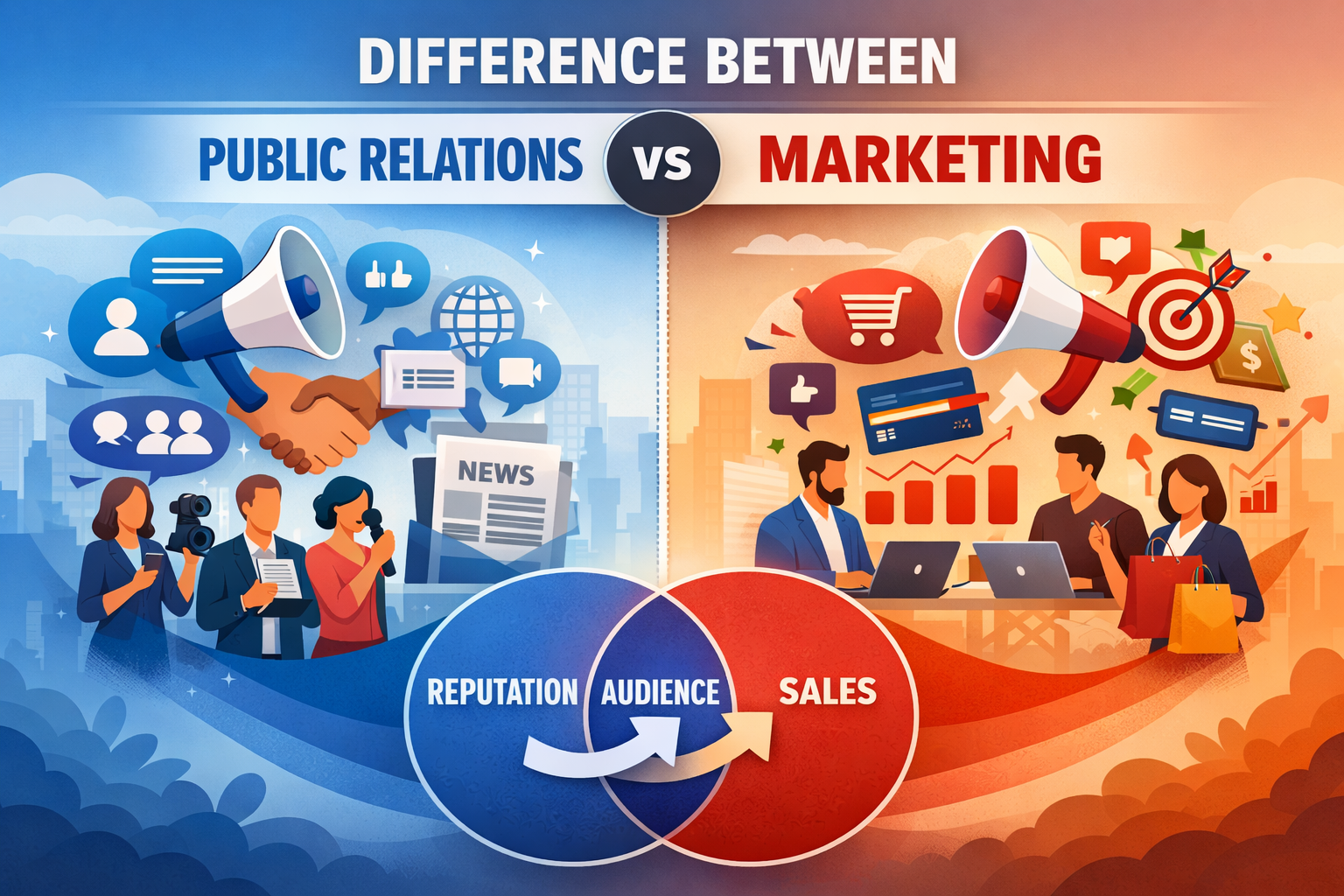
There are some similarities between PR and marketing that are common i.e., communication strategy, target audience and positioning of a brand but they go astray in purpose:
- PR is devoted to reputation and building trust.
- Marketing is concerned with value exchange and sales.
This difference is the basis of development of their complementary roles.
Theoretical Framework
This paper is based on the three theories:
Excellence Theory (Grunig and Hunt, 1984)
This theory makes PR a strategic role that focuses on mutual understanding that is achieved by bi-directional communication. It emphasizes on relationship more than transaction.
Theory of Relationship Management (Ledingham and Bruning, 1998)
This model indicates that an organization can be successful based on how well relations are with the stakeholders and this supports the core role of PR in building trust.
Marketing Mix Theory (Kotler, 2016)
The 4Ps model (Product, Price, Place, Promotion) describes the marketing strategies, which are guided into influencing the consumer behavior in order to drive the objectives of the business.
These theories combined reflect the complementary and different nature of PR and marketing.
Methodology
The research design adopted in this study is a qualitative research design through the analysis of secondary data. Theoretical and practical aspects of PR and marketing have been studied through the systematic review of academic journals, textbooks, and industry reports.
The methodology includes:
- Comparison of major theories.
- Investigation of the literature.
- Both disciplines conceptually synthesized.
The method can allow one to gain a thorough discussion on the topic without use of primary data.
Findings
It shows that there is a multi-dimensional connection between PR and marketing with convergence and divergence at strategic, operational, and evaluative levels.
Functional Overlap in Communication Tools
PR and marketing have a broad spectrum of communication instruments, such as narratives, generation of digital content, and segmentation of the audience. The two fields use platforms like social media, websites, especially when it involves an integrated campaign.
Divergence in Core Objectives
Marketing is mostly transactional, which aims at generating revenue and acquiring customers. PR, on the contrary, is interpersonal and it focuses on trust, credibility and long term stakeholder relationships.
Differences in Media Orientation and Control
Marketing is based on the use of paid media where there is control of messages and predictability. PR relies on earned media, increasing credibility at the expense of control of messaging.
Temporal Orientation and Strategic Focus
The marketing strategies usually focus on short-mixed and medium-term results whereas PR takes a long-term view based on the maintenance of organizational image.
Measurement and Evaluation Metrics
Quantitative measures of effectiveness are used to measure the marketing effectiveness in terms of ROI and conversion rates. PR measurement is more based on qualitative measures such as media mood and perception.
Role in Construction of Brand Identity
Brand identity is created by marketing through repeated communications and promotion and reinforced by PR by making third parties appear legitimate.
Growing Convergence within the Digital Environment
Online social networks have broken the classical borders, and both fields should cooperate in the fields of content marketing and influencer work.
Organizational Collaboration and Integration
Organizations are embracing integrated communication techniques and this enhances consistency and efficiency. This however needs to be better defined in terms of roles.
Risk of Role Ambiguity and Strategic Confusion
Devoid of categorical differences, integration can result in mismatched goals and unconstructive communicational plans.
Value addition to Organizational Legitimacy and the Performance in the market
PR builds the organizational legitimacy by developing trust and marketing leads to economic performance. Their combination forms an equal platform of success.
Discussion
The results validate the fact that PR and marketing are complementary but different fields. The overlap between them is expressed in shared communication tools, whereas the point of difference is found in purpose and evaluation.
Theoretically, PR is in line with the relationship and stakeholder theories, and marketing is based on the exchange and consumer behavior models. In practical terms, they need to be incorporated in an online-first setting, where viewers need authenticity and value.
Integration should however be strategic and not superficial. The organizations ought to make sure that PR retains its credibility-oriented position as marketing makes tangible results. This is a balance that is vital in the attainment of reputational strength as well as financial performance.
Strategic Implications
In order to optimize effectiveness, organizations must:
- Distinct PR and marketing roles.
- Promote cross-functional cooperation.
- Coordinate messages in every medium of communication.
- Strike the right mix between credibility and promotion.
Conclusion
PR and marketing are vital elements of communications in the organization, with their respective roles, which are complementary. Whereas marketing engages the customers and sells the company, PR creates relationships and trust.
This paper has shown that they overlap at the point of common communication approaches and differ at the point of goals, approaches and metrics of evaluation. Properly managed strategic integration also improves the image of an organization as well as its performance in the market.
References
Cornelissen, J. (2020). Corporate communication: A guide to theory and practice (6th ed.). Sage Publications.
Grunig, J. E., & Hunt, T. (1984). Managing public relations. Holt, Rinehart & Winston.
Kotler, P., & Keller, K. L. (2016). Marketing management (15th ed.). Pearson Education.
Kotler, P., & Mindak, W. (1978). Marketing and public relations: Should they be partners or rivals? Journal of Marketing, 42(4), 13–20.
Ledingham, J. A., & Bruning, S. D. (1998). Relationship management in public relations: Dimensions of an organization-public relationship. Public Relations Review, 24(1), 55–65.
Smith, R. D. (2017). Strategic planning for public relations (5th ed.). Routledge.