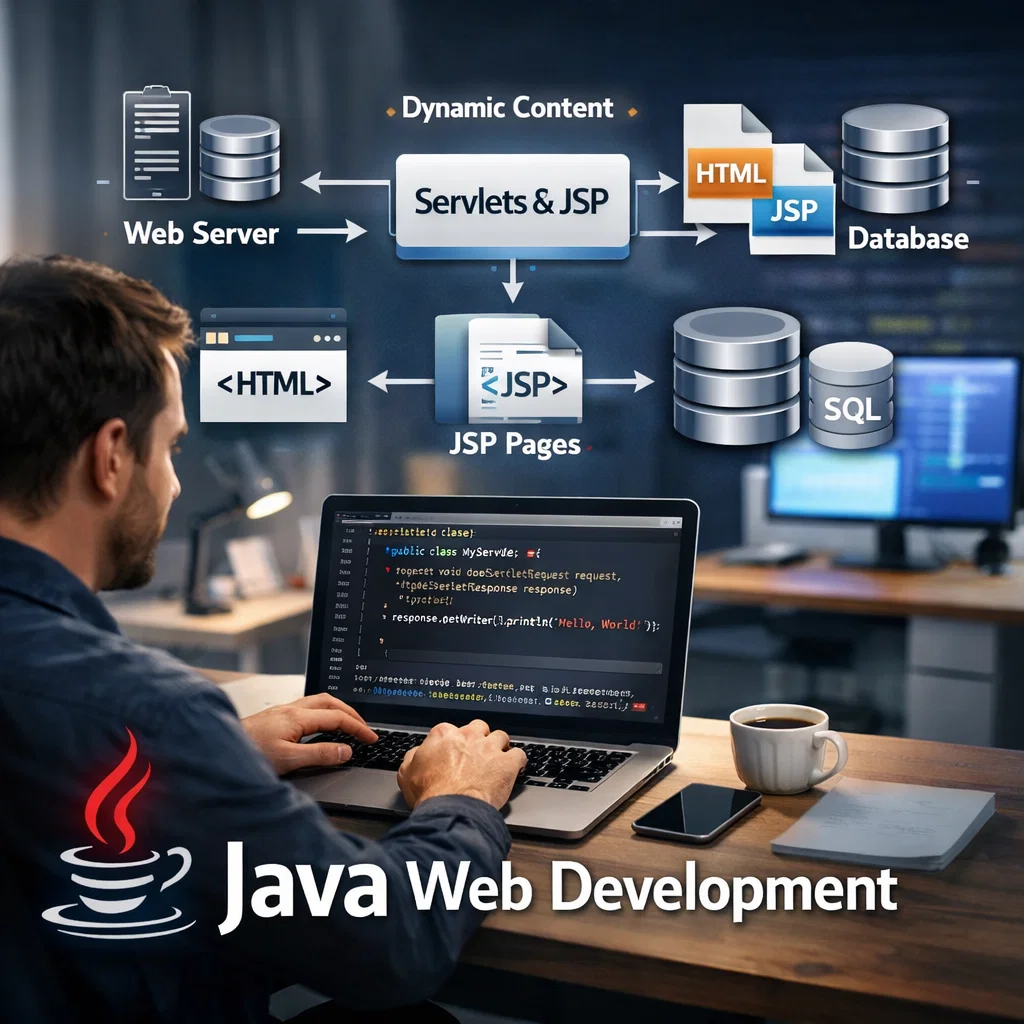
Java web development has been essential in the development of dynamic, scalable, and secure web applications. Java has enabled web developers to develop strong and interactive websites with the introduction of technologies such as Servlets and JavaServer Pages (JSP). And in this paper, we shall explore the fundamentals of Java web development, including Servlets and JSP—the two most popular web development technologies in server-side development. We are going to discuss the functionality of these technologies, the way they pass and receive HTTP requests and responses, and how dynamic web content can be created using Java.
Table of Contents
- Java Web Development Introduction
- What are Java Servlets?
- Servlets and HTTP Response/Request
- What are JavaServer Pages (JSP)?
- The Major Differences Between Servlets and JSP
- Java Web Applications Deployment
- Conclusion
Java Web Development Introduction
The development of the web has seen a significant change where the web applications of today have to be dynamic in the generation of content and the intricacy of interactions. Java has a number of tools that can be used in the development of a scalable web application, amongst the most popular of which are Servlets and JSP.
Java Web Development mainly deals with server-side technologies through which dynamic content can be generated depending on requests by the user. Servlets are the process of managing the responses and requests of an HTTP, and JSP is the technology that is employed to make the task of building dynamic pages easier.
These two technologies are used together to offer an effective web development model in Java, accompanied by such popular web servers as Apache Tomcat and Java EE containers. In order to begin with, it is necessary to learn how they can cooperate and concepts of server-side processing.
What are Java Servlets?
A Servlet is a server-side object in the Java world of web development that takes in HTTP requests and responds to them. Servlets are Java programs and are run on a web server. They are used as middlemen between the request made by the user and the dynamic content delivered by the server.
A Java Servlet is done by implementing the interface of the Servlet of javax.servlet.Servlet. Servlets run within a servlet container (e.g., Apache Tomcat). When a user makes a request to the server, the servlet processes the request and sends a response, which is normally in the form of HTML content.
Servlets are necessary to work with HTTP requests—the data received is processed, relevant actions (such as communicating with a database) are performed, and a suitable HTTP response is sent.
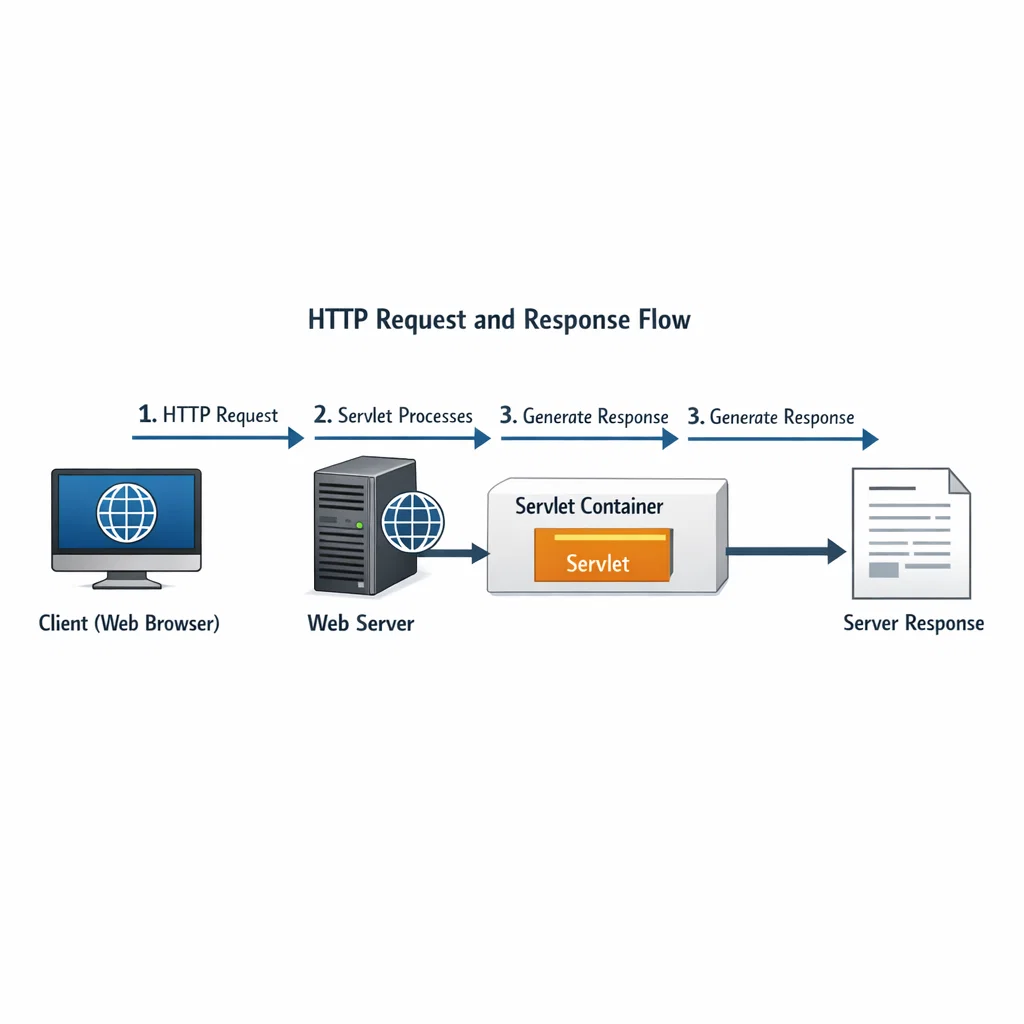
Basic Servlet Workflow
- Request: The client (typically a browser) makes an HTTP request to the server.
- Processing: The request is sent via the server to the relevant servlet. The request is processed by the servlet.
- Response: A servlet creates a response, which might either be HTML, JSON, or XML, and transmits the response to the client.
Servlets are best suited to those cases where you require interoperation with a back-end system (such as a database) or need to perform special business logic on the server side.
Servlets and HTTP Request/Response
The main functionality of a Servlet is that it allows accepting HTTP requests and sending HTTP responses. The servlet container provides interfaces such as doGet() and doPost(), in which different varieties of HTTP requests are processed. These procedures align with the HTTP methods GET and POST.
Working with GET and POST Requests
- GET: It is a technique to access information that is on the server. It is most frequently applied when the client just wishes to look at the information or browse a website.
- POST: This is an operation that occurs when the client sends data to the server (e.g., posting a form).
The servlet processes each request and may be able to extract data from the request, carry out required operations, and even send back a response. For example:
@WebServlet(“/hello”)
public class HelloServlet extends HttpServlet {
protected void doGet(HttpServletRequest request, HttpServletResponse response) throws ServletException, IOException {
response.setContentType(“text/html”);
PrintWriter out = response.getWriter();
out.println(“<h1>Hello, World!</h1>”);
}
}
The example provided above uses a basic servlet that replies to a request by the client with a message in HTML format when the client makes a request to the server at /hello.
What are JavaServer Pages (JSP)?
Another technology in Java web development is JavaServer Pages (JSP), which is intended to make the development of dynamic web pages easier. JSP gives developers the ability to code Java directly into HTML pages. It is like PHP or ASP, except that it uses Java as the scripting language.
A JSP is a page that is written in Java and is embedded in an HTML page. The Java code is then executed at the server-side to create dynamic content. When a user makes a request on a JSP page, the server executes the Java code and transfers the resulting content (e.g., HTML) to the client.
The capability of decoupling between presentation and business logic is one of the important advantages of JSP. It assists programmers in structuring their codes in a better way, with JSP handling the presentation part and Servlets taking care of the business logic.
As an example, the following page is a JSP page:
<html>
<head>
<title>Hello JSP</title>
</head>
<body>
Hello, <%= request.getParameter(“name”) %>!
</body>
</html>
In this case, the JSP page reads a name parameter in the request and dynamically generates a greeting message.
Servlets versus JSP: The Major Differences
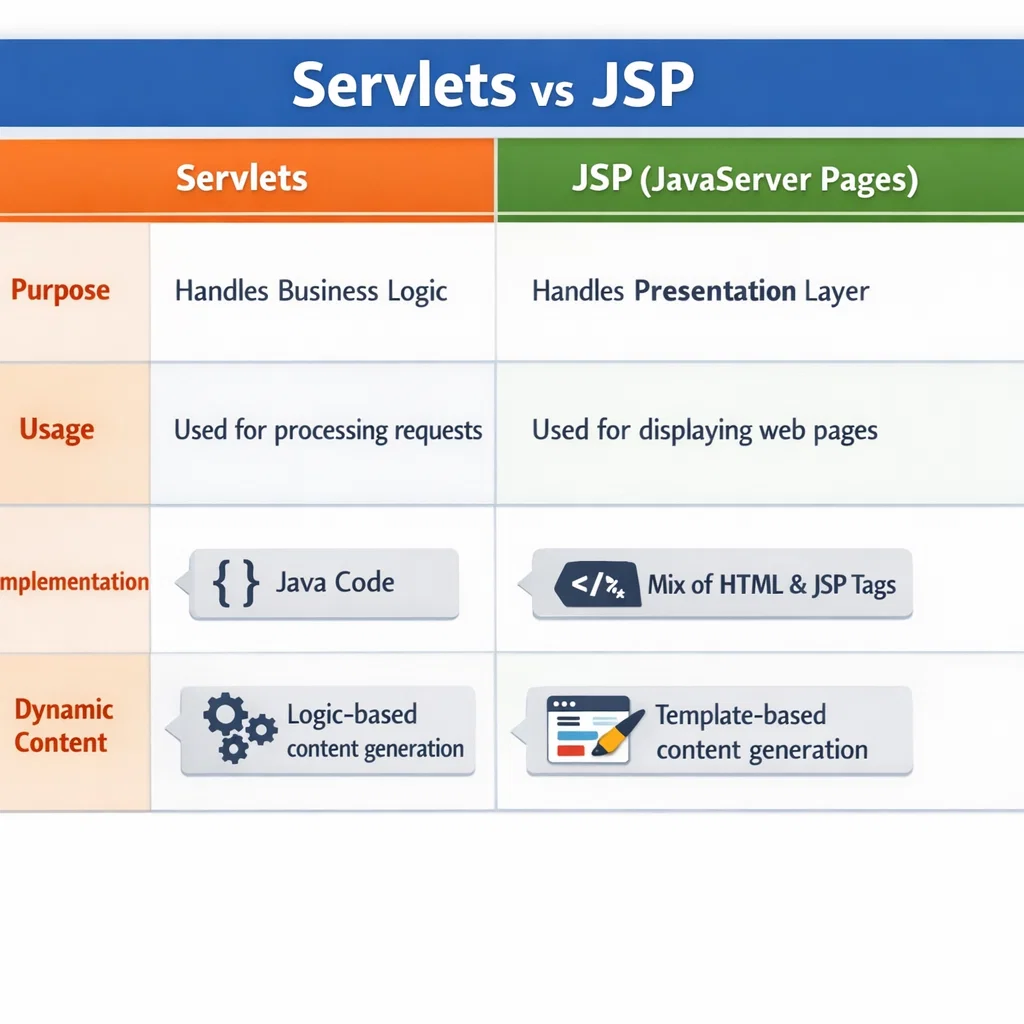
Although both Servlets and JSP are intended to deliver dynamic web content, they differ in the following aspects:
- Servlets: They are used to manage web application business logic. They are Java classes that handle HTTP requests and create responses.
- JSP: It is essentially concerned with the presentation of the results produced by a servlet. It enables developers to place Java code in the HTML to generate dynamic content.
To put it more simply, the server-side logic and processing are implemented using Servlets, whereas the user interface and presentation are implemented using JSP. The combination gives a strong means to develop dynamism in web applications.
Java Web Applications Deployment
Once you have created a Java web application with the use of Servlets and JSP, the next step is to deploy it to a web server. Examples of common Java web servers include:
- Apache Tomcat: One of the most common servlet containers for implementing Java web applications.
- Jetty: A lightweight servlet container that is commonly used to develop applications.
- JBoss: A more robust application server that can handle full Java EE applications.
To deploy a Java web application, it is necessary to package the application as a WAR (Web Application Archive) file. This file holds everything required by your application, such as Servlets, JSPs, and other required resources such as libraries and setup files.
After creating the application as a WAR file, it is possible to deploy it to a server by placing the file in the directory required and then starting the server. The server will automatically identify the application and make it accessible to users.
Conclusion
To sum up, web development based on Java and Servlets as well as JSP has a robust structure for developing dynamic web applications on the server-side. The main business logic is handled by Servlets, and JSP eases the creation of dynamic content by injecting Java code into HTML. With this knowledge of how these technologies can interoperate, developers will be able to create scalable and maintainable web applications, capable of handling sophisticated interactions with users.
With the ever-changing landscape of Java, technologies like Servlets and JSP remain central to the development of effective and dynamic web applications. Developers can create rich web experiences using Java web applications that can be easily deployed on well-known servers such as Apache Tomcat, meeting current requirements.