In modern oral health care, interpretation of research data is critical towards sound decision-making and provision of evidence-based care. The study of the distribution and determinants of the health conditions in populations, especially oral health professionals, offers the means to analyze trends, evaluate interventions, and evaluate risk factors. But graphics and table reading is not the only way to interpret epidemiologic data, it requires a methodical way of comprehending metrics of association, significance, and possible biases. The paper will discuss the principles and approaches, which oral health practitioners can adopt in the interpretation of epidemiologic results, thus, improving their clinical decision-making and practice in the area of public health.
The Significance of Interpretation of Data among Oral Health Professionals
Through epidemiologic studies, a lot of information is produced on oral diseases of which caries, periodontal disease, oral cancers, oral malocclusions. To the professional in oral health, it is important to interpret these data in the correct way. It allows clinicians to:
- Find vulnerable groups and focus on prevention measures.
- Determine the efficiency of therapeutic methods and community-based health.
- Give research results as practical advice to patients.
The competence to interpret the data allows dental practitioners to go beyond anecdotal evidence and make the clinical judgment based on scientifically sound information.
Background Knowledge Basic Epidemiologic Measures
Epidemiologic measures are basic measures that one should be acquainted with before analyzing the results of the study. These measures assist in measuring the sheer incidence of diseases and the intensity of risk factor and outcome correlation.
Incidence and Prevalence
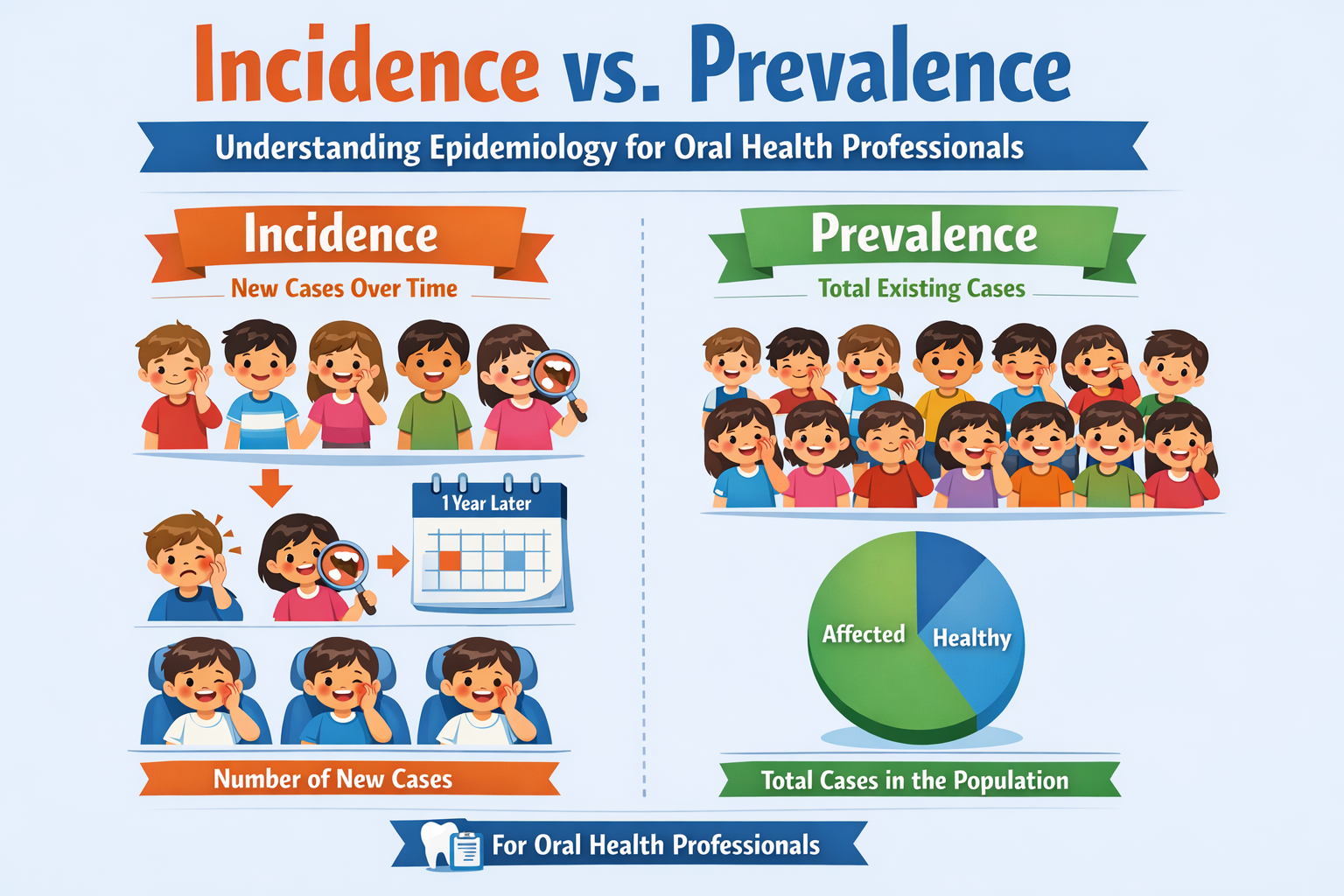
The term Incidence is used to refer to the number of new cases of a disease within a population within a given period of time. It specifically comes in handy in measuring the risk of developing oral diseases like dental caries or gingivitis.
Prevalence refers to the total number of cases that exist among a population at a particular time. Cross sectional studies commonly use prevalence measures to determine the burden of diseases and how this knowledge can be used in community interventions such as water fluoridation or school based dental programs.
Knowledge of all of the incidence and prevalence enables oral health professionals to aid in putting research into context and assessing trends in the frequency of oral disease.
Measures of Association
Association measures are measures that determine the relationship between exposure factors and health outcomes. Popular measures of oral health research are:
- Relative Risk (RR): Shows the difference between the probability of a disease in the exposed population and the unexposed population, in relation to the probability that the disease happens in the former population. Considering the example, RR is capable of estimating the influence of smoking on the risk of periodontal disease.
- Odds Ratio (OR): OR is typically utilized in case-control studies, and is utilized to estimate odds of a disease between exposed and unexposed groups.
- Risk Difference (RD): This is the absolute change in the incidence of disease in two populations representing a direct measure of impact.
The oral health professionals will need to ensure the relative and absolute measures are taken into consideration to determine the clinical significance of the findings.
Calculating Statistical Significance
Statistical significance helps to ascertain whether the results that are observed are most likely to be caused by chance. There are two concepts, which are vital:
P-Values
The p-value is used to estimate the likelihood of the results of observed association due to chance alone. One of the frequently used thresholds is p < 0.05. A p-value that is less than this value is deemed to be statistically significant implying that there is a true association.
Statistical significance, however, does not mean clinical significance. Oral health intervention can demonstrate statistically significant reduction in the caries incidence with little practical impact. Hence, the practitioners should interpret p-values and effect sizes.
Confidence Intervals
The confidence intervals (CI) are provided as a range within which the actual effect is likely to fall, usually at a 95 percent level of confidence. Narrow CIs imply accurate estimates and wide imply uncertainty. To explain, a research study with an OR of 2.0 (95% CI: 1.8-2.2) indicates that there is a strong and robust correlation between caries risk and sugar intake.
Assessment Study Design and Quality
It is not that studies are all created equal. Interpretation of epidemiologic data requires critical interpretation that involves the knowledge of study design and methodological quality.
Observational Studies
Cross-sectional, case-control and cohort designs fall under the scope of observational studies that are a common type of research on oral health studies. Their ability is to present the relationships between the risk factors and the results but not to demonstrate the causality. The oral health professionals must investigate the presence of studies that controlled the confounding factors and applied the relevant sampling techniques.
Experimental Studies
Randomized controlled trials (RCTs) are the most evidence-based in causal inference. RCTs can be used to evaluate the usefulness of interventions in the field of dentistry, including fluoride varnishes, sealants or new oral care tools. To make dependable conclusions, critical appraisal helps to evaluate the randomization techniques, blinding, and the competence of the sample size.
Meta-Analyses and Systematic Reviews
Systematic reviews are reviews that combine the results of a number of studies, which gives comprehensive evidence on clinical practice. The meta-analyses are quantitative syntheses of data, which provide pooled effect estimates. The interpretation of these sources should consider inclusion criteria, heterogeneity, and publication bias by the oral health professionals.
Identifying Bias and Confounding
Study results can be misleading due to bias and confounding that cause inaccurate interpretation. Data literacy can only be attained through awareness of such threats.
Types of Bias
- Selection Bias: It is a situation in which the participants in the study are not a representative of the target population. To illustrate, a survey on the prevalence of caries was only carried out in the private clinics which might not be representative of the community.
- Information Bias: An error in the measurement or data collection process, e.g. misclassification of the disease.
- Observer Bias: Can be present when the expectations of the investigators cause effects in the data recording or interpretation.
Confounding
Extra variables that may distort real associations are referred to as confounders. An example is that the relationship between caries in the mouth and the consumption of sugar may be confounded by socioeconomic status. Multivariate regression is one of the statistical methods that can be used to address confounding, but the practitioners need to confirm that confounding variables have been adjusted.
Effect Size and Clinical Relevance Interpretation
Although statistical significance is significant, oral health practitioners need to pay attention to the effect size and clinical relevance. For instance:
- In an RCT, a new toothpaste can be found to decrease the plaque scores by 2 points, which is statistically significant and may not have a meaningful effect on patient outcomes.
- It is on the other hand possible for an intervention that causes a decrease in the periodontal pocket depth by 1 mm to have a significant effect on oral health in the long-term even when the p-value is small.
The analysis of statistical and practical significance helps clinicians to make adequate choices regarding the implementation of new interventions or the promotion of preventive strategies.
Putting Epidemiologic Data into Evidence-Based Practice
The process of data interpretation is not an academic undertaking, but it directly impacts evidence-based practice of oral health. Key applications include:
- Prevention Measures: Awareness of risk factors allows designing specific prevention measures, i.e., community fluoride programs or dietary education.
- Patient Education: Clinicians will be able to convey the risks and benefits through the proper use of correct data and promote the practice of oral hygiene.
- Policy Advocacy: Adequate deciphering of epidemiologic data will empower oral health workers to champion policies in the society on health promotion like school-based dental screening programs, and legislation on sugar-sweetened drinks.
Finally, data interpretation skills will promote a culture of lifelong learning and improvement in oral health practice.
Resources and Tools to improve data literacy
Multiple ways can be used to improve epidemiologic literacy in oral health professionals:
- Continuing Education Courses: Web based courses and workshops offer systematic education in interpreting research information and implementing the results in practice.
- Critical Appraisal Checklists: Some of the tools such as the CONSORT, STROBE, and PRISMA guidelines are used to assess the quality of studies and reporting.
- Statistical Software: SPSS, R, or SAS are the programs that allow practitioners to directly analyze the data and comprehend the dynamics of the statistical output.
Through combining these resources into professional growth, oral health professionals can enhance their ability to analyze rather complicated data with proper accuracy.
Possible Traps in Interpreting Data
Even the most experienced clinicians may get into the interpretative traps. Common errors include:
- Excessive focus on P-values: Consequentialism can cause one to be misleading in estimating the effect of an intervention.
- Lack of consideration of Bias and Confounding: The absence of such consideration may lead to incorrect conclusions.
- Inferences for Beyond Study Population: It can be inappropriate to make inferences about a different population based on the results of a particular cohort.
Being sensitive to such traps enables oral health professionals to be critical thinkers who protect the integrity of evidence-based decisions.
Conclusion
The ability to interpret epidemiologic data is one of the requirements of oral health practitioners who are dedicated to evidence-based practice. Knowing measures of association, statistical significance, quality of the study, and bias will enable the clinicians to implement research findings into real-life interventions that enhance oral health. Ongoing learning, critical evaluation, and ongoing use of data literacy will enable oral health professionals in making knowledgeable decisions, promoting the health of the people, and eventually maximizing patient care.
Through these skills, the practitioners will not be passive consumers of research but they will be involved in the development of oral health knowledge and practice. Data literacy does not only represent a professional benefit – it is a duty to the communities and patients they work with.