Introduction
Financial reporting has become an important component in promoting transparency, accountability and decision making in the economic systems today. Financial information is important to the investors, creditors, regulators, and other stakeholders who use it to determine the performance, position, and prospects of the entities. Nevertheless, in order that such information can be useful and credible across boundaries and in various industries, it needs to be prepared in a consistent manner based on a series of principles. The need led to creating the Conceptual Framework of Financial Reporting.
The Conceptual Framework gives a theoretical and philosophical basis on which the accounting standards are formulated. It stipulates the purpose of financial reporting, the qualitative features of useful financial reporting information, definitions of financial statements elements and the recognition and measurement criteria. The absence of this ordered basis would endanger the accounting standards with inconsistency, arbitrariness and fragmentation.
In order to see how these principles are applied in practical sense, it is worthwhile to see how they influence financial reporting practices around the world. The framework is not a standard but it regulates how the standard-setters, preparers and regulators go about formulating and implementing accounting standards in a consistent manner. This paper will give a coherent discussion of the Conceptual Framework, its purposes, theoretical approaches, and regulatory importance, especially by the guiding authorities, like the International Accounting Standards Board (IASB).
The Purpose and Nature of the Conceptual Framework
Conceptual Framework is a logical set of interconnected goals and components that is set to support financial accounting and reporting standards. It is used to serve three main purposes:
- Advice on how standard-setters should come up with uniform and rational standards.
- Help to preparers in using accounting policies where no particular standard is stated.
- Assistance to the users on the interpretation and understanding of financial statements.
Notably, the framework increases uniformity between jurisdictions. Global economy is usually characterized by companies operating in several countries and investors putting up capital in different countries. A harmonized conceptual foundation is a guarantee that, the financial statements that have been prepared in International Financial Reporting Standards (IFRS) are comparative and reliable.
Objectives of Financial Reporting
The Conceptual Framework has its center of the goal of general-purpose financial reporting. The overall aim, in the framework that is developed by the International Accounting Standards Board, is:
To present financial data on a reporting entity that is of value to the current and prospective investors, lenders, and other creditors in decisions made regarding the provision of resources to an entity.
1. The Decision-Usefulness Approach
The model embraces the decision-usefulness goal. Financial statements are not meant to reflect the past transactions; the statements are meant to give information that can make economic decisions. These decisions include:
- Purchasing, selling, or retaining equities.
- Granting or settling loans
- Management performance assessment.
- Evaluation of future cash flow.
This model indicates the transformation of stewardship-only models to larger capital market efficiency.
2. Assessing Future Cash Flows
Even though most of the financial statements only report on past events, the ultimate aim of the financial statements is to assist the users predict the future net cash inflows. The profitability, liquidity, solvency and risk information helps in assessing how an entity is able to provide returns.
3. Stewardship and Accountability
In addition to the role of decision-making, financial reporting has a stewardship role. Shareholders and other providers of resources are accountable to the management. The management of the organization can show that it uses the resources entrusted to it in a responsible way by showing open financial data.
The Framework has theoretical Foundations.
The Conceptual Framework is based on a number of theoretical pillars which are based on accounting theory, economics and finance.
The Entity Concept
The entity concept considers the business as independent of the owners. The financial statements are financial position and performance of the entity and not that of its shareholders. This principle creates a clear picture in the identification of assets, liabilities, income, and expenses.
The Assumption of Going Concern
The financial statements are prepared with an assumption that the entity will carry on with operations in the near future which can be predicted. Other bases of measure should be used in case this assumption is false.
Accrual Basis of Accounting
The model focuses on accrual accounting as opposed to cash accounting. When transactions and events happen, they are recognized and not when cash is received and paid. This gives a more realistic image of the economic performance.
Concepts of Capital Maintenance
Maintenance of financial and physical capital is also covered in the framework. Financial capital maintenance is on maintaining the monetary investment as opposed to physical capital maintenance which is on maintaining the operating capacity. These are the concepts that affect the determination of profit.
Qualitative Characteristics of Useful Financial Information
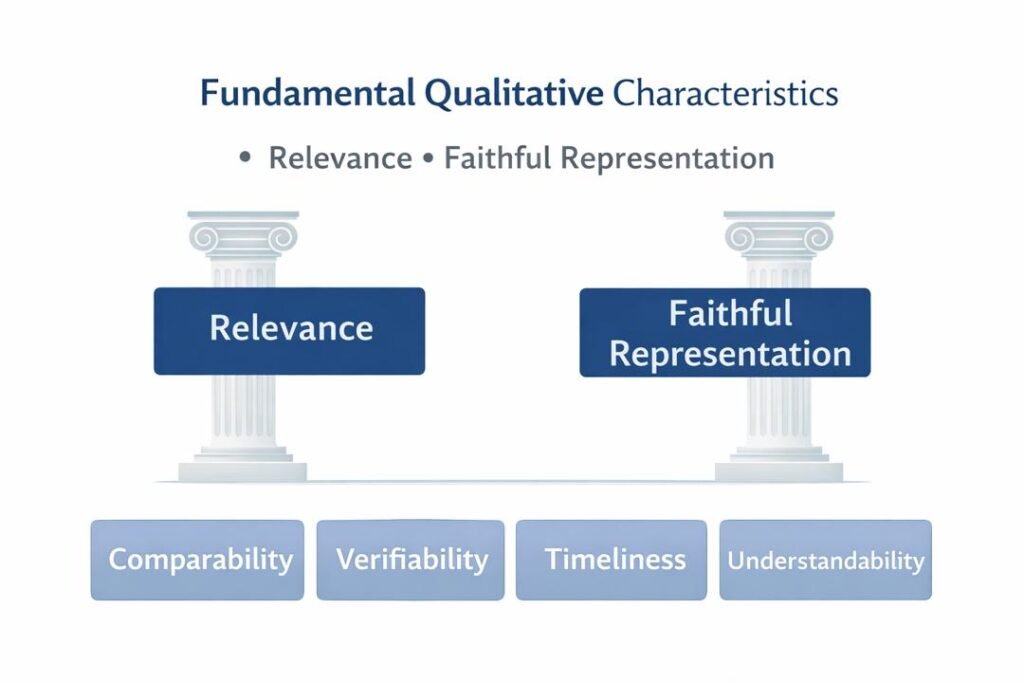
One of the key contributions of the Conceptual Framework is the effort to determine the qualitative attributes of useful information.
Fundamental Qualitative Characteristics
- Relevance: It is relevant when information can determine the choice of the users. One of the main elements of relevance is materiality.
- Faithful Representation: Information should be full, impartial and devoid of misjudgment. Honest depiction is a guarantee of reliability.
Improving the qualitative features
- Comparability: allows users to determine the similarities and differences among entities.
- Verifiability: Assures that observers should come to similar conclusions.
- Timeliness: Data should be on hand when required.
- Understandability: Information must be simple and short.
The combination of these features forms a guideline to assess the accounting standards and the preparation of financial statements.
Elements of Financial Statements
The framework specifies the basic items that are reported on financial statements:
- Assets: An asset is a current economic value that is under the control of the entity due to the occurrence of the past. This is based on the concept of control and not ownership.
- Liabilities: A liability is an existent claim of the entity to transfer an economic resource because of the past occurrences.
- Equity: Equity is the leftover interest in the assets after the deduction of the liabilities.
- Income and Expenses: Income improves equity (without contributions of the owner).Equity (before distributions to owners) is reduced.
The use of clear definitions will make recognition and measurement consistent across accounting standards.
Recognition and Measurement Principles
Recognition Criteria
An item is recognized when:
- It has the definition of an element, and
- Recognition offers information which is relevant and is a faithful representation of the underlying phenomenon.
Measurement Bases
The framework considers a number of measurement bases, which comprise:
- Historical cost
- Current cost
- Fair value
- Value in use
- Fulfillment value
There are strengths and weaknesses of each basis of measurement. The bases picked by the standard-setters are determined by the economic environment and requirements of information.
Regulatory importance of Framework
The Conceptual Framework is a significant regulation.
1. Guidance for standard-setting
The framework is referred to as the basis of the development of International Financial Reporting Standards (IFRS) by the International Accounting Standards Board. In the development of new standards or amendments to the current standards, the IASB would make sure that they are in line with the objectives and principles of the framework.
2. Reducing Inconsistencies
In the absence of a theoretical background, standards may develop independently which results in contradictions. The framework facilitates consistency and minimizes contradictions of standards.
3. Filling Gaps in Standards
Where no particular IFRS standard exists, the preparers use the framework to make accounting policies, which are acceptable and consistent.
4. Improving International harmonization
The use of the IFRS in many jurisdictions has enhanced international comparability. This harmonization is anchored by the framework by making sure that accounting practices have common theoretical foundations.
Relationship with the International Financial Reporting Standards (IFRS)
Close connection with the International Financial Reporting Standards Foundation governance structures is related to the Conceptual Framework. Although the framework leads to the development of standards, it does not dictate the prevailing standards. In the cases of conflict, certain IFRS standards prevail.
However, the framework influences the development of standards and helps to increase transparency, legitimacy, and trust of people in global capital markets.
Ensuring Consistency across Jurisdictions
The capital markets in the world require consistency. The investors are comparing international companies in industries. The framework ensures:
- Uniform definitions of financial factors.
- Principles of consistency in recognition and measurement.
- Similar disclosure standards.
The consistency lowers information asymmetry and reduces the cost of capital.
Criticisms and Limitations
In spite of the strengths, the Conceptual Framework also has its critics:
- It can be excessive abstraction so that it cannot be put into practice.
- On other occasions, there is a conflict between relevance and faithful representation.
- Political/economic pressures have the ability to impact standard-setting.
However, the framework is necessary to ensure logical consistency and lead reforms.
Conclusion
The Conceptual Framework of Financial Reporting is the intellectual foundation of the international accounting standards. It makes financial reporting relevant, reliable and consistent by formulation of clear objectives, defining elements of financial statements and establishment of qualitative characteristics.
By advising the International Accounting Standards Board and shaping the development of IFRS, the framework contributes to harmonization of the work of the different jurisdictions and increases confidence in the financial information. Such a consistent base of foundations is essential in a globalizing economy. Finally, accounting standards are not helped by the Conceptual Framework in isolation-it maintains its credibility, comparability and integrity of financial reporting across the globe.
Get more well researched information about the Conceptual Framework for Financial Reporting here.