Abstract
The emergence of regional and state broadcasting in Nigeria following independence was a turning point in the centralized colonial control of the media to the decentralized structure of communication based on the concept of federalism. This paper will discuss the way regional governments set up their local radio and television stations, initially with the breakthrough of the Western Nigeria Television (WNTV) in 1959, and how the trend took over into state-run broadcasting systems with state creation waves. The work relies on a qualitative historical approach based on archival literature and communication theory to determine the effect of decentralization on the content diversity, political messaging, cultural representation, and development of regions. Based on the media federalism theory, political economy of communication and development media theory, the article holds that decentralization did not only increase cultural presence and capacity of professionals in broadcasting but also institutionalized political interference in media content. The Nigerian case illustrates that federal political systems greatly influence media organization, owners’ structure, and communicative performance in the postcolonial nations.
Keywords: Regional broadcasting, State media, Western Nigeria Television, Media federalism, Political communication, Nigerian media history.
1.0 Introduction
Nigerian broadcasting history indicates the political development of the state in general. Since the colonial centralization of media to the Nigerian Broadcasting Service (NBS) and the regional freedom and finally, state-owned media, the media institutions evolved along with the constitutional reorganization and federalization.
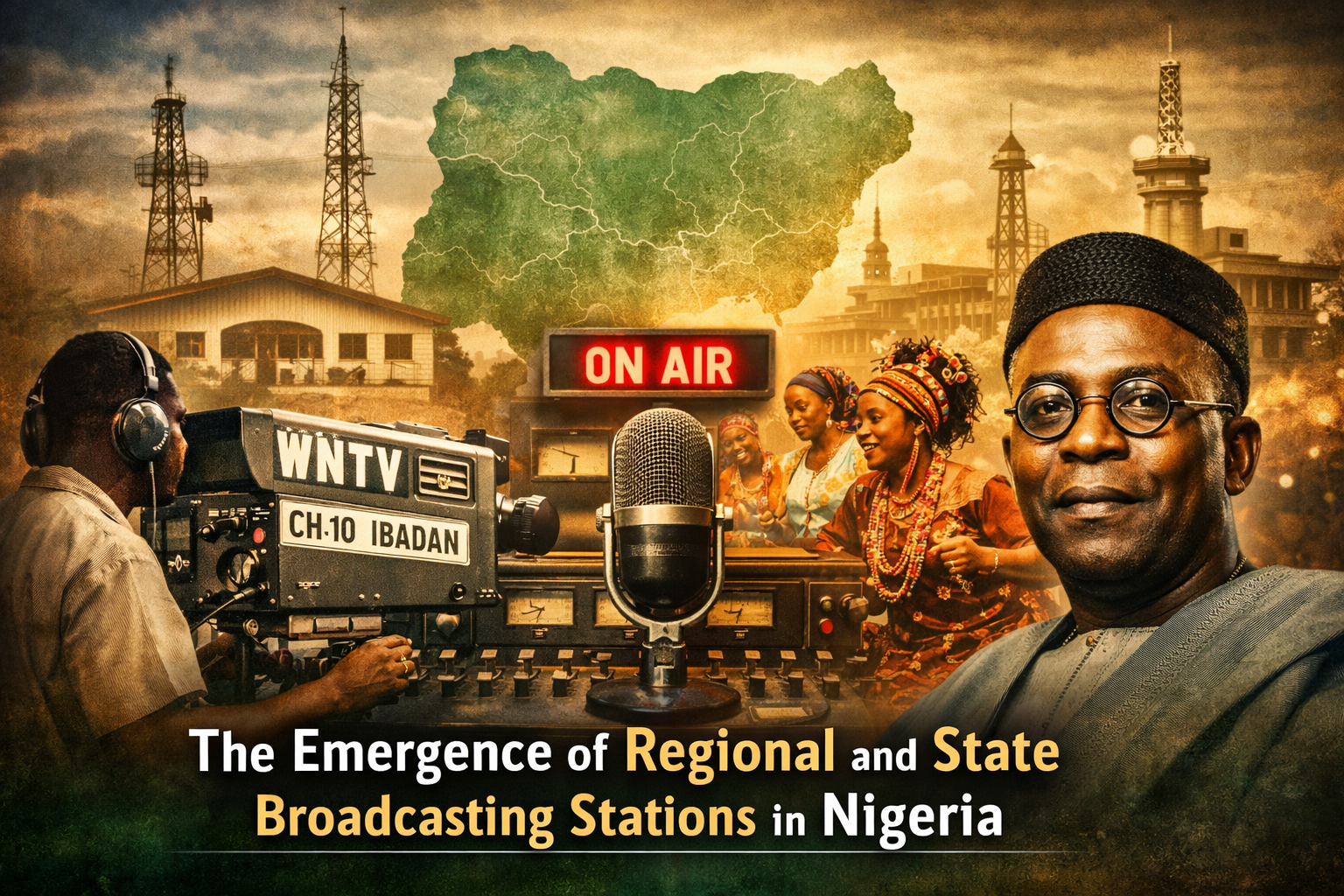
Western Nigeria Television (WNTV) was founded in 1959, which was a milestone in the history of African television. Being the first television channel in Nigeria and across tropical Africa, it was a regional ambition and a technological development (Uche, 1989). Its establishment marked the onset of a decentralized broadcasting system that enabled regions in Nigeria to enjoy communicative freedom within a federal system.
The following paper will explore how the emergence of regional and subsequent state broadcasting stations took place in Nigeria around three overriding questions:
What was the impact of decentralisation on the structure and ownership?
How did regional control affect the range of content and representation of culture?
What is the impact of state ownership on political messages and the independence of media?
2.0 Literature Review
2. 1 Colonial Broadcasting Station
In Nigeria, colonial broadcasting was centrally controlled and operated mainly in the interests of the administration but not participatory communication (Larkin, 2008). The Nigerian Broadcasting Service acted as the arm of the colonial power that spread the official news and imperial storytelling.
Uche (1989) cites that early broadcasting organizations were influenced by the ideals of the British public service but did not have effective local representation. Programming did not actively involve the use of the indigenous language, and there was often a lack of cultural diversity in the programming.
2.2 Regionalization and Media Expansion
According to scholars, the 1954 Lyttleton Constitution acted as a pivot point to allow the regional governments to validate their powers in the internal affairs, and one of the areas that was allowed was broadcasting (Omu, 1978). The Western Region took this opportunity most aggressively by the start of WNTV.
Uche (1989) claims that the creation of WNTV was politically opportune. And it was not only technological innovation but a calculation of regional independence. The same happened in Eastern and Northern Regions and resulted in the spread of locally owned broadcasting corporations.
2.3 Media Proliferation and Creation of States
This state creation exercise in 1967 under General Yakubu Gowon resulted in the states being divided into the former regions, and increased broadcasting institutions. The ownership of the media became increasingly connected with the state governments (Akinfeleye, 2003).
Decentralization helped in gaining access and local representation, and, on the other hand, entrenched government control. According to scholars, state government-controlled broadcasting stations were often used as political tools (Oso, 2012).
3.0 Conceptual Review
3.1 Decentralization
Decentralization involves giving up authority of the central government to subnational entities. Decentralization affects the ownership structure, the editorial independence and the production of content in media systems (McQuail, 2010).
3.2 Media Federalism
Media federalism is the correspondence of a country’s political federal system and the communication institutions. Broadcasting systems are usually manifestations of regional liberty and decentralized power between central and subnational governments in federal states.
3.3 State-Controlled Broadcasting
State-controlled broadcasting is defined as the media institutions owned and financed by the government. These are systems that can encourage the goals of the public service, yet they can be easily politicized (Voltmer, 2013).
4.0 Theoretical Framework
4.1 Political Economy of Communication
The political economy perspective focuses on the effects of the ownership-power relations on media content (Mosco, 2009). Broadcasting infrastructure in Nigeria was under the control of regional governments, which affected editorial decision-making and the programming agenda.
4.2 Development Media Theory
The development media theory puts forward the idea that the media in postcolonial societies have a tendency to support national building and modernization (McQuail, 2010). Broadcasting stations in the region positioned themselves as an instrument of learning and growth.
4.3 Media Federalism Theory
Media federalism postulates that plural communication structures would be the result of decentralized political systems. The broadcast expansion of the Nigerian region cuts across this theoretical model.
5.0 Methodology
In this study, the qualitative research design adopted is historical. The secondary academic literature, archival sources, policy reports, and scholarly discussions of the history of Nigerian broadcasting were taken as the sources of data.
In its study, the paper uses interpretive analysis to analyze institutional evolution, ownership patterns, and content orientation. The approach is appropriate to the research of structural developments and theoretical implications in the study of media systems.
6.0 Findings
6.1 Institutional Proliferation
The regional broadcasting autonomy started with the founding of WNTV in 1959. Thereafter, Eastern Nigeria Broadcasting Service and the Broadcasting Company of Northern Nigeria were established.
After the state formation in 1967 and 1976, the states created their broadcasting companies. Multiplication of institutions increased the scope of geography and the division of audiences.
6.2 Content Diversity
Local television improved the linguistic and cultural coverage. The number of indigenous language programs was on the rise, especially Yoruba, Igbo and Hausa.
Regional realities were portrayed in television drama, educational programming and the local news content. This diversified the Nigerian media beyond the colonial homogeneity.
6.3 Political Messaging
Decentralization enhanced political communication within the subnational levels. Broadcasting platforms were also involved in policy promotion by the regional and state governments to consolidate political legitimacy.
Nonetheless, the independence of the editors was restricted. State-owned stations often gave attention to the government narratives at the expense of opposition voices.
6.4 Regional Development
Broadcasting stations triggered professional training, development of technical infrastructure and employment. Some of the early broadcasting centers like Ibadan, helped in economic development in the region.
7.0 Discussion
The experience of Nigerians shows that decentralization enlarges and limits media systems at the same time. Regional broadcasting, on the one hand, gave a voice to culture and localized communication. Structural bias was, on the other hand, vested in political ownership.
Media federalism theory describes the instability between the federal political system and the broadcasting structure of Nigeria. However, pluralism is limited by the concentration of ownership in government, which is reflected by the analysis of political economy when institutional expansion occurs.
The founding of WNTV is still of historical value. It put Nigeria on the leading edge of African broadcasting innovation and represented technological self-determination in a late colonial situation. But it also demonstrated the competitive politics of the regions in Nigeria as their regional ownership emerged.
8.0 Conclusion
With the introduction of regional and state broadcasting stations in Nigeria, the communication structure of the country was completely transformed. Decentralization increased the diversity of content, improved the cultural representation, and regional development. Nevertheless, state ownership leads to political interference in the work of the media.
The broadcast history of Nigeria explains why it is a complex issue of federalism, media ownership, and democratic communication in postcolonial societies. Regional broadcasting is still influential in the current debate on media independence and reform.
References
Akinfeleye, R. (2003). Fourth estate of the realm or fourth estate of the wreck? Lagos: University of Lagos Press.
Larkin, B. (2008). Signal and noise: Media, infrastructure, and urban culture in Nigeria. Duke University Press.
McQuail, D. (2010). McQuail’s mass communication theory (6th ed.). Sage Publications.
Mosco, V. (2009). The political economy of communication (2nd ed.). Sage Publications.
Omu, F. (1978). Press and politics in Nigeria, 1880–1937. Longman.
Oso, L. (2012). Press and politics in Nigeria: On whose side? Lagos Historical Review, 12(1), 45–62.
Uche, L. U. (1989). Mass media, people, and politics in Nigeria. Concept Publishing.
Voltmer, K. (2013). The media in transitional democracies. Polity Press.