Quick Summary:
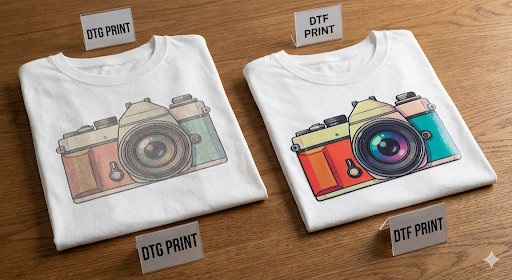
DTG (Direct-to-Garment) printing sprays water-based ink directly into fabric fibers, making it ideal for soft, highly detailed designs on 100% cotton apparel. DTF (Direct-to-Film) printing involves printing onto a specialized film and transferring it via a heat press, offering unmatched fabric versatility across cotton, polyester, and blends. While DTG provides a softer hand feel, DTF typically delivers higher color vibrancy and durability.
DTG vs. DTF Printing: What’s Better for Custom Apparel?
In today’s competitive custom apparel market, businesses comparing DTG vs. DTF printing are typically evaluating print quality, fabric compatibility, machine investment, and long-term durability. The custom apparel industry has evolved rapidly, moving away from bulk-only orders toward highly efficient, digital, made-to-order production.
Choosing the right printing method is no longer just about putting ink on a shirt; it is about matching the correct technology to your fabric, your design style, and your business model. Whether you are launching a streetwear brand, ordering corporate uniforms, or researching the best shirt printing machine for a home business, understanding the mechanics behind these two dominant methods is crucial.
In this comprehensive guide, we will break down the exact differences between DTG and DTF, compare their machinery and costs, and help you determine which method will elevate your custom apparel.
What Is DTG Printing?
When researching apparel production, the first question most people ask is, what is dtg printing?
The dtg printing meaning stands for Direct-to-Garment. Just as the name implies, this technology works very much like a standard desktop inkjet printer, but instead of feeding paper through the machine, it prints directly onto clothing.
The DTG Process
In dtg shirt printing, the garment is pre-treated with a special liquid that helps the ink bond to the fibers and prevents it from soaking too deeply into the fabric. The shirt is then loaded onto a platen and fed into the dtg printing machine. The printer uses specialized, eco-friendly, water-based inks to spray the design directly into the fabric. Finally, the ink is cured using a heat press or tunnel dryer.
Because the ink penetrates the fibers, a dtg print results in a very soft “hand feel”, meaning you can barely feel the ink when you run your hand over the shirt. This makes dtg t shirt printing the gold standard for complex, photorealistic designs with intricate details and gradients.
DTG vs Traditional Methods
It is important to understand the difference between a dtg machine and a traditional screen printing machine. Screen printing requires creating a physical stencil (screen) for every single color in a design, making it cost-prohibitive for small orders. DTG printers, however, require no setup screens. They print full-color digital files instantly, making them perfect for one-off prints and on-demand fulfillment. DTG performs best on 100% ring-spun cotton or high-cotton blends.
What Is DTF Printing?
As fabric trends shifted toward performance wear and unique blends, the industry needed a new solution. This leads to the next major question: what is dtf printing?
The dtf meaning printing stands for Direct-to-Film. Unlike DTG, which prints onto the shirt, this method prints the design onto a specialized piece of PET film.
The DTF Transfer Process
To answer what is dtf, we have to look at its unique workflow. First, a dtf printing machine prints the colored ink onto a clear film, followed immediately by a layer of white ink. While the ink is still wet, a specialized hot-melt adhesive powder is applied to the back of the print.
This powder is then melted in a curing oven, turning the film into a ready-to-use dtf transfer. To apply the design to the garment, you place the film onto the shirt and use a dtf heat press to bind the adhesive to the fabric. Once it cools, you peel away the film, leaving a vibrant, durable graphic behind.
DTF vs Other Transfer Methods
Dtf transfer printing solved many of the industry’s biggest headaches. For years, people used sublimation printing for polyester garments. However, sublimation only works on light-colored, 100% polyester fabrics. DTF changed the game because it can be applied to any fabric cotton, polyester, nylon, leather, and dark or light colors without any pre-treatment.
DTG vs DTF Printing Comparison Table
To quickly evaluate which method suits your needs, here is a side-by-side breakdown of the two technologies:
| Feature | DTG Printing (Direct-to-Garment) | DTF Printing (Direct-to-Film) |
| Print Method | Ink sprayed directly into fabric fibers | Ink printed on film, applied via heat press |
| Fabric Compatibility | Best on 100% cotton and high-cotton blends | Works on cotton, poly, blends, nylon, leather |
| Durability | Fades naturally over time (vintage look) | Highly resistant to cracking and fading |
| Color Vibrancy | Excellent, but absorbs slightly into fabric | Extremely vibrant; ink sits on top of fabric |
| Hand Feel | Very soft, breathable, integrated into fabric | Slightly thicker, plastic-like feel on large designs |
| Machine Cost | Very high investment ($15k – $100k+) | Lower initial investment ($3k – $15k) |
| Pre-Treatment | Required for dark garments | Not required for any garment |
| Best Use Cases | Premium retail cotton tees, photorealism | Activewear, blends, hats, bulk transfers |
DTG Printing Machine vs DTF Printing Machine
If you are looking to bring production in-house, choosing between a dtg printing machine and a dtf machine involves significant financial and operational considerations.
Investment and Maintenance
DTG printers are substantial investments. High-end, commercial-grade DTG machines can cost tens of thousands of dollars. Furthermore, they require strict daily maintenance. The white ink used in DTG is heavy in titanium dioxide, meaning if the machine sits idle, the ink can clog the printheads, leading to expensive repairs.
A dtf printing machine generally requires a lower barrier to entry. While commercial setups are still an investment, they are often less expensive than top-tier DTG units. However, DTF setups require more physical space because the workflow involves the printer, a powder shaker/dryer unit, and an industrial heat press.


Production Speed
When comparing any shirt printing machine, workflow speed matters. DTG requires pre-treating the shirt, drying the pre-treat, loading the shirt, printing, and then curing the ink. It is a slower, more labor-intensive per-shirt process.
DTF allows for rapid batch printing. You can print hundreds of logos onto a continuous roll of film in hours. You can store these transfers for months and simply press them onto shirts as orders come in, making it highly efficient for scaling a small business.
Print Quality Comparison
Both methods produce retail-quality garments, but they excel in different visual areas.
- Detail Sharpness: DTG excels at capturing the finest details, soft drop shadows, and photorealistic skin tones. Because it functions like an inkjet printer on a soft canvas, the blending is incredibly smooth.
- Vibrancy: DTF is the clear winner for color pop. Because the ink is printed on a non-porous film and backed by solid white ink, the colors remain incredibly bright and do not get muted by the color of the underlying fabric.
- A Note on UV DTF: While discussing film transfers, you might encounter the term uv dtf printing (or uv dtf). It is important to note that UV DTF uses ultraviolet light to cure ink on a film for hard surfaces (like glass, mugs, and plastics). It is essentially a digital sticker and is not used for apparel.
Durability & Wash Test
When investing in custom apparel, longevity is a primary concern.
The dtg vs dtf durability debate often comes down to personal preference. DTG inks bind with the cotton fibers. Over dozens of washes, the print will gently fade along with the fabric, resulting in a soft, vintage aesthetic. It rarely cracks, but it will lose some initial punch.
DTF transfers sit on top of the fabric, bonded by a strong adhesive. As a result, DTF boasts incredible stretch resistance. You can pull a DTF-printed t-shirt aggressively, and the design will stretch and rebound without cracking. It holds its vibrant color through countless heavy wash cycles, making it the preferred choice for athletic wear and heavy-duty work uniforms.
Cost Differences
The financial breakdown between the two methods extends beyond the machinery.
- Ink and Consumables: DTG ink is notoriously expensive, especially the white ink required for dark shirts. The pre-treatment liquid also adds to the per-shirt cost. DTF ink, film, and adhesive powder generally cost less per square inch than DTG supplies.
- Set-up Differences: DTF requires you to purchase an industrial heat press to apply the transfers. While DTG also requires a heat press (or tunnel dryer) to cure the ink, the physical application of a DTF transfer requires precise pressure and temperature control to ensure the adhesive binds permanently.
Which Is Better for Heavyweight T-shirts?
For brands using thick, premium streetwear garments, the interaction between ink and fabric changes.
Heavyweight t-shirts (typically 200 GSM and above) are usually made of thick, ring-spun cotton. This thick cotton is highly absorbent, making it a phenomenal canvas for DTG printing. The dense fibers soak up the water-based ink, creating a rich, integrated print that feels premium.
Conversely, DTF also performs exceptionally well on heavyweight cotton. Because the transfer sits on top of the fabric, the thickness of the shirt does not affect the vibrancy of the print. If your heavyweight tee is a cotton/polyester blend, DTF is the safer choice to prevent dye migration.
DTG Printing Near Me vs Online Print-on-Demand
As businesses seek custom apparel, many start by searching for dtg printing near me” or “local dtg printing services.
Working with a local shop allows you to feel the fabric in person and potentially avoid shipping times. However, local shops often have limited machine capabilities, restricted blank apparel options, and higher per-unit costs to cover their physical overhead.
The alternative is utilizing an online print-on-demand (POD) platform.
PrintHaul leverages modern DTG and DTF printing technologies to ensure designs remain vibrant across different fabric types while maintaining a made-to-order production model. DTG is expertly utilized for cotton-heavy apparel to ensure a soft hand feel, while DTF provides the necessary versatility for poly-blends and activewear. With no minimum order requirements, reduced inventory waste, and shipping speeds that depend entirely on your region, modern POD services often outpace local brick-and-mortar shops in efficiency and quality control.
Final Recommendation
Determining the best printing method for t-shirts in depends entirely on your fabric choice and business model.
- Choose DTG if: Your brand focuses on 100% premium cotton garments, you prioritize a soft, breathable hand feel, and your designs feature complex, photorealistic details with soft gradients.
- Choose DTF if: You print on a wide variety of fabrics (polyester, nylon, blends), you require maximum color vibrancy, you want to print on challenging placements (like sleeves or neck labels), or you need high durability for activewear and uniforms.
Both technologies have revolutionized the custom apparel space. By aligning the right print method with the right fabric, you ensure your merchandise looks professional, feels great, and lasts for years.
If you’re looking for high-quality custom t-shirt printing with fast turnaround and no minimums, you can explore our print-on-demand services at PrintHaul to get started.
FAQ Section
What is dtg printing on shirts?
DTG (Direct-to-Garment) printing is a digital process where water-based ink is sprayed directly into the fibers of a shirt using a specialized inkjet printer, resulting in a soft, detailed print.
What is dtf printing?
DTF (Direct-to-Film) printing involves printing a design onto a special PET film, applying an adhesive powder, and using a heat press to transfer the design permanently onto a garment.
Is DTF more durable than DTG?
Generally, yes. DTF utilizes a hot-melt adhesive that binds strongly to the fabric, offering excellent stretch resistance and color retention over many heavy wash cycles without cracking.
Is DTG better for cotton?
Yes. DTG printing is optimized for 100% ring-spun cotton. The natural fibers absorb the water-based inks perfectly, resulting in a vibrant print with an exceptionally soft hand feel.
Which printing method lasts longer?
DTF maintains its color vibrancy and structural integrity longer under heavy washing and stretching. DTG is highly durable but naturally fades over time, giving the garment a softer, vintage appearance.
Which is cheaper: DTG or DTF?
In terms of equipment and consumable costs (ink, film, powder), DTF is generally cheaper to operate than DTG. DTG requires expensive white ink and pre-treatment fluids, raising the per-shirt cost.
Can DTF print on polyester?
Absolutely. One of the biggest advantages of DTF printing is its versatility; it can be applied seamlessly to 100% polyester, cotton/poly blends, nylon, and even leather.
Do I need a heat press for DTF?
Yes. A commercial-grade heat press is mandatory for DTF printing. The heat and pressure are required to melt the adhesive and bond the transfer film permanently to the fabric.
What is a DTG printing machine?
A DTG printing machine is a specialized, industrial-scale inkjet printer designed with specific platens to hold garments flat while printheads spray textile inks directly onto the fabric.
What is UV DTF printing?
UV DTF printing uses ultraviolet light to cure ink onto a transfer film. Unlike standard DTF, which is used for apparel, UV DTF acts like a highly durable digital sticker applied to hard surfaces like glass, metal, and plastics.