Abstract
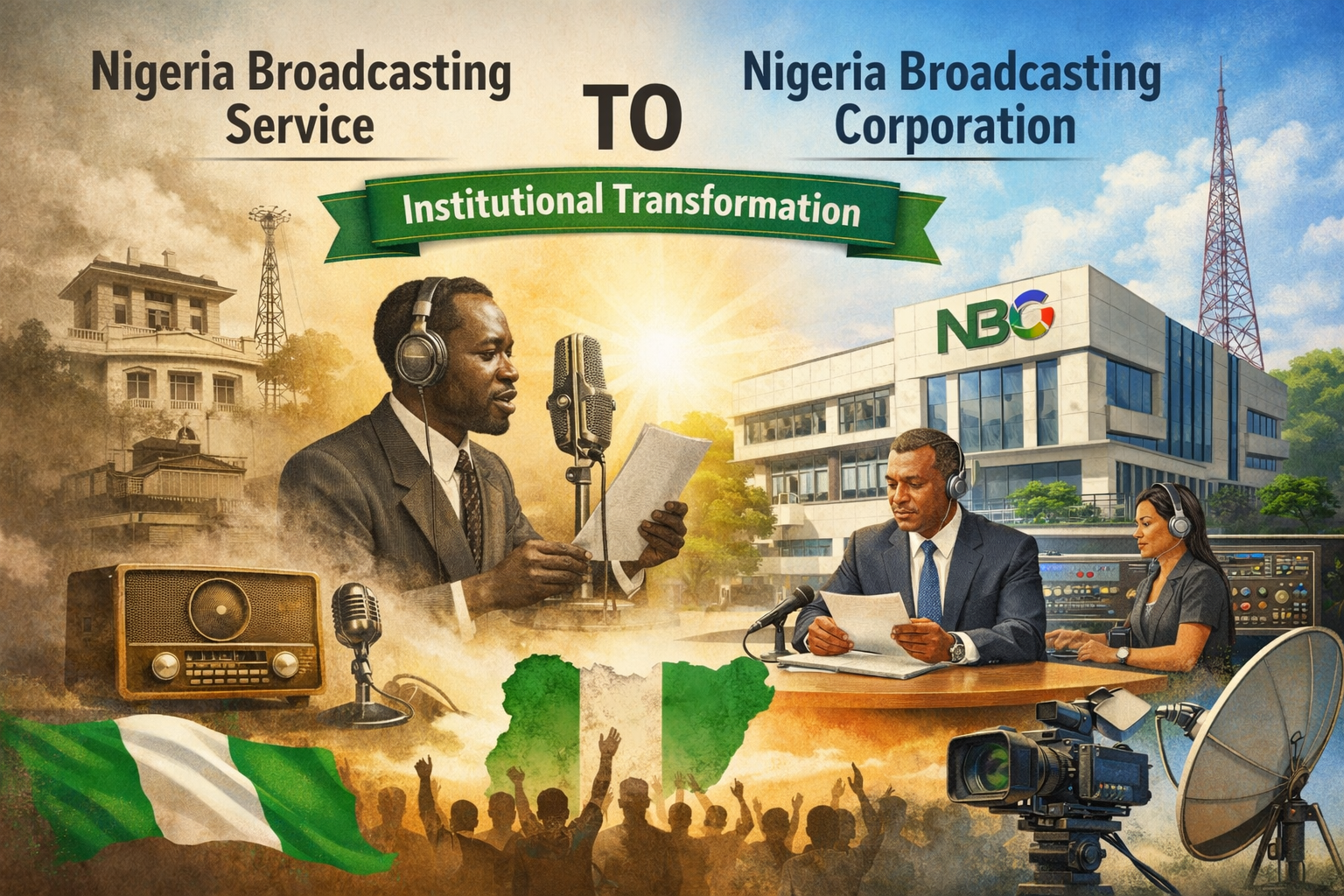
Broadcasting in Nigeria has been developed in accordance with the political, social, and technological development of the country. This paper will analyze the history of the setting up of the Nigeria Broadcasting Service (NBS) and how it was later adapted into the Nigeria Broadcasting Corporation (NBC). It examines structural reforms, alterations in policies, innovations in programming and the contribution that broadcasting makes to the formation of national identity. The article employs a historical-qualitative method to draw attention to the role of these institutions in the growth of federal and regional broadcasting and the development of the modern media environment in Nigeria.
Keywords: Nigeria Broadcasting Service, Nigeria Broadcasting Corporation, institutional change, broadcast development, national identity, policy change.
Introduction
The use of broadcasting as a key means of communicating with the masses and social integration has been at the center stage of Nigeria. Radio broadcasting in Nigeria started with the setting up of the Nigeria Broadcasting Service (NBS) in the year 1951. The NBS was initially inspired by the British Empire Service (now the BBC World Service) to deliver news, educational programs and entertainment content and also create a sense of shared identity among the diverse communities in Nigeria (Uwaifo, 2018).
In 1956, there was a planned institutional reform in the form of a transition to the Nigeria Broadcasting Corporation(NBC). The NBC was charged with the responsibility of integrating broadcasting services, harmonizing programming, and reaching out to the nationwide coverage. This revolution proves that broadcasting used to be a colonial means of controlling information and turned into an instrument of national development, cultural promotion, and political education (Ajibade, 2015).
Literature Review
The history of broadcasting in Nigeria has been studied by a number of scholars based on the colonial era, as well as the post-independence era. Ajibade (2015) contends that broadcasting was originally a tool of political control, but eventually, it was used as a tool of nation-building. Likewise, Ofem (2019) explains that the formation of the NBC provided an outlay on standard programming and federal regulation, which impacted later state and regional stations.
Uwaifo (2018) points to such technological inventions of the time as Radio Diffusion Boxes (RDBs), which were used to transmit wired contents in non-individual radio receiver areas of the community. According to Oso and Pate (2017), broadcasting has a socio-cultural aspect that fosters literacy, education, and a national identity. All these works highlight the dual role of broadcasting, which is to inform and to unify.
Theoretical Framework and Conceptual Review
Conceptual Review
In the Nigerian setting, broadcasting can be taken as a government organization that disseminates information, spreads cultures and brings the people together. Institutional transformation is a process by which an organization, in response to evolving needs in society, has undergone structural, technological and programmatic changes. The case of NBS to NBC transformation in this study is an illustration of the transformation of institutions by putting in place measures such as policy reform, structural adjustment, and adoption of technology.
Theoretical Framework
The theories that are used in the study are the Public Sphere Theory (Habermas, 1989) and the Nation-Building Theory. Public Sphere Theory assumes that mass communication, such as broadcasting, provides for spaces of dialogue and for participation of the masses. According to the Nation-Building Theory, media institutions are important in the construction of the national consciousness, especially in a multi-ethnic society. These frameworks combined describe how NBS/NBC helped to the formation of a shared identity of the Nigerian people via standardized programming and education broadcasts.
Methodology
The proposed study focuses on a historical approach as it is qualitative and uses secondary sources, archives, and books. Information on the foundation, structural shifts, program development and legislative changes regarding NBS and NBC has been gathered. The analysis concentrates on the patterns of institutional reform, technological development and the integration process on the national level and the scope to which the corporation has impacted the development of the regional broadcasting.
Findings
Establishment of NBS
The NBS was established to bring together radio transmissions in the urban areas, especially in Lagos, Kaduna and Enugu. It had programming that consisted of news, public services, drama, cultural, and educational programs. The NBS depended on British Empire Service content heavily but eventually created locally oriented shows that would represent the cultural diversity of Nigeria (Uwaifo, 2018).
Transition to NBC
The transition was formalised by the Nigeria Broadcasting Corporation Act of 1956. The NBC centralized governance came up with executive councils and also formed the regional programming units. It enhanced the radio systems, refined technical quality and enhanced coordination of federal and regional stations. These changes allowed the NBC to harmonize news broadcasts, education, and entertainment in Nigeria (Ofem, 2019).
Programming and National Identity
The NBC programming had an intentional involvement in promoting national cohesion. The citizens were aware of the policies in the country through news bulletins and through dramas, cultural music, and the educational programs, which enhanced inter-ethnic understanding. The broadcasts will supplement formal schooling, especially in rural places where formal education was not accessible to many (Oso & Pate, 2017).
Technological Advancements
The NBC invested in FM transmission modernization, transmitter networks, and modernization of the studios. Such advances improved coverage, sound and were also engaging to the audience. The adoption of FM facilitated the speciality in programming, such as the youth-oriented shows, public awareness and the local culture programming.
Effect on Federal and Regional Broadcasting
The NBC template was the prototype of the state-level broadcasting authorities. Local stations also followed NBC standards in their programming and technical standards, which created national standards of cohesion and a local presence. Federal cooperation with NBC provided that broadcasting became the instrument of public policy distribution, health promotion, and national education campaigns (Ajibade, 2015).
Discussion
The change of NBS to NBC is used to demonstrate how broadcasting has evolved from a colonial tool to a national institution. The NBC was structured so that it had centralized management and, at the same time, embraced diversity in the region. It was programmatically focused on cultural integration, education and civic engagement. On the technological front, the corporation invested in infrastructure that expanded the presence of radio into rural locations.
It can be seen that the NBC has played a significant role in the nation-building process through its dualism as it fosters unity on the national level by using standard programmes, but at the same time resolves the regional cultural issue. This equilibrium led to political stability, social cohesion, as well as literacy development. The challenges to be faced by the corporation are also pointed out by the study, such as the lack of funds, balancing between the federal control and the local independence, and the control of the content of the work with the different language and cultural groups.
Conclusion
The creation of the Nigeria Broadcasting Service and its reorganization into the Nigeria Broadcasting Corporation is one of the most important stages in the media history of Nigeria. The standardization of broadcasting, the advancement of national unity, and the establishment of regional and federal growth were possible with the help of legislative changes, structural reorganization, and programming innovation that allowed the NBC to achieve success. The NBC is still a stalwart of the Nigerian broadcasting system, which indicates the persistence of the role played by institutional transformation in defining the process of public communication, and cultural integration and nation-building.
References
Ajibade, L. T. (2015). Broadcasting in Nigeria: History, policy, and development. Lagos: Media Press.
Habermas, J. (1989). The structural transformation of the public sphere: An inquiry into a category of bourgeois society. Cambridge, MA: MIT Press.
Oso, L., & Pate, U. (2017). Mass media and national integration in Nigeria. Ibadan: University Press.
Ofem, B. (2019). The transformation of broadcasting institutions in post-colonial Nigeria. Journal of African Media Studies, 11(3), 45–63.
Uwaifo, V. (2018). Radio diffusion and public enlightenment in colonial Nigeria. Lagos: Heritage Publishers.
Nigeria Broadcasting Corporation. (n.d.). About NBC.