Abstract
This paper looks into how the British Empire Service (now British Broadcasting World Service) influenced the development of early broadcasting in colonial Nigeria through the provision of radio diffusion boxes (RDBs). This paper discusses the manner in which colonial rulers used wired relay systems to disseminate centrally mediated content and the impact that this had on the political, social, and technological underpinning of Nigerian broadcasting. The paper relies on the study of historical and communicational scholarship to examine the diffusion box system as a tool of imperial communication policy, politicalization of society and standardization of culture. The outcomes indicate that, although the system increased accessibility to information and provided a technical foundation for subsequent broadcasting institutions, it also placed centralized authority and produced little indigenous content. This model has its traces in the contemporary culture of the Nigerian broadcasting organization that is both structural and regulatory.
Keywords: British Empire Service, BBC World Service, radio diffusion boxes, colonial Nigeria, broadcasting history, imperial communication, wired relay system.
1.0 Introduction
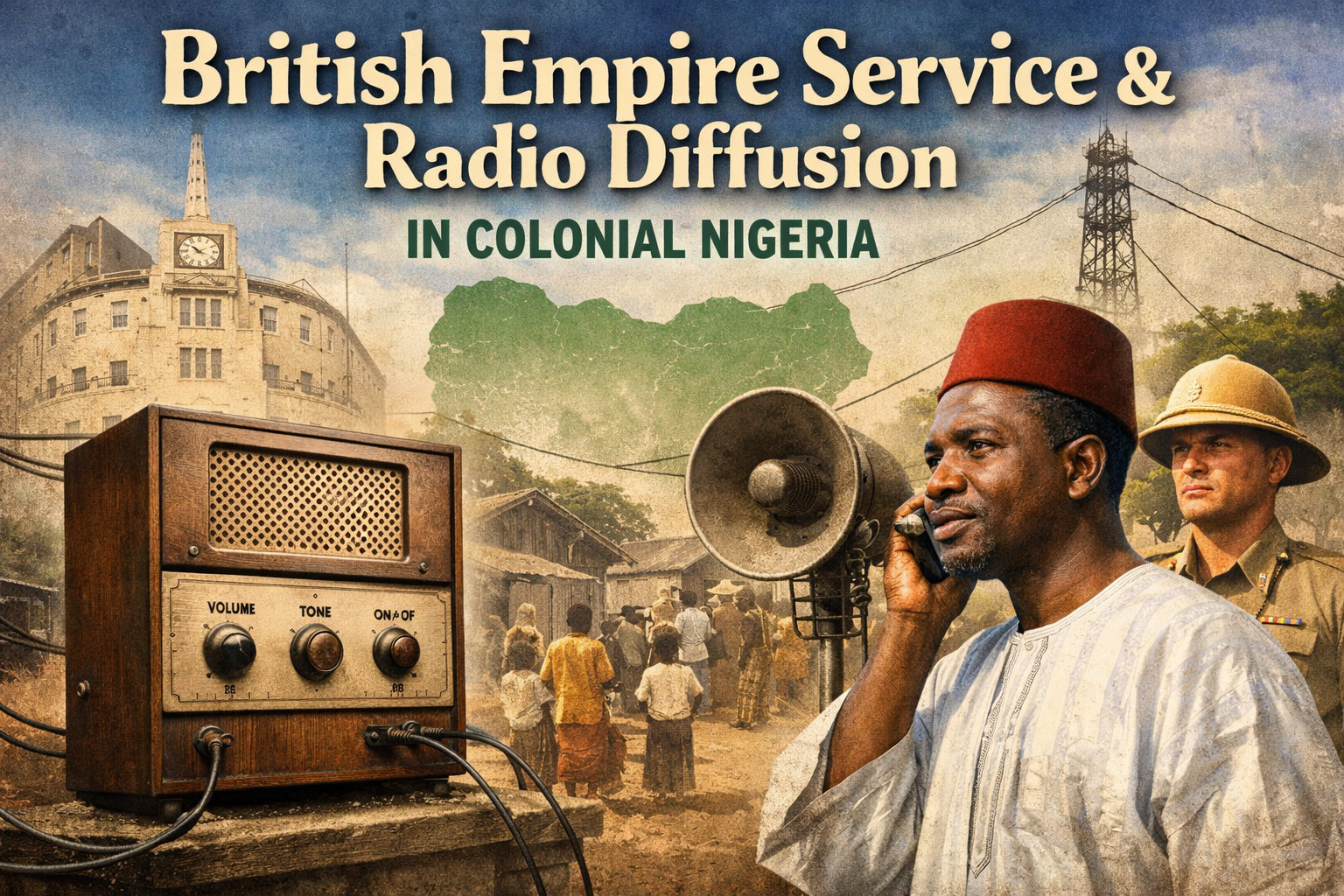
Broadcasting in Nigeria did not become a localized mass communication enterprise, but as an extension of the British imperial policy. The Radio Distribution Service (RDS), which was widely referred to as the radio diffusion box system, was introduced by the British colonial authority in the 1930s to transmit programs in London to some of the urban centers in Nigeria. These systems were broadcast using the wired loudspeakers in homes and places of worship. Central production was done by the British Empire Service, which was later to become the BBC world service.
The radio diffusion box was first launched in 1935, and this signified the official start of broadcasting in Nigeria (Uche, 1989). The Nigerian model, however, was wired unlike the traditional radio broadcasting system, which utilized wireless transmission. This structure enabled the colonial governments to regulate the programming content, besides restricting local editorial freedom.
This paper explores the role that the British Empire Service played in the early broadcasting systems in Nigeria and assesses the political, social and technological consequences of the diffusion box format. It posits that colonial broadcasting had two purposes, namely to promote imperial cohesion and to mold the opinion of the colonials, and at the same time to provide an infrastructural and institutional basis to the postcolonial broadcasting.
2.0 Literature Review
2.1 The Colonial Broadcasting and Imperial Policy
As it has been observed by scholars, broadcasting by British colonies was strongly associated with imperial communication goals (Briggs, 1995). The British Empire Service was formed in 1932, and it was meant to project British views over the empire and ensure political unity. Its spread to Africa was an opportunity to support loyalty and resist conflicting international propaganda (McDonnell, 2016).
The diffusion box system was used in Nigeria as a cheap system to pass imperial broadcasts. Uche (1989) notes that this organization allowed the colonial administrators to relay controlled information but not to allow local broadcasting. It is therefore not just a technological but a political RDS system.
2.2 Broadcasting Development Within Nigeria
In 1951, the transformation of the RDS into the Nigerian Broadcasting Service (NBS) occurred, and this shifted towards a more local programming (Lodele, 1979). However, early programming was still strongly subject to British formats of public service broadcasting. According to scholars, the colonial broadcasting organizations were organized in such a way as to encourage order, discipline, and efficiency in administration and not participatory communication (Bourgault, 1995).
In addition, interactive engagement was limited by the technological constraints that diffusion boxes had. This was in contrast to wireless sets, where diffusion boxes did not provide tuning abilities to the listener, who could not choose to get other sources of information. This strengthened control of content distribution.
3.0 Conceptual Review
3.1 Radio Diffusion Boxes
Diffusion boxes were radio receivers boasting of wires, and these were attached to central receivers. London signals were retransmitted in urban regions like Lagos and Ibadan by use of cables to subscribers. Subscribers were charged subscription charges but not allowed to select the programming.
Diffusion boxes are conceptually similar to a model of relay broadcasting by making the audience passive consumers of centrally curated content. This is unlike in the pluralistic broadcasting systems, where many sources and audience choice are permitted.
3.2 Imperial Communication
Imperial communication is the process used by the colonialists to ensure the control of political and cultural dominance over foreign lands. The main element of this strategy was broadcasting, as it allowed spreading news, propaganda during the war and some cultural programs which strengthened the imperial identity (Briggs, 1995).
The British Empire Service was an international arm of domestic British broadcasting, which projected imperial-serving narratives.
4.0 Theoretical Review
4.1 Modernization Theory
The modernization theory is based on the assumption that mass media are critical in spreading values and information required by society in order to develop (Lerner, 1958). The colonial rulers defended broadcasting programs in Nigeria as a tool of modernization and education. The diffusion box system brought about new structures of mediated communication that were able to introduce Nigerian audiences to the world news and administrative announcements.
Critics, however, are of the view that the modernization theory tends to obscure asymmetrical power dynamics in which the exchange of information flows is skewed towards the dominant societies and the subordinate ones.
4.2 Dependency Theory
Dependency theory also offers a different view by focusing on structural imbalances within the world communication networks (Schiller, 1976). The dependency relationship is demonstrated through the reliance on British-made material.
5.0 Methodology
This paper will take the historical-analytical approach, which will use secondary sources such as academic books, peer-reviewed journals, and archival information. The discussion will combine historical accounts of colonial broadcasting policies and theoretical explanations of communication studies.
The analysis of the institutional progress, technological infrastructure and policy framework determines the wider implications of the diffusion box system as it relates to colonial governance through the review of the developments.
6.0 Findings
6.1 Political Implications
The diffusion box system was a form of political control. It was used to relay wartime news and strengthen loyalty towards Britain during World War II. Colonial powers were able to ensure ideological uniformity by restricting other sources.
6.2 Social Implications
Nigerians were exposed to events around the world through the system, and early cultures of broadcast listening were developed. Open listening areas were converted to community information sharing areas. Nonetheless, the culture of the British dominated in programming, sidelining the native views.
6.3 Technological Implications
The wired relay model held back the independent wireless broadcasting infrastructure development technologically. It also, however, created administrative organizations that would become national broadcasting companies, such as the Nigerian Broadcasting Corporation (NBC), which was founded in 1957.
7.0 Discussion
British Empire Service played a big role in shaping early broadcasting in Nigeria. Though the diffusion box system has increased access to mediated information, it has embedded the centralized control and strengthened colonial hierarchies.
This system continues to be felt in modern Nigerian broadcasting, especially in centralization of regulation and the presiding influence of foreign broadcasters. The historical experience depicts that the political contexts and power relations influence the formation of communication infrastructures.
8.0 Conclusion
Introduction of the British Empire Service into the country as a result of the radio diffusion box system became the pioneer stage of broadcasting in Nigeria. Although it was introduced as a technological development with the aim of modernizing communication, the wired relay system was a tool mainly used to govern the empire. Through broadcasting centrally edited content in Britain to the Nigerians, colonialists guaranteed political uniformity, reduced ideological diversity, and strengthened imperial rule.
The diffusion box model brought about great political, social and technological impacts. Politically, it made the media centralized and broadcasting a further form of the administrative continuation of the state. In social terms, it influenced the early listening culture, a new urban elite audience and propagated British cultural standards over the native. At the technological level, it was restrictive, but it was used to establish the infrastructural and bureaucratic basis, which became the foundation of future national broadcasting organizations like the Nigerian Broadcasting Service and the Nigerian Broadcasting Corporation.
Theoretically, the system shows conflicts between modernization and dependency systems. Although it brought about the modern communication infrastructure, it also led to structural reliance on metropolitan content production. This type of colonial broadcasting tradition is still observed in modern media regulation, institutional framework, and professional practices in Nigeria.
The significance of the British Empire Service and radio diffusion boxes in colonial Nigeria can thus be said to be vital towards the contextualization of the historical background of media centralization and the development of the broadcasting culture in postcolonial Nigeria.
References
Bourgault, L. M. (1995). Mass media in sub-Saharan Africa. Indiana University Press.
Briggs, A. (1995). The history of broadcasting in the United Kingdom: Volume III. Oxford University Press.
Ladele, B. (1979). Broadcasting in Nigeria: A historical perspective. African Affairs, 78(312), 215–226.
Lerner, D. (1958). The passing of traditional society. Free Press.
McDonnell, J. (2016). The BBC and imperial broadcasting. Journal of British Studies, 55(3), 678–701.
Schiller, H. I. (1976). Communication and cultural domination. International Arts and Sciences Press.
Uche, L. U. (1989). Mass media, people and politics in Nigeria. Concept Publishing.