Introduction
The financial accounting cycle refers to the systematic procedure which converts the daily business transactions into formal financial statements. Financial information is the foundation of every decision that is made in any organization regardless of the scale of the organization, whether it is a small retail store, a multinational company, or even a non-profit organization. Proper and prompt financial information is required by managers, investors, creditors, regulators and other stakeholders to estimate performance, risk assessments, and make sound decisions. But what happens to a simple business transaction such as buying goods or cash given to you by a customer all ending up in the formal financial statements?
The solution is the financial accounting cycle, which is a well-structured and organized process that converts raw data on transactions into useful financial statements. This cycle makes the difference that the financial information is captured in a consistent, accurate and standard format. It is the procedural discipline that forms the basis of forming the credibility and reliability of financial reporting.
This article expounds on the financial accounting cycle in an elaborate step-by-step manner, indicating how each of the steps leads to the proper preparation of financial statements. Through the cycle, the readers may value the fact that accounting is not just about keeping the records, but it is a powerful tool to make organizations more transparent and accountable.
The Financial Accounting Cycle Overview
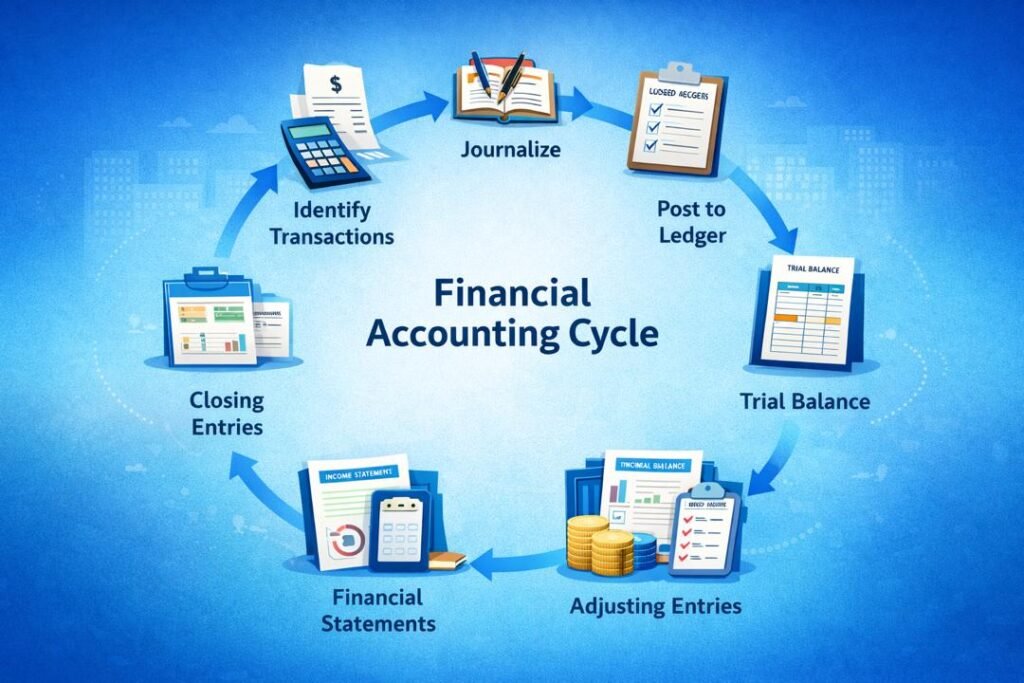
The financial accounting cycle is defined as the process of accounting that involves the registration of financial transactions, categorization of financial transactions, generalization of financial transactions, and the reporting of financial transactions during a particular accounting period. The cycle usually assumes the following stages:
- Identifying transactions
- Journalizing transactions
- Posting to ledgers
- Preparing the trial balance
- Making adjusting entries
- Financial statements preparation.
- Closing entries
All the stage is based on the previous stage, and no transaction will be missed or reported improperly. The cycle is reiterated on a monthly, quarterly, or annual basis of the accounting period and this offers up to date financial information to the stakeholders.
1. Identifying Transactions
Identifying and analyzing business transactions is the initial stage of financial accounting cycle. All the events that take place in a business do not count as accounting transactions. To be recorded such an event must:
- Engage a quantifiable amount of money.
- Impact the financial status of the firm.
- Have sound documentation support.
Examples of Transactions
- Cash purchase of inventory.
- Salary payment of employees.
- Income of customers in the form of cash.
- Borrowing money from a bank
- Sale of goods on credit
Non-financial events: Non-financial events are not entered in unless they have an ultimate financial impact, e.g. new employee not paid immediately.
Importance of Documentation
Evidence of transactions includes the use of source documents, like invoices, receipts, contracts, and bank statements. Accountability is guaranteed through proper documentation and assists internal and external audits.
Proper identification is very important since any errors at this point may trickle down the line of the whole accounting process.
2. Journalizing Transactions
The identification of transactions is followed by a record made in the general journal. This is referred to as journalizing.
The Role of the Double-Entry Accounting
Contemporary accounting is based on the dual entry system where any transaction has to have an impact on at least two accounts. The accounting equation must be that each transaction obeys:
Assets = Liabilities + Equity
Each debit entry must have an equivalent amount of credit entry. This provides equilibrium and internal consistency.
Format of a Journal Entry
In a journal entry, one is likely to have:
- Date of transaction
- Debiting and crediting of accounts.
- Amounts
- Brief description
Example
In the case of a company that buys office supplies in the amount of cash 1,000:
- Debit: Office Supplies $1,000
- Credit: Cash $1,000
This entry raises supplies (asset) and cash (asset).
Importance
Journalizing is a method of making chronological record of transactions. It is the initial official record keeping process and offers a distinct audit trail.
3. Posting to the Ledger
Once the transactions have been recorded in the journal they are moved to the ledger. Posting is known as this process.
What Is a Ledger?
The ledger may consist of separate accounts, including:
- Cash
- Accounts Receivable
- Inventory
- Accounts Payable
- Revenue
- Expenses
All the accounts contain all the transactions that affected it in the period.
Purpose of Posting
The journal keeps the transactions in chronological order whereas the ledger keeps the transactions in account order. This makes it easier to:
- Determine account balances
- Monitor transactions of individual accounts.
- Get ready financial overviews.
By way of illustration, all the entries that involve cash are summed up in Cash account in the ledger.
Accuracy and Cross-Referencing
Posting assures a transfer of debit and credit amounts of journal entries in the right way. Traceability is ensured by cross-references between journals and ledges.
4. Preparing the Trial Balance
Accountants make a trial balance at the end of the accounting period.
What Is a Trial Balance?
A list of all balances of ledger accounts at a particular date is referred to as a trial balance. It confirms that total debits are equal to total credit.
Structure
The trial balance includes:
- Account names
- Debit balances
- Credit balances
Provided that the total debits are equal to total credits then the books are said to be mathematically balanced.
Limitations
Although arithmetic correctness is checked by the trial balance, it fails to check:
- Omitted transactions
- Wrong classification of accounts.
- Compensating errors
However, it is one of the most important points in financial accounting cycle.
5. Adjusting Entries
Not every transaction is registered instantly. Other expenses and revenues are long term and need to be adjusted at the end of the period.
Purpose of Adjusting Entries
Adjustments to entries make financial statements to reflect:
- The accrual accounting basis.
- Matching principle (revenues are matched with expenses)
- Proper asset and liabilities.
Common Types of Adjustments
1. Accrued Revenues: Revenue that is earned, but not received.
2. Expenses Incurred but not paid: Accrued Expenses.
3. Prepaid Expenses: Prepayments.
4. Unearned Revenue: Cash before services are rendered.
5. Depreciation: The cost of asset is charged to the useful life.
Example
In case of accrued rent of rent of $2,000, which has not been paid:
- Debit: Rent Expense $2,000
- Credit: Rent Payable $2,000
Modifications make sure that financial statements give a clear picture of the financial position of the organization.
6. Financial Statements Preparation.
Once the adjustment has been made, it is followed by an adjusted trial balance. It is on this basis that financial statements are built.
Main Financial Statements
Income Statement
- Records revenues and expenditures.
- Establishes net profit or loss.
Retained earnings statement
- Discloses variations in retained earnings.
- According to dividends and net income.
Balance Sheet
- Records assets, liabilities and equity.
- Records financial status as at a given date.
Statement of Cash Flows
- Displays cash receipts and payments.
- Divided into operating, investing and financing activities.
Interrelationship
The financial statements are related:
- The income statement produces net income which is invested in retained earnings.
- Retained earnings are reported in the equity part of the balance sheet.
- The changes in cash are represented in the statement of cash flows.
Importance
The financial statements inform the stakeholders with the necessary information to:
- Investment decisions
- Credit evaluations
- Performance assessments
- Regulatory compliance
It is the step that converts raw accounting information into significant reports.
7. Closing Entries
Closing entries is the last part of the financial accounting cycle.
Purpose
Temporary accounts (revenues, expenses, dividends) are closed with an entry of zero during the following period of accounting.
Process
- Close to Income Summary to revenue Accounts.
- Take expenses (sums to income) to Income Summary.
- Close Income Summary to Retained Earnings
- Close Dividends Retained Earnings.
Permanent accounts (assets, liabilities, equity) are open.
Result
Following the closing, a post-closing trial balance is made up to make sure that only permanent accounts are left and that debits balance credits.
Procedural Discipline and Accuracy
The financial accounting cycle will guarantee:
- Consistency in recording
- Verification through multiple check points.
- Adherence to the accounting standards.
- Stakeholder transparency.
All of the stages are control mechanisms. For example:
- The arithmetic accuracy is checked by the trial balance.
- Adjusting entries assure compliance of accruals.
- Entry closure is used to prepare the system to the next cycle.
This process discipline minimizes the occurrence of mistakes, promotes reliability and improves the stakeholder confidence.
The Continuous Nature of the Cycle
Management accounting cycle is not a single process. It recurs on a periodical basis. Businesses continuously:
- Record new transactions
- Adjust accounts
- Prepare reports
The accounting software has made the process of automation much easier; however, the conceptual structure has not been changed.
Real-life example of the Cycle
Take the case of a small service company in one month:
- Clients provide it with cash amounting to 10,000.
- Pays $3,000 in salaries.
- Purchases equipment for $5,000.
These transactions are:
- Identified
- Journalized
- Posted
- Included in trial balance
- Adjusted (e.g., depreciation)
- Those are reported in financial statements.
- Closed at period-end
This systematic movement is such that all money is kept track of and reported in the right manner.
Importance for Students and Professionals
Making sense of the financial accounting cycle is important so as to:
- Students of accounting learning basics.
- Small business entrepreneurs.
- Reports being interpreted by financial analysts.
- Auditors in checking compliance.
It gives the understanding of the way financial information transforms into a complex transaction to organized financial statements.
Conclusion
Financial reporting is supported by financial accounting cycle. It converts raw transaction data into systematic, trustworthy and significant financial statements via a rigorous and methodical procedure.
Since it all starts with the identification of transactions then moves on to journalizing, posting, trial balances, adjustments, preparation of financial statements, and closing entries, all these steps help in making the financial reporting to be accurate and complete.
Through this systematic process, the organizations are able to be transparent, maintain a sense of accountability and give reliable financial information to the stakeholders. Finally, financial accounting cycle is not only a technical process, but it is also a system that enables proper financial control and correct decision-making process in any company.
Get more well researched information about the financial accounting cycle here.