Abstract
Traditionally, copy editing was a key process of maintaining accuracy, clarity, and consistency in the process of newspaper production. The use of digital publishing technologies contributed to the decline of manual tools and established editorial practices, such as page-based proofreading on paper manuscripts, institutional-wide editing symbols, official institutional stylebooks, and hard-copy page layouts, before the rise of digital publishing technologies. This paper investigates the traditional tools and practices involved in copy editing and appraises their contribution towards influencing the newsroom processes and editorial quality. The article presents qualitative historical and conceptual analysis, using which the issues of manual editing practices and their impact on journalism professionalism and institutional credibility were examined. The results show that the traditional copy editing systems have been able to create sustainable editorial values such as accuracy, uniformity, responsibility, and cooperative workflow, which are still instrumental in the current digital copy editing contexts. Even in the modern world with advanced technology, the historical processes of contemporary editorial practice have deep roots. The paper concludes that the scoop into the traditional copy editing methods is very useful to the present-day newsroom requirements and that the subject of human editorial judgment in reporting is still relevant to date.
Keywords: copyediting, newspaper editing, proofreading, newsroom work, editorial practices, newsroom history.
1.0 Introduction
Copy editing is one of the most essential processes of the newspaper production, and it is the quality control process that converts the raw journalistic material into publishable news. In history, prior to the mainstream use of computer-assisted editing, newspapers relied on organised manual systems to perfect language, check facts and standardise the presentation.
Conventional newsrooms worked under well-orchestrated editorial processes that used physical copies in the form of manuscripts, hand-written notes, and group work processes. The editors used the traditional practices to make sure that the stories published were in line with professional and ethical practices. All these practices were the basis of the operations of the contemporary editors.
The historical methods used in copy editing portray the way journalism established the mechanisms of ensuring credibility and linguistic continuity among publications. Although editing now is largely based on digital tools, most of the principles of editing date back to manual editing in the past.
This paper will discuss the traditional copy-editing tools and practices in newspaper systems, and how they have contributed to the history of newspaper production, and their enduring effects on newspaper journalism today.
2.0 Literature Review
Academic explanations of copy editing focus on the role it plays in protecting the journalistic credibility and readability. According to Einsohn and Schwartz (2019), copy editing can be defined as both a linguistic and analytical procedure that provides clarity, coherence, and observance of stylistic conventions. Throughout research on newsrooms, it was found that editorial gatekeeping played an important part in preserving professionalism in the mass communication (White, 1950).
The historical analysis reveals that the newsroom activities during most parts of the twentieth century were characterized by manual editorial processes (Franklin, 2005). Reduced error in production meant that editors communicated effectively with typesetters and proofreaders by use of physical manuscripts and common symbols of correction.
According to McKane (2014), stylebooks ensured institutional identity by fostering an editorial voice, and Harrower (2018) clarifies that proofreading became a practice in defence of the expensive errors of printing. The modern studies indicate that the digital editing technologies are more of duplicating than substituting the traditional editing (Lopez-Garcia et al., 2017).
3.0 Conceptual Review
3.1 Editorial Quality Control as Copy Editing
One can conceive of copy editing as a complex process, which entails grammatical correcting, structure refining, style matching, and fact checking. The old form of editing focused on interpretation and did not emphasize on mechanical correction.
3.2 Practices in manual proofreading
In manual proofreading, the editors were forced to read through the manuscripts several times with emphasis on modifying the manuscripts in terms of clarity, grammar, and factuality. Typeset proofs were checked in comparison with original copies by the proofreaders to identify errors in production.
3.3 Stylebooks as Standardization Mechanisms
Stylebooks were sets of codified editorial principles on spelling, capitalization, abbreviations and journalistic style. Such sources were used to provide uniformity in extensive amounts of printed literature.
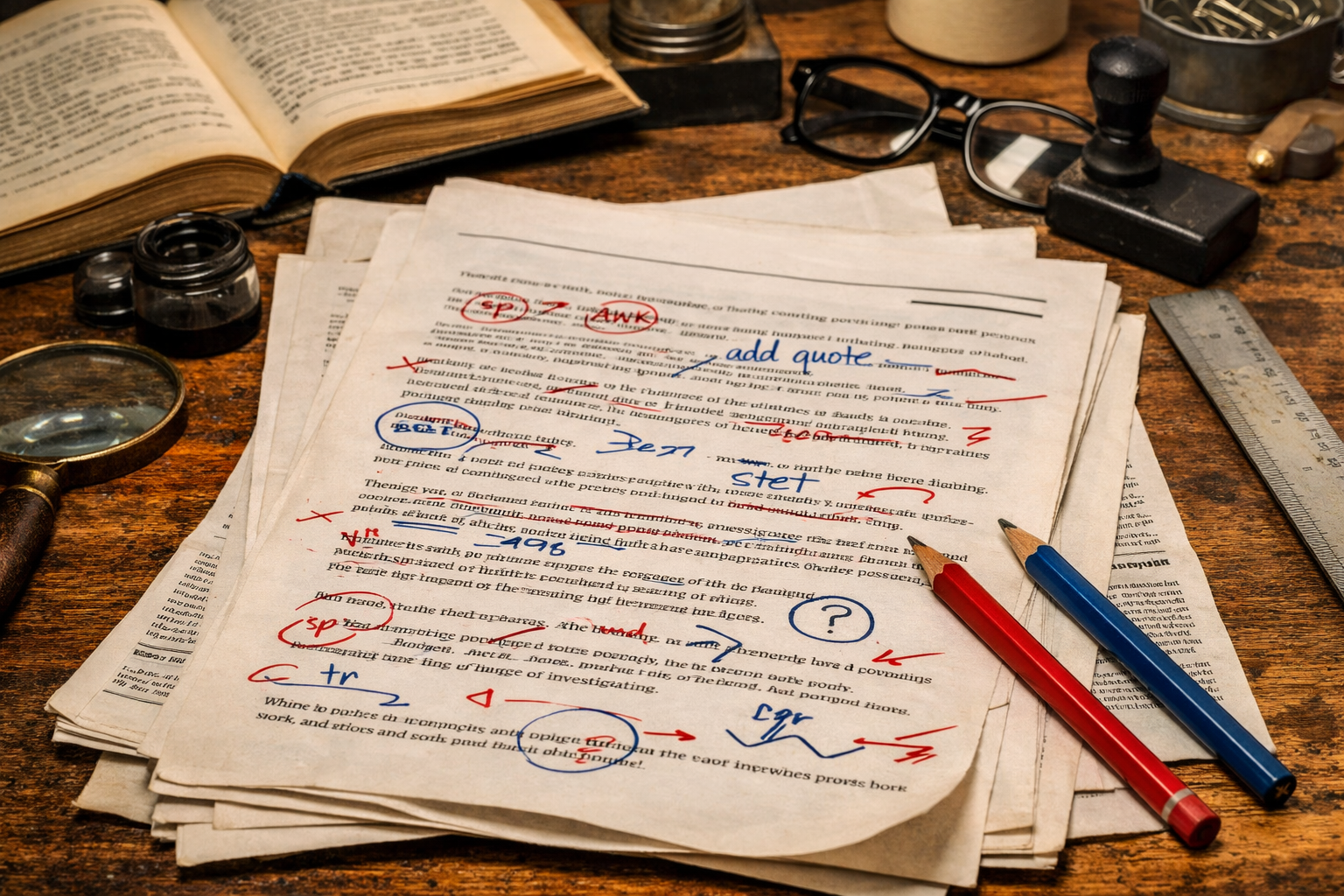
3.4 Revising Marks as Professional Communication Resources
Standard editing symbols were used as a professional language that allowed an efficient cooperation between editors and typesetters when strict deadlines were to be met.
3.5 Hard-Copy Layout Systems
The hard-copy layout entailed laying out printed columns, headlines and pictures onboard. Placement decisions including those of the edition affected the saliency of a story and how it would be interpreted by the reader.
4.0 Methodology
The research design used in this work is a qualitative, historical and conceptual study with an objective of finding out the conventional newsroom practices.
The methodology of the research involves:
- Document Analysis: The analysis of academic literature and manuals of professional editing.
- Historical Analysis: Newsroom operations before digital publishing.
- Synthesizing Concepts: Theoretical approaches to editorial gatekeeping and institutional communication.
Through this style of interpretation, editorial practices can be studied as social and professional systems and not necessarily as technical processes.
5,0 Theoretical Framework
5.1 Gatekeeping Theory
The Theory of Gatekeeping describes how editors control the circulation of information to be published (White, 1950). The copy editors used to be the institutional gatekeepers who were in charge of deciding on the understanding of clarity, relevance and accuracy.
5.2 Media Institutional Theory
The media institutional theory implies that newsroom practices influence journalistic work (Shoemaker and Reese, 2014). The use of traditional tools in editing instituted orderliness and standardization of the news-making production processes.
The combination of these theories explains the impact of the practice of manual editing on the newsroom structure and journalistic reputation.
6.0 Findings
The review pinpoints a number of distinguishing features of the conventional copy editing:
6.1 Organized Editorial Process
The production of the newspapers underwent consecutive steps with reporters, copy editors, proofreaders, and layout editors, so that there are several levels of examination.
6.2 Human-Centered Editorial Judging
The contextual interpretation and professional experience of the editors were extensively used more than automatic correction systems.
6.3 Standardization by use of Stylebooks
Institutional identity and credibility to the readers were enhanced by editorial consistency.
6.4. Effective Interchange of Information through Editing Symbols
Unified correction marks facilitated quick communication between the personnel in the newsroom.
6.5 The integration of editing and design
Hard-copy layouts linked textual editing and visual narration, affecting the news hierarchy and the participation of the audience.
7.0 Discussion
As has been shown by the fact that traditional editorial principles are still there, technological innovation has not changed editorial philosophy; it has changed the tools. Digital platforms implement the same principles as previous manual practices in terms of tracking changes, collaborative editing systems, and electronic style guides.
There was also a sense of mentorship and responsibility in the traditional newsroom practices that was as a result of direct collaboration. Although digital workflows are effective in enhancing efficiency, they might decrease interpersonal editorial interaction, which is historically effective in promoting professional development.
The results support the opinion that human editorial judgment is still unreplaceable. Technical mistakes can be identified by automated systems, but they are not capable of assessing the situation, equity, or plot complexity.
8.0 Conclusion
The production of newspapers relied on the conventional copy editing apparatus and standards as the basis of operation and ethics of newspapers. The process of manual proofreading, editing symbols, institutional stylebooks and hard-copy layouts entrenched systematic methods of accuracy and consistency that have survived to influence the present-day journalism.
Although technology changes very fast, these historical practices continue to have a deep influence on contemporary editorial workflow. The knowledge of the traditional copy editing has been a great way of gaining some much-needed knowledge on the long-held standards that maintain journalistic integrity.
Future studies can consider how human expertise and artificial intelligence can be combined in hybrid editorial systems to retain such foundational principles and acclimate to changing media conditions.
References (APA 7th Edition)
Einsohn, A., & Schwartz, M. (2019). The copyeditor’s handbook (4th ed.). University of California Press.
Franklin, B. (2005). Key concepts in journalism studies. Sage Publications.
Harrower, T. (2018). Inside reporting: A practical guide to the craft of journalism. McGraw-Hill Education.
López-García, X., Rodríguez-Vázquez, A. I., & Pereira-Fariña, X. (2017). Technological convergence in newsrooms. Journalism Practice, 11(10), 1239–1255.
McKane, A. (2014). News writing. Sage Publications.
Shoemaker, P. J., & Reese, S. D. (2014). Mediating the message in the 21st century. Routledge.
White, D. M. (1950). The “gatekeeper”: A case study in the selection of news. Journalism Quarterly, 27(4), 383–390.