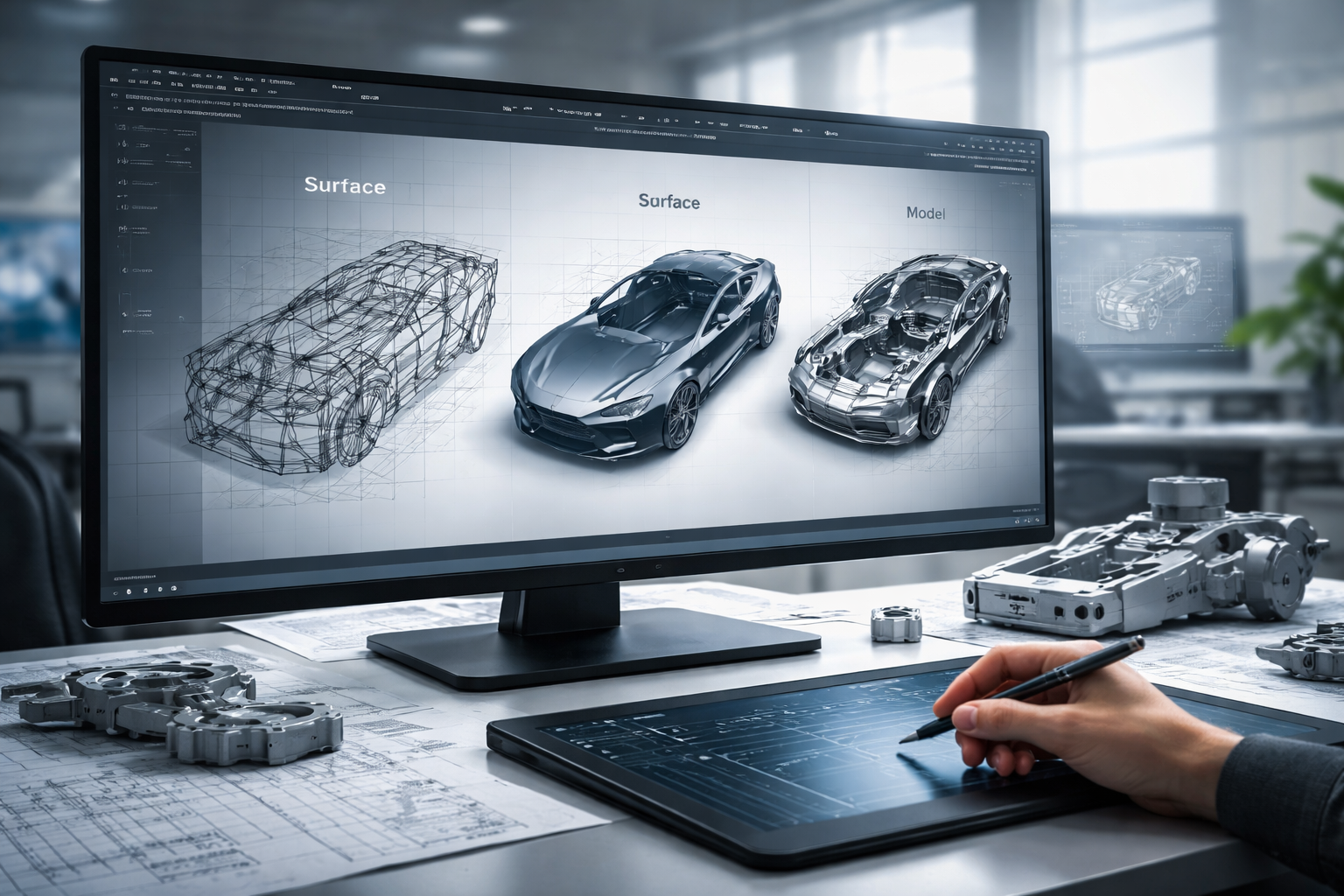
Modern engineering design, computer-aided design (CAD), animation, manufacturing, and simulation is based on geometric modeling. Designers use digital representations of the objects well before they are actually produced, whether it is a car part or an aerospace component or a consumer electronics component. Wireframe, surface, and solid modeling are some of the major geometric modeling techniques that can be considered fundamental in determining the way digital shapes are created, represented, and edited.
To gain a wider technical context of these modeling techniques, it is better to know not only their definitions, but also the difference between them on a structural and functional level. In this paper we have made an in-depth comparative study of the wire frame, surface and solid modeling including their structure, strengths, shortcomings and practical uses to understand when each of them is most efficient.
Knowledge on Geometric Modeling
Geometric Modeling is the concept that has been established to assist in the understanding of the features of biological systems. The term geometric modeling is used to describe the mathematical modeling of three-dimensional (3D) objects in a computer environment. These representations enable the engineers and designers to:
- Imaginatively design products prior to production.
- Examine structural and physical behaviour.
- Perform simulations
- Nurse production drawings.
- Produce components through CNC or additive manufacturing.
The three major modeling models wireframe, surface, and solid have differences in terms of the way they portray geometry, store data and the interaction possibility.
Wireframe Modeling
Wireframe Modeling Structure
The oldest and the simplest 3D is the wireframe modeling. It represents objects using:
- Points (vertices)
- Lines (edges)
- Curves
In this technique, a skeletal structure of the object is defined only. The surfaces and volumes are absent, only the outline of the structure. Wire frame models are made of coordinate points already linked by lines or arcs in the 3D space. There are these edges defining the shape but not the interior and exterior areas.
Posits of Wireframe Modeling
- Minimal computing power – Wireframe models do not need much processing power.
- Quick sketching and editing – The designers are able to sketch out complex frameworks in a short period of time.
- Transparent internal features – There are no surfaces on any of the edges.
- Best when conceptual designing required – Best when it comes to preliminary ideation.
Weaknesses of Wireframe Modeling
- There is no surface or volume information – Mass, volume, or material properties cannot be calculated.
- Problem of ambiguity of interpretation – Line overlaps will produce visual ambiguity.
- Inappropriate to manufacture – Data in manufacturing must be surface or solid.
- Weak simulation properties – FEA and CFD require more complicated geometry.
Application Case Studies of the Wireframe Modeling
- CAD Preliminary concept drawings.
- Structural layout planning
- Simple mechanical linkages
- Geometric forms illustrated by education.
Wireframe modeling is best suited when the early design phase is being undertaken, speed and conceptual mastery are at a higher value than physical realism.
Surface Modeling
Surface Modeling Organizational Structure
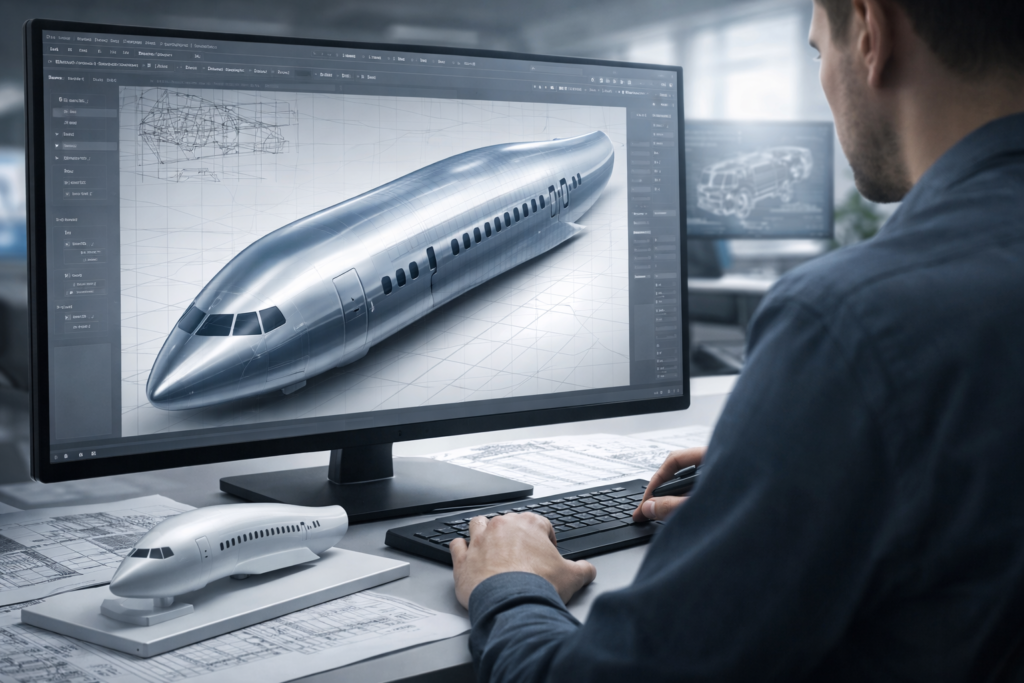
Surface modeling is an extension of wireframe modeling into mathematical surfaces between boundary curves. This technique defines:
- Curved surfaces
- Parametric patches
- Non-Uniform Rational B-Splines and splines.
Surface models, in contrast to solid modeling, only define the outer skin of an object and do not by themselves have any volume. Parametric equations are used to describe surfaces so that the curvature and smooth transitions may be controlled.
Surface modeling has the following benefits
- Large geometric flexibility – Complicated organic and aerodynamic shapes are possible.
- Better curvature control – DM designers are able to control smoothness and continuity (G1, G2, G3).
- An excellent surface modeling – Body Auto and consumer products surface modeling used.
- Improved lighting – Surfaces are realistic to render/shade.
Surfacing Shortcomings of Surface Modeling
- No intrinsic definition of volume – Properties of mass have to be converted to solid models.
- Increased complexity – Requires high skill and control on continuity.
- Possible gaps/ inconsistencies – Unjoined surfaces can lead to manufacturing mistakes.
- Refining time consuming – Precision surfacing involves a process of iteration.
Real-life Applications of Surface Modeling
- Automotive exterior design
- Aerospace fuselage shaping
- Industrial product design
- Electronics casing Consumer electronics casing.
- Imagery and action effects.
Surface modeling is best used where the form, aerodynamics, and physical attractiveness are paramount.
Solid Modeling
Structure of Solid Modeling
Solid modeling is the full 3D objects that have the volume. In solid models, unlike wireframe and surface models, solid models contain:
- Surfaces
- Edges
- Vertices
- Enclosed volume
Two primary approaches:
- Boundary Representation (B-Rep) – A solid is defined in terms of bounding surfaces which form a volume.
- Constructive Solid Geometry (CSG) – Solids are built by operations with primitive objects (cube, cylinder, sphere): union, subtraction, intersection.
Both topology and geometry are mathematically defined in solid modeling, allowing physical simulation to be done correctly.
The benefits of Solid Modeling
- Full physical representation – Mass, density, volume, and center of gravity can be determined.
- Preparedness to manufacture – CNC machined and 3D printed.
- High level of compatibility and simulation – Structural, thermal and fluid.
- Less ambiguity – Interior and exterior are well defined.
- Parametric modification – Feature-based modeling is easily updated.
Shortcomings of Solid Modeling
- Increased computing power – Consumes increased memory and processing resources.
- Less easy with complex freeform shapes – Organic shapes might be required to be surface modelled initially.
- Steeper learning curve – Feature-based learning is based on the structured thinking.
Active Applications of Solid Modeling
- Mechanical component engineering.
- Production and textile production.
- Structural engineering
- Medical device modeling
- 3D printing
Solid modeling is best used in cases where accuracy, manufacturability and the accuracy of simulation are demanded.
Comparison of the Surface, Solid Modeling and Wireframe
Structural Differences
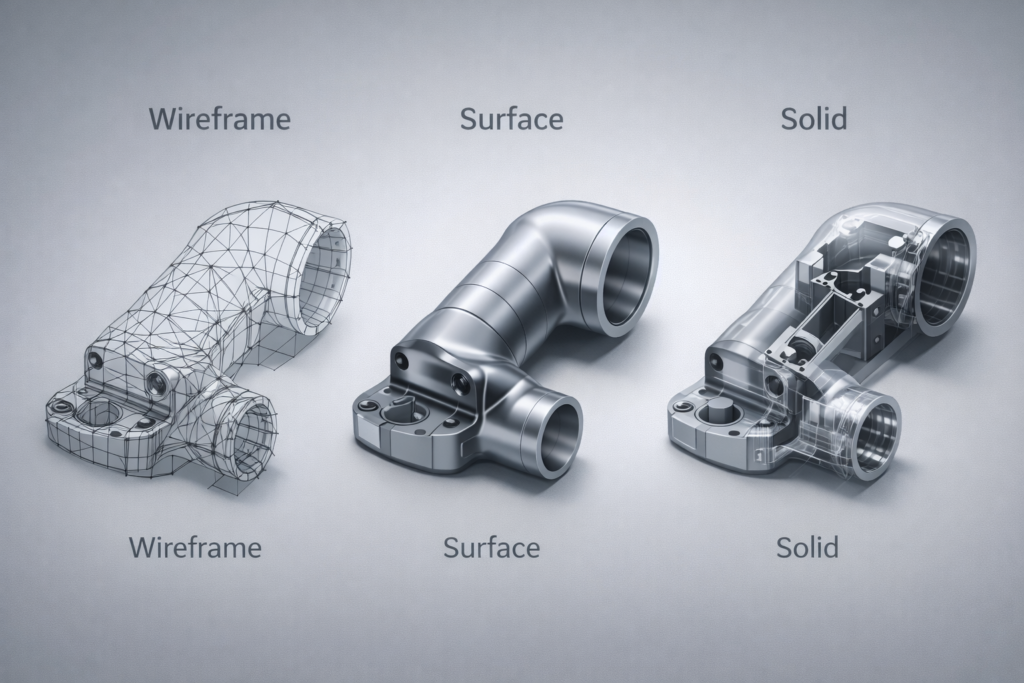
| Characteristics | Wireframe | Surface | Solid |
| Representation | Points and lines only | Surfaces only | Surfaces and volume |
| Volume Data | No | No | Yes |
| Mass Properties | No | Limited | Yes |
| Complexity | Low | Medium to High high | High |
| Suiting Appropriateness | Poor | Moderate | Excellent |
In wireframe models, edges are described only. Topical designs determine the outer skin. Whole bodies in 3D are characterized by solid models.
Technical Distinctions
- Data Structure – Vertex-edge lists: Vertex-edge lists Data Structure – Surface: Parametric patches: Surface Data Solid: Topological + geometric data: Vertex-edge lists Surface: Parametric patches.
- Simulation Capability – Wireframe The capability of simulation is minimal; Surface The surface simulation is limited; Solid Full structural simulation.
- Editing Flexibility – Highly flexible but ambiguous: Wireframe: Surface: Parametric feature modification: Highly flexible but ambiguous; Solid:
When each modeling technique can be used
- Wireframe: Ideas sketches, architecture, meager computing resources.
- Surface: Organic/aerodynamic shapes, visually refined products, continuity of curvature.
- Solid: Preparation of manufacture, engineering analysis, physical property computations.
These techniques are frequently combined in modern workflows, where wireframe is used to start with, surfaces are added to it and solid models are created to use in final production.
Smooth collaboration in Contemporary CAD systems
- Create a wireframe sketch
- Create surfaces using boundary curves.
- Introduction of surfaces into a closed solid.
- Add parametric features
The methodology is a layered approach because it employs the strong points of each modeling method with reduced weaknesses.
Merits of Comparative Understanding
- Improved design efficiency
- Better tool selection
- Reduced modeling errors
- Improved communication within the team
- Kaizen simulation preparation
Selecting the right modeling process will guarantee that the data is accurate, no errors are generated, and it will aid the manufacturing preparedness.
Applications in the real-world industry
- Automotive: exterior surface modelling, solid modeling engines.
- Aerospace: solid structures, surface modeling of aerodynamic shells.
- Design of products: Surface design: Aesthetic modeling, Solid design: Durability.
- Architecture/Construction: The BIM systems are analyzed using solid modeling.
Conclusion
The geometric modeling revolves around wireframe, surface and solid model. They have their peculiarities:
- Wireframe: Simple and quick and best suited when it comes to conceptual design.
- Surface: Control of shape to a minimum, perfection in aesthetics and aerodynamics.
- Solid: Full physical model, suitable to simulation and production.
These methods are complementary to each other in contemporary processes. The knowledge of their differences positively influences the designers and engineers to make wise decisions which enhance efficiency and accuracy in creating digital products.