Abstract
Copy editing is an inherent part of professional journalism, and the aspect has been under-researched in scholarly literature as compared to reporting and investigative duties. This paper discusses copy editing process in journalism and how the process of refining language, grammar, structure, style and fact testing takes place before it is published. The article uses the available literature in media studies, newsroom practice and communication theory to discuss how the editor role holds accountability in upholding house style, ethical accountability and clarity and coherence. Based on qualitative document analysis of academic literature and newsroom guidelines, the paper reveals some fundamental steps of the copy editing process to the structural review, linguistic correction, fact verification, and enforcement of style. The results show that copy editing is not only a process of mechanical correction but a gatekeeping/quality-control process that guards credibility, lessens the risk of litigation and enhances audience trust. The argument places copy editing in the context of gate keeping theory and professional ethics in the argument that editorial refinement is a major factor in news meaning and perception by the people. The analysis comes to the conclusion that copy editing is the key to journalistic professionalism and should be given more scholarly and institutional attention.
Keywords: Copy editing; newsroom practice; newsroom journalistic standards; newsroom gate keeping; newsroom house style; newsroom ethics; newsroom editorial process.
Introduction
Journalism is founded on fact, clarity and persuasion. When reporters collect information and write stories, an essential step in transforming a manuscript into publishable news is the copy editing. Journalism copy editing work is the systematic modification of news material to fit linguistic, stylistic, moral, and structural criteria and publish it.
The copy editing is often viewed as a simple correction of grammar but, according to the academic literature, it has a wider scope of functions in making sure of coherence, historical accuracy, and institutional continuity (Harcup, 2015). The assessment of the editors is based not only on the language mechanics but also on the narrative structure, the legal risk, impartiality, and the correspondence to the guides of the organizational style.
Even though the world is evolving with the advent of technology and the acceleration of the rate at which digital journalism is being published, the process of copy editing is still a staple of the newsroom. The paper discusses the theoretical relevance, conceptual bases, and practical phases of copy editing, by making it an important quality control mechanism of the present day journalism.
Literature Review
The analysis of scholarly literature on journalism has traditionally been involved with reporting, news values, and media effects, but the editorial functions play an equal role. Tuchman (1978) explained that news production is a process that has been created socially through institutional routines. Copy editing is an aspect of these routines, which is a filter of the presentation of the text before its spread to the public.
Shoemaker and Reese (2014) noted that the organizational norms and hierarchies affected the newsroom practices. The copy editors work within this structure to maintain consistency and professionalism. Their work has concurred with the gatekeeping processes, where the decision made regarding wording, framing and structure impacts on how the information will be presented to the audiences.
According to one of the studies by Harcup (2015), editorial oversight brings out greater credibility by minimizing the possibility of factual inaccuracy and linguistic ambiguity. Moreover, the body of media law research emphasizes the role of the editor to avert defamation and other unethical acts (McQuail, 2010).
Research in digital journalism has also noted that the pace of publishing can undermine the conventional editorial protection (Franklin, 2014). Yet, copy editing still acts as a quality gateway even in the online setting.
Conceptual Review
Defining Copy Editing
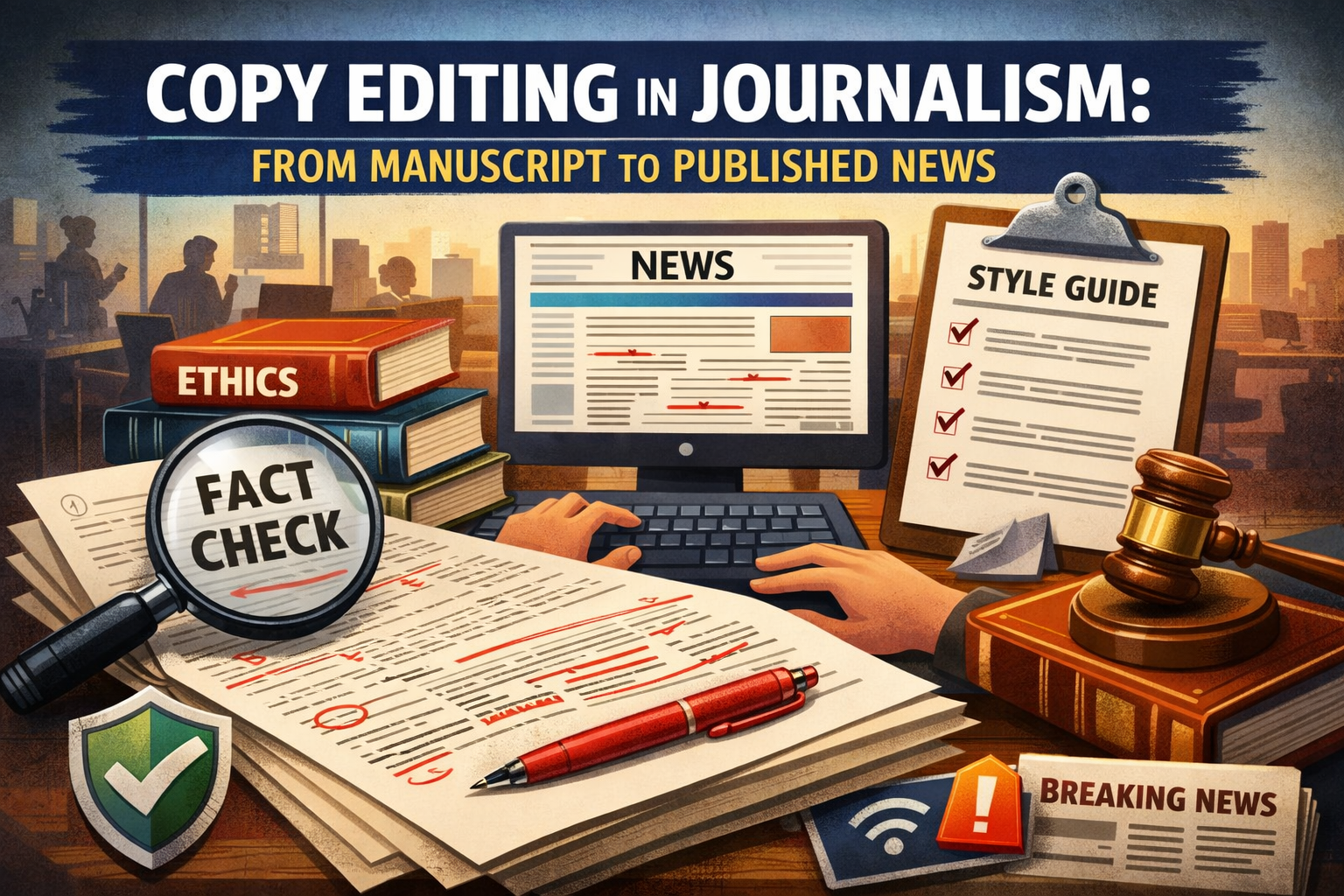
Copy editing is a method of conducting a review and updating written work before it can be published. In journalism, it involves correction of grammar and punctuation marks, rephrasing content to make it understandable, fact-checking and house style.
Core Components
Tasks that are normally undertaken during the copy editing process include:
- Language Correction – Punctuation, grammar, spelling, and syntax corrections.
- Structural Editing – Making sure that there is a logical structure and that structure is followed by the inverted pyramid format.
- Fact Checking – Checking the names, dates, statistics, and quotations.
- Style Enforcement – The use of newsroom-specific rules concerning capitalization, abbreviations and formatting.
- Ethical Screening – Discovering biased language, defamatory or privacy breaches.
All these elements make the manuscript go beyond draft writing to a professional news production.
Methodology
The research design in this study is a qualitative study design that will be based on document analysis. The academic books, peer-reviewed journal articles, newsroom manuals, and texts on media theory were analyzed and common themes were discovered in connection with copy editing.
The analysis focused on:
- Accounts of newsroom processes.
- Theoretical explanations of gatekeeping.
- Code of ethics and editorial standards.
- Accuracy and credibility in journalism studies.
The results were grouped by applying thematic coding to structural, linguistic, ethical, and organizational aspects of copy editing.
Theoretical Framework
Gatekeeping Theory
The theory of gatekeeping describes the nature of information screening prior to its exposure to the society (Shoemaker and Reese, 2014). The copy editors are the minor gatekeepers who purify the language and the structure so as to match the institutional and ethical guidelines. Their choices have an effect on framing, focus and clarity.
Professionalism Theory
Accuracy, objectivity and accountability are some of the norms of professionalism in journalism (McQuail, 2010). These norms are operationalized in copy editing, which entails the precision of text and the consistency in style.
Findings
The examples of literature and newsroom practices analysis indicate several important findings:
Copy Editing Increases Credibility
Correct grammar and factual information minimizes the threat of misinformation. The editorial review gives news organizations added credibility to the audience.
It Holds Institutional Identity
The consistency of house styles strengthens brand image. The similarity of formatting and terminologies is what separates this publication from that one.
It Minimizes Legal Risk
Media houses are also shielded against lawsuits by having defamatory words and unsustainable statements filtered out by the editors.
It Improves Readability
The logical order of the sentences and clarity in sentence structure make the sentences easier to understand.
Discussion
The results confirm that copy editing goes beyond technical correction. In the editorial refinement, in a gate keeping perspective, news is interpreted in different ways by the audience. Framing can be subtly influenced by decisions on word choice, phrasing of the headline and emphasis on the structure.
Moreover, when dealing with digital journalism, where speed is at times the competition of accuracy, the copy editor becomes more of a necessity. Although the use of automation can help in grammar checking, the human editors offer some contextual judgment that cannot be fully experienced by technology (Franklin, 2014).
The paper also shows a conflict between quality and speed. With the decreased number of staff and higher production demands in newsrooms, editorial supervision can be narrowed. However, the undermining of copy editing standards will pose a threat to reputational loss.
Conclusion
Copy editing is an indispensable part of the production of journalism. It edits crude manuscripts into clear, precise and professionally organized news materials.
This paper will prove that the copy editing process serves as a gate keeping mechanism and a system of professional standards enforcement through theoretical analysis and literature review.
References
Franklin, B. (2014). The future of journalism: Developments and debates. Routledge.
Harcup, T. (2015). Journalism: Principles and practice (3rd ed.). Sage Publications.
McQuail, D. (2010). McQuail’s mass communication theory (6th ed.). Sage Publications.
Shoemaker, P. J., & Reese, S. D. (2014). Mediating the message in the 21st century: A media sociology perspective (3rd ed.). Routledge.
Tuchman, G. (1978). Making news: A study in the construction of reality. Free Press.