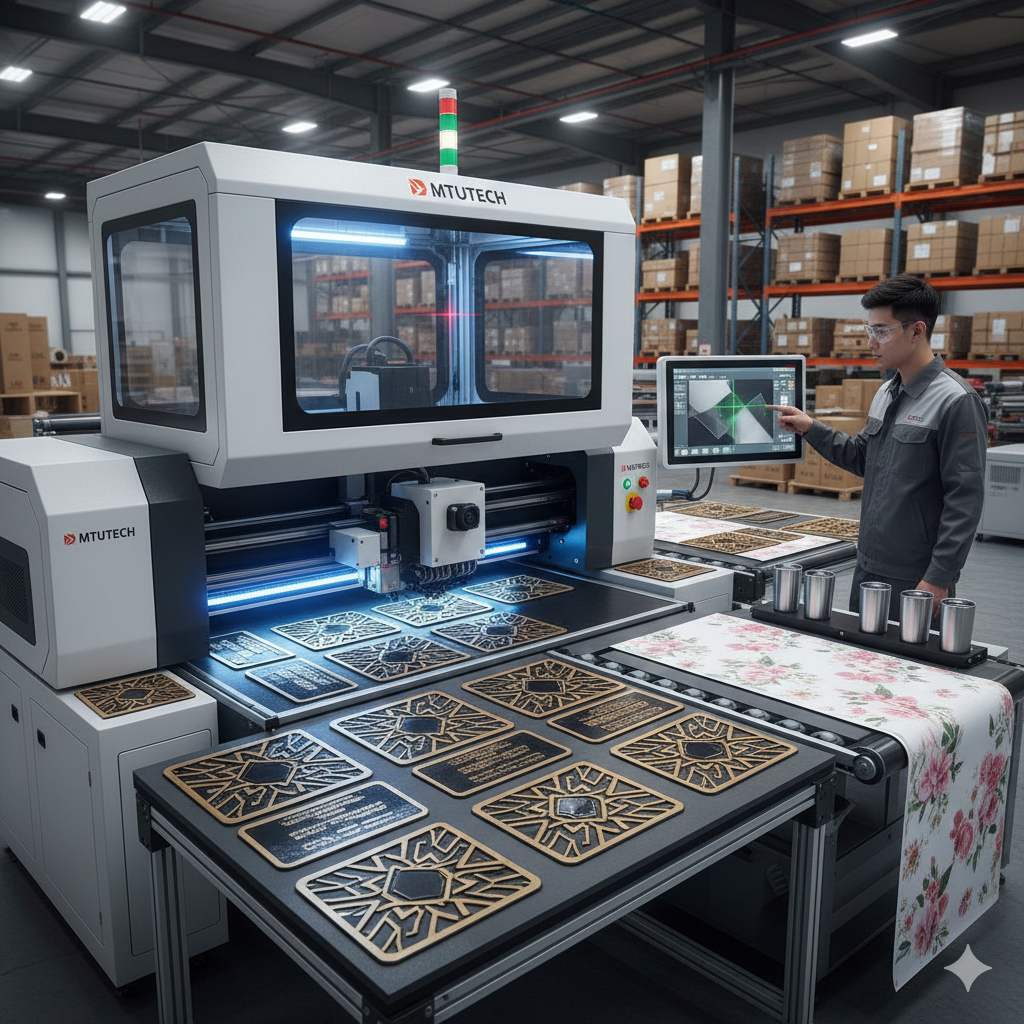
Visual positioning UV printers are revolutionizing printing workflows by combining high accuracy with automation. These machines use integrated camera systems to scan substrates before printing, ensuring that artwork lands precisely on each object. Businesses that adopt this technology significantly reduce material waste and reprints. With applications across promotional products, signage, awards, and packaging, visual positioning UV printers streamline production for small, medium, and industrial-scale operations. Their flexibility allows printing on flat, curved, or textured surfaces without manual adjustments. By investing in a reliable visual positioning system, print shops increase efficiency, profitability, and client satisfaction while producing consistent, high-quality output.
How Visual Positioning UV Printers Work
Visual positioning UV printers rely on digital cameras mounted on the print carriage. These cameras scan each substrate for position, shape, and rotation before printing begins. Software then automatically adjusts the artwork to match the scanned surface, compensating for irregularities up to several millimeters. This eliminates human error and reduces reprint rates dramatically. By using real-time alignment, these printers maintain consistent registration across batches, even on warped or pre-cut materials. The combination of advanced sensors, AI visual positioning, and multi-layer ink control ensures accurate results on diverse substrates such as acrylic, metal, wood, glass, and promotional items, enabling businesses to meet tight deadlines without sacrificing quality.
Advantages of Camera-Based Positioning
Camera-based positioning provides several advantages over traditional manual setup printing. Operators no longer need to measure or align each substrate individually. Registration marks are automatically detected, and print placement is adjusted on the fly. This reduces setup time, eliminates costly errors, and maintains repeatable results across high-volume runs. Businesses printing curved or irregularly shaped products, like bottles or custom packaging, benefit from perfect alignment even with complex geometries. For industries requiring precision, such as medical labeling, electronics, or awards, camera-based positioning ensures regulatory compliance and enhances aesthetic quality. Overall, automation increases workflow speed and reduces labor costs, boosting operational efficiency.
Key Features of Visual Positioning UV Printers
Modern visual positioning UV printers include high-resolution cameras, multi-layer printing, CMYK+White+Varnish channels, and flat or cylindrical printing compatibility. Machines handle materials up to 180mm thick and support media widths ranging from 600mm to 2500mm. Rotary attachments allow printing on cylindrical objects like bottles, tumblers, or golf balls. Integrated UV curing systems ensure consistent adhesion and scratch-resistant finishes. Some models include AI visual positioning for irregular surfaces and automatic print height detection. These features enable businesses to produce high-quality prints on complex materials without manual adjustments. Compact models suit small product runs, while industrial models scale for high-volume production efficiently.
Applications of Visual Positioning UV Printers
Visual positioning UV printers are versatile across industries. Promotional product companies print phone cases, USB drives, pens, and custom gifts. Award and recognition businesses produce metal and acrylic trophies, plaques, and medals. Signage manufacturers create ADA Braille signs, wayfinding labels, and multi-panel wall graphics. Packaging companies print boxes, cosmetic jars, bottles, and containers with precise registration. Cylindrical items, including bottles and tumblers, are handled with rotary attachments. Additionally, these printers support specialty materials like leather, ceramic, foam, and corrugated board. This adaptability enables print shops to expand offerings, increase revenue, and fulfill complex custom jobs with precision and consistency.
Selecting the Right Model
Choosing the right visual positioning UV printer depends on business scale, substrate types, and production volume. Small-format models like the MT-UV 9060 Pro handle promotional items and small products efficiently. Hybrid models support both rigid and roll media for medium-sized shops. Large-format industrial models, such as MT-UV 2000HR and MT-UV 2513, accommodate architectural panels, home décor, and high-volume signage. Factors like maximum print height, media thickness, ink channels, and rotary compatibility should guide your selection. Testing sample materials before purchase ensures compatibility and allows operators to train on the system. Proper selection optimizes productivity while minimizing investment in underutilized features.
Printing Quality and Accuracy
Visual positioning UV printers deliver unmatched accuracy with tolerances under 0.1mm on most substrates. Multi-layer printing allows textures, embossing, and glossy effects, while cameras compensate for warped or irregular materials. High-resolution printheads ensure vivid colors with consistent registration on CMYK+White+Varnish layers. These features are crucial for applications requiring precise overlays, such as packaging with pre-printed logos or multi-panel wall graphics. Automated calibration reduces operator dependency and ensures consistent first-pass success rates above 95%, minimizing material waste and reprints. High precision enhances brand reputation, allowing businesses to produce professional-quality products reliably and efficiently.
Ink Types and UV Curing Systems
Visual positioning UV printers use specialized inks compatible with diverse surfaces. White underbase inks provide opacity on transparent or colored materials, while varnish layers add gloss or texture. UV curing systems adjust lamp intensity to match ink density and substrate type, ensuring full polymerization without tackiness. LED UV lamps are energy-efficient and provide consistent curing across complex multi-layer prints. Proper ink management ensures minimal waste, high color fidelity, and durability. Businesses benefit from long-lasting prints suitable for outdoor signage, awards, packaging, or decorative products. Efficient curing systems also reduce production times while maintaining premium output quality.
Maintenance and Technical Support
Regular maintenance is essential for optimal performance. Printheads should be cleaned frequently, UV lamps inspected, and software kept up to date. Many manufacturers provide remote technical support, guiding operators through calibration, troubleshooting, and routine adjustments. Having trained personnel minimizes downtime and ensures consistent output. Reliable support allows businesses to handle urgent jobs without delays, maintain color accuracy, and meet client deadlines. Periodic preventive maintenance extends equipment life and preserves alignment accuracy, which is critical for high-precision printing. Choosing a supplier with dedicated support ensures long-term ROI and uninterrupted production for businesses of all sizes.
Future Trends and Opportunities
Visual positioning UV printers are evolving with faster speeds, AI-assisted positioning, and modular printhead systems. Increased automation and broader substrate compatibility will expand applications in promotional, industrial, and custom markets. Sustainable low-waste printing and energy-efficient UV curing systems are gaining importance. Multi-layer printing, 3D textures, and cylindrical object capabilities open new revenue streams for innovative products. Print shops can adopt hybrid models for small-scale customization while scaling to industrial operations as demand grows. Staying ahead of these trends ensures competitiveness, higher client satisfaction, and profitable operations. Visual positioning technology represents the future of precise, high-efficiency UV printing.
- Q: What is a visual positioning UV printer?
A: A printer that uses integrated cameras to scan substrates and automatically align artwork for precise printing. - Q: How does visual positioning improve print accuracy?
A: The camera detects the substrate’s position, shape, and rotation, ensuring artwork lands perfectly even on irregular or curved surfaces. - Q: What types of materials can be printed?
A: Acrylic, metal, wood, glass, PVC, ceramic, leather, foam, corrugated board, promotional products, and cylindrical objects. - Q: What are the benefits for small businesses?
A: Reduced reprints, material savings, higher first-pass success rates, and the ability to handle custom jobs efficiently. - Q: Can visual positioning printers handle high-volume production?
A: Yes, industrial models maintain consistent accuracy across large-format panels and hundreds of pieces per day. - Q: How do UV curing systems work?
A: They polymerize ink using LED lamps adjusted for substrate type and ink density, ensuring durable, scratch-resistant prints. - Q: Are cylindrical objects compatible with these printers?
A: Yes, with rotary attachments, bottles, tumblers, and similar items can be printed with precise alignment. - Q: What features enhance precision?
A: AI visual positioning, multi-layer printing, height detection, and multi-printhead configurations improve accuracy on complex surfaces. - Q: How important is maintenance?
A: Essential. Regular printhead cleaning, lamp inspection, and software updates prevent downtime and ensure high-quality output. - Q: What future trends should businesses watch?
A: Faster speeds, AI-assisted positioning, hybrid UV solutions, 3D textures, and sustainable, energy-efficient printing systems.