Introduction
The effectiveness of any project, it might be in the field of business, education, construction, information technology or community development- is highly dependent on how well the project is planned, executed and controlled. Often the reason why many projects fail is not due to poor idea, but it is rather due to poor or unstructured process of managing the project. It is at this point that project life cycle comes in very handy.
Project life cycle is a methodical process that gives a project a direction on how to start and end the project. It divides the project into manageable phases and it becomes more convenient to plan the activities, resources allocation, track progress, and performance. Through these planned phases, project managers are able to exert control, minimize risks, prevent confusion and ensure that the objectives are met within the scope, time and budget constraints.
The present paper will discuss what a project life cycle can mean, examine the five major stages that it consists of, namely, the initiation, planning, execution, monitoring and control, and the closure, and identify the key activities and deliverables of each stage.
Knowledge about the project life cycle
Project life cycle is the steps that project passes through before it reaches its completion. It is a systematic way of project management through the breakup into rational stages. The stages have particular objectives, tasks, and output that are successful in the project success.
The project life cycle provides answers to three big questions in a simple manner:
- What needs to be done?
- When should it be done?
- What will we do to know that it has been successfully completed?
The project life cycle is relevant since it:
- Enhances organization and planning.
- Improves stakeholder communication.
- Assists in performance and progress tracking.
- Minimizes project uncertainty and risks.
- Provides adequate documentation and accountability.
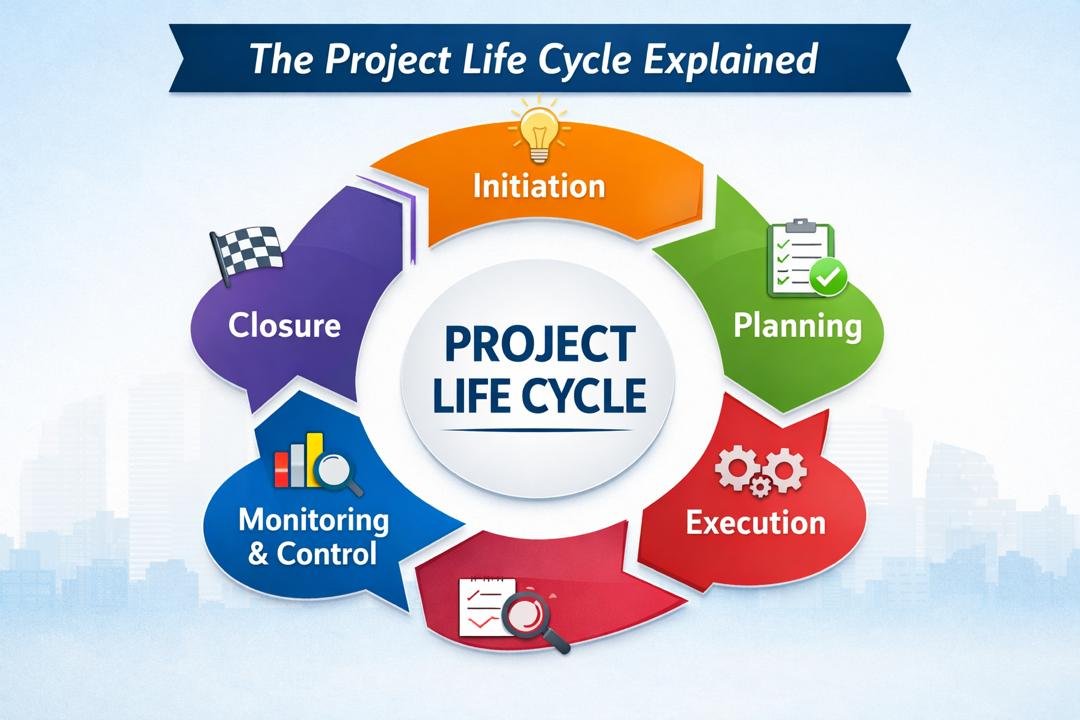
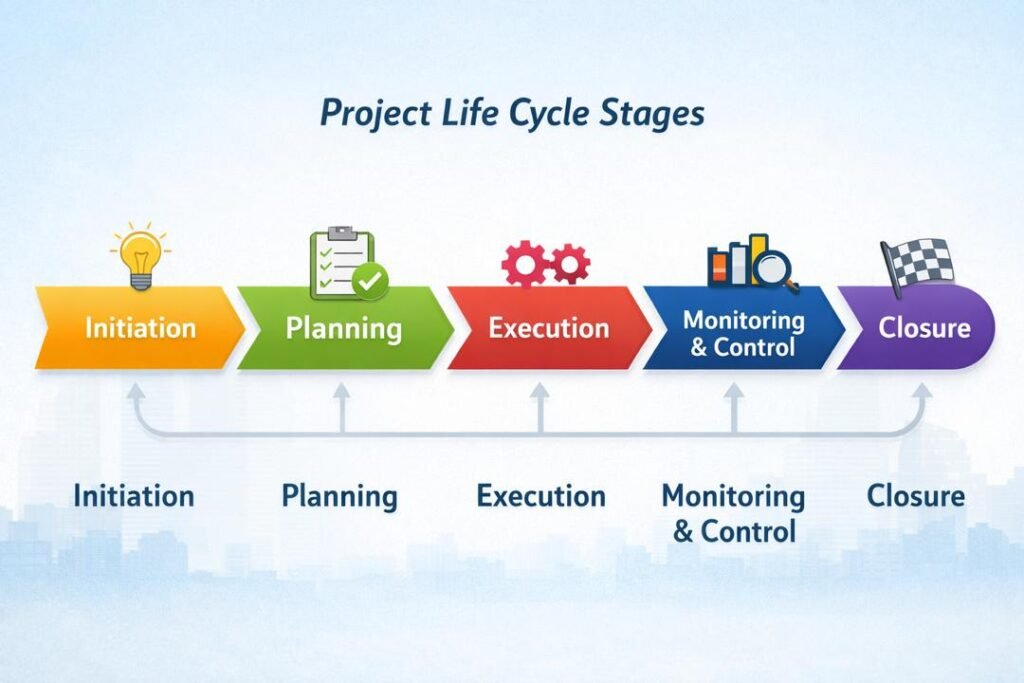
Despite the fact that various organizations might change the life cycle to fit their requirements, the most universally acceptable model is divided into five key phases:
- Initiation
- Planning
- Execution
- Monitoring and Control
- Closure
All these processes are very fundamental in ensuring the smooth running of the project throughout the concept to the end.
Stage 1: Project Initiation
The first level of the whole project is the initiation level. It is the place where the project idea is outlined, analyzed, and accepted. This is the point at which the organization gets to determine whether the project is worth undertaking and whether it fits in business or organizational objectives.
Major Events during the Initiation Stage
The key tasks that are undertaken in the course of project initiation are:
- Determining the project requirement
This is the identification of a problem, opportunity or a demand that the project is seeking to fulfill. In a case in point, a business can realize that it needs to create a new mobile application to enhance the process of customer engagement.
- Establishing project objectives.
Clear objectives will be used to clarify the aims of the project. These are to be specific, measurable, achievable, relevant and time-bound (SMART).
- Undertaking feasibility analysis.
A feasibility study is conducted to know whether the project is viable in terms of technical, financial, operational and legal reasons.
- Identifying stakeholders
Stakeholders are individuals or groups which are interested in the project. This will involve sponsors, clients, team members and end users.
- Project charter development.
Project charter is a document that gives authority to the project. It presents the purpose, scope, objectives, important stakeholders, and the project manager.
Major Deliverables of the Initiation Stage
The deliverables will be primarily:
- Project Charter
- Business Case
- Feasibility Report
- Stakeholder Register
These deliverables give formal consent and a clear guideline of proceeding to the planning stage.
Stage 2: Project Planning
The planning phase is said to be the most significant part of the project life cycle. The reason behind this is that a properly planned project will make it more likely to succeed and a poorly-planned one will most likely fail, experience delays and cost overruns.
Project planning entails the creation of a step by step road map detailing the execution of the project, monitoring and controlling of the project.
Important activities of the Planning Phase
- Defining project scope
The scope of project clearly gives the inclusion and exclusion of the project. This will aid in avoiding scope creep which is the uncontrollable growth of the project requirements.
- Developing the Work Breakdown Structure (WBS).
The WBS divides the project into small manageable tasks or activities. This allows the delegation of roles and resources to be estimated easily.
- Scheduling activities
Project schedule is created to demonstrate the order of activities, dates and milestones. Gantt charts and network diagrams are typically employed.
- Resource planning
This entails determination of the human, financial, and material resources that will be needed to finish the project.
- Budget estimation
The cost estimates are made on all the activities so as to come up with the overall project budget.
- Risk management planning
The possible risks are determined, examined and contingency measures created.
- Communication planning
It prepares a communication plan that outlines the manner in which information is going to be disseminated among the stakeholders.
- Quality planning
Quality standards and criteria are set in place to guarantee that deliverables turn out to be as expected.
Key Deliverables Planning Phase
Major deliverables include:
- Project Management Plan
- Scope Statement
- Work Breakdown Structure (WBS).
- Project Schedule
- Budget and Cost Estimates
- Risk Management Plan
- Communication Plan
- Quality Management Plan
These are documents that act as a blue print to be followed in the implementation of the project.
Stage 3: Project Execution
The implementation phase is a phase in which the project is carried out. The stage involves implementation of project plans and production of deliverables.
This is normally the most time consuming, resource and energy consuming stage.
The Major Activities in the Execution Stage
- Delegation to the team members: According to the project plan, team members have responsibilities assigned to them.
- Organizing human and material resources: The project manager makes sure that there is an efficient utilization of resources and a team that works in harmony.
- Creation of the project deliverables: This is the place where the real product, service or product of the project is developed.
- Stakeholder management expectations: Communication is done regularly to ensure that the stakeholders are informed and involved.
- Ensuring quality assurance: Quality checks are conducted to quality work to meet set standards.
- Implementing changes: Authorized modifications are implemented without affecting the project too much.
The Major Deliverables of the Execution Stage
Its principal deliverables are:
- Final products or outputs of the projects.
- Status reports
- Updated project documents
- Performance data
Leadership, team work, communication and problem-solving are very crucial in the success of this stage.
Stage 4: Monitoring and Control
It goes hand in hand with the monitoring and control as part of the execution process. When working on the project, the project manager keeps up with the progress of the project and ensures that it is on schedule.
This phase is used to make sure that the deviations of the plan are detected at an early stage and appropriate measures are implemented.
The major actions during the Monitoring and Control Stage
- Performance measurement of projects.
Key performance indicators (KPIs) are used to measure performance in terms of time, cost, scope and quality.
- Comparison of achieved progress with the plan.
The project manager ensures that the actual results are compared with the planned targets in order to detect the gaps.
- Managing changes
Any modifications in scope, schedule or budget are formally considered and accepted by means of a change control process.
- Risk monitoring
Risks are constantly checked and contingency plans brought into operation when necessary.
- Quality control
Quality inspection of deliverables is done.
- Reporting to stakeholders
Stakeholders are informed of the progress regularly.
Monitoring and Control Stage Deliverables
Key deliverables include:
- Performance reports
- Change approval and requests.
- Updated project plans
- Risk logs
- Quality inspection reports
This is a very important phase in keeping the control and avoiding the project failure.
Stage 5: Project Closure
The closure phase is the formalization of the closure of the project. It also makes sure that everything is done, goals have been attained and the project is closed.
This phase is as well neglected but plays a critical role in learning as well as responsibility.
Major Operations during the Closure Stage
- Delivering all deliverables: The client or sponsor reviews the project outputs and accepts them.
- Closing contracts: All the contracts with the suppliers and vendors are facilitated and resolved.
- Releasing resources: The resources and team members are reallocated to other projects.
- Project evaluation: A post-project review is conducted to gauge what went fine and what can be better.
- Lesson learning documentation: Experience gained is documented in order to enhance subsequent projects.
- Project documentation archiving: Records of the entire project are kept as reference and compliance.
Deliverables of the Closure Stage
The key deliverables will be:
- Final project report
- Client acceptance document
- Lessons learned report
- Project closure document
- Archived project files
The stage provides adequate documentation and knowledge transfer.
Significance of the Project Life Cycle to Project Management
The project life cycle is a critical aspect towards project success. The significance of it can be explained in the following way:
- Gives order and organization: It divides complicated projects into small steps.
- Improves control and monitoring: It is possible to monitor progress at each stage.
- Improves communication: The stakeholders know what to expect at any stage.
- Minimizes risks and uncertainty: Issues are recognized at an early stage.
- Facilitates superior decision making: Data and reports would enable managers to make informed decisions.
- Ensures accountability: Roles, responsibilities and deliverables are well spelt.
Conclusion
Project life cycle is one of the key concepts in project management that offers a systematic platform in managing projects until their completion. Organization is able to manage resources, maintain control, and realize project objectives by subdividing the project into five main components namely the initiation, planning, execution, monitoring and control and closure.
Further, every stage includes particular activities and deliverables that make a contribution to a performance. The project life cycle will provide superior planning, coordination, risk management, and probability of project success when managed appropriately.
Project life cycle in the current competitive and complex world is not only advantageous but also necessary to every individual or organization dealing with projects management.
Get more well researched information about the project lifecycle here.