Introduction
In the modern competitive and high speed business world, organizations are greatly dependent on projects so as to implement strategic objectives, provide value and stay relevant. Projects are the focus of organizational success whether involving a new product, a digital system or the physical infrastructure construction. Nevertheless, on numerous occasions planned projects fail to meet their deadlines, exceed budgets, or fail to deliver desired results, even when they have a well-thought-out plan and have experience. The existence of project bottlenecks is one of the biggest causes of these failures.
Project bottlenecks refer to barriers or restrictions that slacken and or come to the halt the smooth flow of project activities. They slack efficiency, cause delays, drive up costs, and usually demoralize project teams. The bottlenecks may take place during all phases of the project lifecycle, including initiation and planning, execution, and closure, and they may either be human, technical, or organizational. Every project manager must understand the usual bottlenecks which are likely to slow down project progress. Through defining these bottlenecks in the initial stages and implementing the workable solutions, project managers can ensure the improvement of the performance of the project swiftly, enhance risks management, and deliver the project punctually.
This article examines the most prevalent project bottlenecks, reasons behind them, and suggested workable ways in which the project managers may employ to avoid delays, cost management, and project momentum during the project delivery process.
Understanding Project Bottlenecks
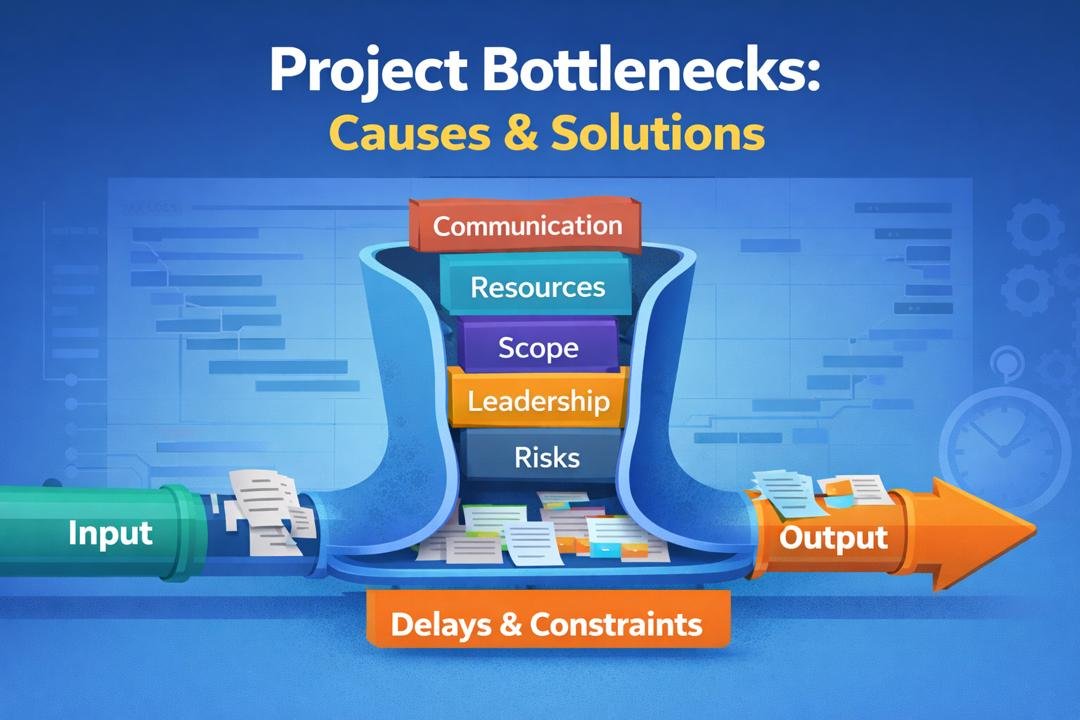
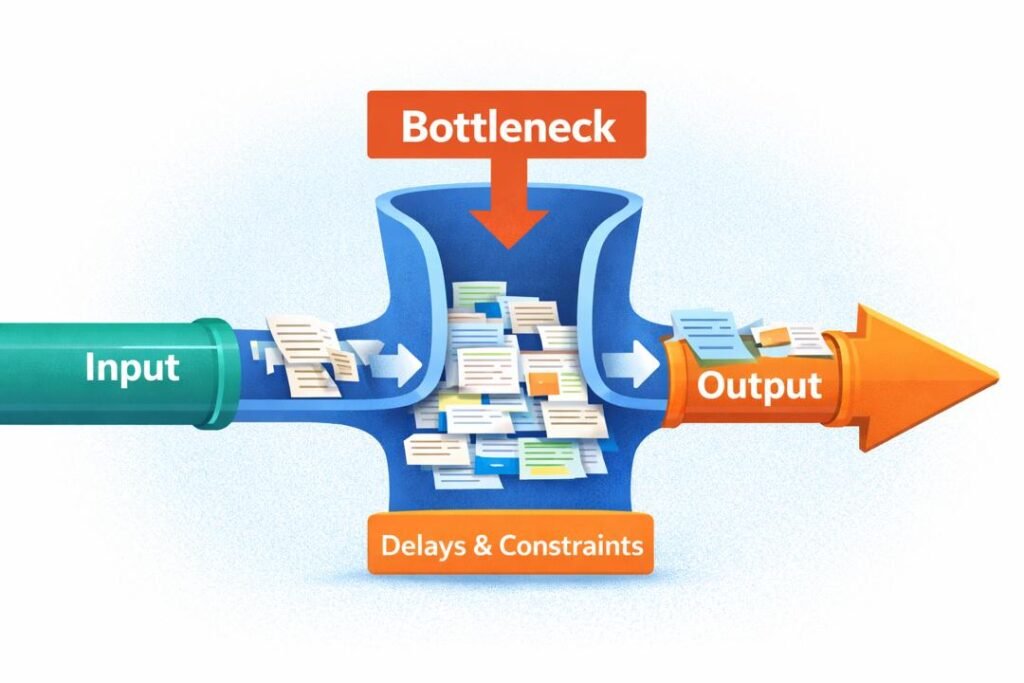
Project bottleneck is a term that is used to refer to a point in a project where the flow of work is constrained or limited leading to delays or inefficiency. It resembles the bottleneck of the bottle, where the flow of the liquid becomes slower due to the inability to pass through the opening freely. Bottlenecks in project management restrict the progress of a team.
The bottlenecks can be caused by:
- Weak resources (people, time, money or tools).
- Lack of coordination and communication.
- Unclear goals or scope.
- Weak leadership and decision making.
- Market influences or stakeholder intrusion.
Unless they are dealt with early enough, bottlenecks may develop into severe issues like schedule overruns and budget overruns, poor quality deliverables and even project failure.
1. Poor Communication
Description
One of the most frequent and harmful bottlenecks of project management is poor communication. It arises when communication among the project stakeholders is not disseminated clearly, in time and correctly. This entails miscommunication within the team, no updates made by the management or no specifications of what and how to do.
Causes
The causes of poor communication may include:
- Absence of spelt-out communication channels.
- More cultural or language barriers.
- Excessive use of informal communication.
- Lack of frequent meetings and reporting.
- Poor documentation
Impact on Projects
In cases of communication breakdown:
- The team members can be working on the erroneous tasks.
- Errors and rework increase.
- There are clashes between the stakeholders.
- Making decisions becomes slow and inefficient.
Finally, lack of communication causes confusion, wastage of time and wastage of efforts.
Practical Solutions
Some of the ways through which project managers can deal with communication bottlenecks include:
- Drawing a communication plan that will specify who, what, when, and how of communication.
- Collaboration tools (Microsoft Teams, Slack, or Trello).
- Conducting frequent meetings (daily stand-ups, weekly reviews and milestone reviews).
- Promoting feedback and active listening.
- Proper record keeping and common project records.
Good communication will make sure that all people are oriented towards the project objectives and duties.
2. Resource Constraints
Description
Resource constraint comes in when a project has inadequate resources to carry out work effectively. Such resources can be human resources (staff), financial resources (budget), physical resources (equipment), or technological resources (software and tools).
Causes
Common causes include:
- Poor resource planning
- Incorrect resource allocation within a team
- Budget cuts
- Lack of trained human resources
- Sudden modifications in project requirements.
Impact on Projects
The lack of resources may cause:
- Increased work load and burnout in the team members
- Delays in task completion
- Reduced quality of outputs
- Overtime or outsourcing costs of a project.
Practical Solutions
In order to deal with resource constraints, the project managers ought to:
- Make adequate resource planning and forecasting.
- Monitor resource availability and usage with resource management tools.
- The most important and urgent tasks are first.
- Ask to get more resources where needed.
- Train team members to undertake several duties.
Efficient allocation of resources will help to make sure that the appropriate people and equipment are there at the appropriate moment.
3. Lack of clarity in Project Scope (Scope Creep)
Description
Unclear project scope happens when there is no clarity in terms of what the project intends to achieve, deliverables, or the requirements. The scope creep occurs when additional work or features are introduced without due approval and timelines and budget alterations.
Causes
This common bottleneck is normally brought about by:
- Ineffective gathering of requirements.
- Absence on stakeholder activities in the planning.
- Lack of the project scope statement.
- Client/management pressure to include new features.
Impact on Projects
Unclear scope leads to:
- Misunderstanding in project objectives
- Work overload and pressure
- Budget overruns
- Missed deadlines
- Dissatisfied stakeholders
Practical Solutions
To avoid bottlenecks that occur as a result of scope, project managers can:
- A clear project scope document should be developed.
- Applying such tools as Work Breakdown Structure (WBS).
- Formally gaining approval of any scope changes.
- Training the stakeholders on the effects of scope creep.
- Introducing a change process management.
The existence of clear scope management will ensure that there is maintenance of focus and unwanted expansions are avoided.
4. Ineffective Leadership
Description
The role of leadership in projects is very important. Ineffective leadership is where the project managers do not succeed in guiding, motivating and coordinating the team.
Causes
This bottleneck can be as a result of:
- Lack of leadership skills
- Inability to make good decisions
- Lack of conflict resolving ability
- Low emotional intelligence
- Lack of accountability
Impact on Projects
Failure to utilize leadership leads to:
- Low team morale
- Poor performance
- Lack of direction
- Increased conflicts
- Reduced productivity
Practical Solutions
Project managers ought to overcome leadership bottlenecks by:
- Become a good leader and interpersonalist.
- Give definite guidance and anticipations.
- Promote cooperation and teamwork.
- Solve disputes in a reasonable manner.
- Be a role model and lead through example.
Good leadership gives a sense of trust and ensures the team is always goal-oriented.
5. Poor Risk Management
Description
Poor risk management is associated with failing to identify, assess, and manage the possible risks of projects.
Causes
This happens due to:
- Cases of poor risk assessment of planning.
- Ignoring warning signs.
- The over-optimism of project success.
- Poor contingency planning.
Impact on Projects
Ineffective risk management brings about:
- Unexpected delays
- Cost overruns
- Project disruptions
- Increased uncertainty
Practical Solutions
Project managers should:
- Make frequent risk evaluation.
- Develop a risk register.
- Create contingency plans.
- Monitor risks continuously.
- Engage the stakeholders in risk discussions.
When the risks are managed proactively, the surprise is reduced and the stability of the project is achieved.
6. Substandard Technology and Tools.
Description
The implementation of old or wrong tools may slow down the processes of projects and decrease efficiency.
Causes
This bottleneck arises from:
- Budget limitations
- Resistance to change
- Lack of training
- Poor tool selection
Impact on Projects
Inadequate tools result in:
- Paper-based and laborious processes
- Increased errors
- Poor collaboration
- Delayed reporting
Practical Solutions
Project managers can:
- Invest on new project management software.
- Educate train staff about new equipment.
- Automate repetitive tasks.
- Assess instruments on a regular basis.
Technology helps to increase productivity and better project control.
7. Stakeholder Misalignment
Description
Misalignment of stakeholders is the situation in which the stakeholders possess varied expectations, priorities, or interests concerning the project.
Causes
It is often caused by:
- Poor stakeholder analysis
- Lack of engagement
- Conflicting objectives
- Inadequate communication
Impact on Projects
Misalignment leads to:
- Conflicting demands
- Frequent changes
- Delays in approvals
- Increased conflicts
Practical Solutions
In order to handle the stake holders:
- Early identify all the important stakeholders.
- Know what they want and what they have an impact on.
- Communicate regularly.
- Make them participate in decision-making.
- Diplomatic conflict management.
Stakeholders who are on the same page ease the success of the project and curb resistance.
Advantages of dealing with the project bottlenecks
Organizations obtain a number of advantages when project bottlenecks are identified and dealt with:
- Enhanced Productivity: There is increased workflow without a lot of disruptions.
- Cost Control: Fewer wastes and reworks cut the costs of the project.
- On Time Delivery: Projects are on time and in milestones.
- Better Quality: Improved planning and execution will lead to better results.
- Growth in Team Morale: Well-defined procedures and management inspire teams.
Conclusion
Complex and dynamic project environments are bound to experience project bottlenecks. Nonetheless, they need not result in failure. Knowing the pitfalls that impede the progress of the project, poor communication, resource constraints, scope ambiguity, ineffective leadership, weak risk management, inefficient tools, and stakeholder misalignment, the project managers will be able to take proactive measures to reduce their effects.
The solution to the successful management of projects is in their early identification, constant monitoring and practical solutions. Project managers can overcome the barriers and carry on with their project by means of strong communication, proper planning, effective leader, and the utilization of relevant tools.
Finally, project bottlenecks would not only be avoided but also corrected in a way that would not only ensure that delays and cost overruns are avoided but also that the overall performance of the project, the satisfaction of the stakeholders and the success of the organization is improved. In a world that is characterized by innovation, and growth, caused by the projects, it is a skillset that all project professionals should learn to master in order to handle the bottlenecks.
Get more well researched information about project bottlenecks here.