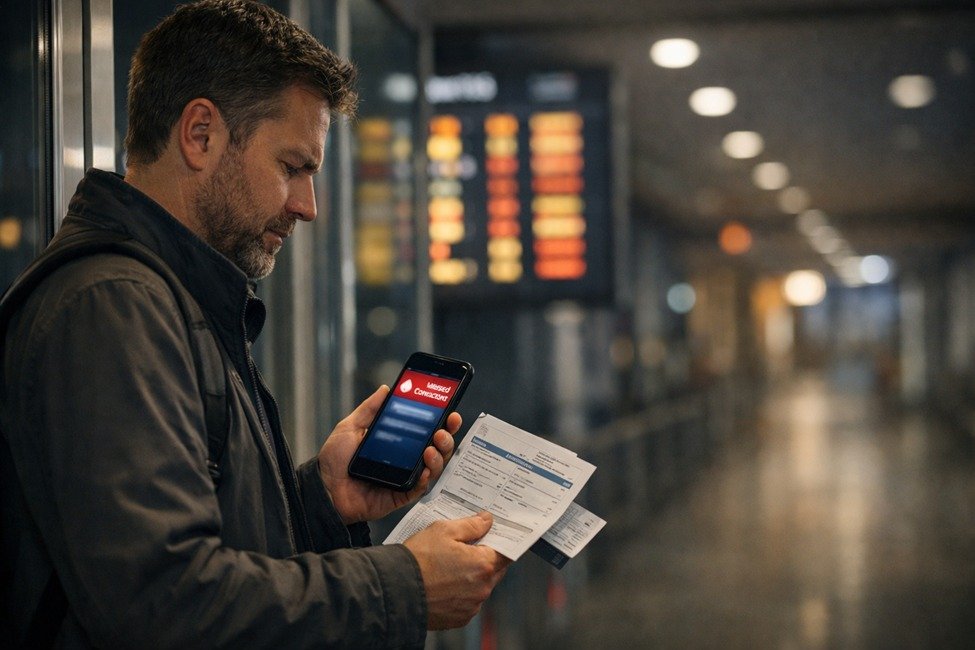
I can recall the message that came up on my phone at 2:07 a.m.: I have missed my connection, yet it is the same ticket. Am I entitled to delayed flight compensation?
When you have ever been waiting under a departures board and seen your gate change, the first flight you were in slip, and the second flight walked out quietly behind your back, you already have a taste of panic and disbelief.
The positive thing is that the flight compensation claim may be effective in a missed-connection case. The bad thing is that the majority of people concentrate on the uninformed details.
When you use Voos to see your remedies, or you just need to know how flight compensation works, the situation is broken down in a concise manner, with one practical point that you may or may not prevail.
The Missed-Connection Situation Is Often Misdiagnosed
Here’s what usually happens.
You take two stages on your way. The first flight is delayed. The airline also lets you know that you will still make the connection or they just do not say anything. You run through the terminal, come gasping out of breath and find the gate closed. Now you are rebooked a few hours later, a few hours later, sometimes the next day.
The first question that most travelers will focus on is as follows: What about the first flight, how late can you be?
It is no wonder so, but not the best method of assessing a flight compensation claim.
The Single Fact That Determines Most Flight Compensation Claim Cases
In missed-connection cases on one ticket, the determining detail is normally this:
Was it late when you got to your final destinations than what was planned?
Not the time the first flight went out. Not how late you got to the connecting airport. Not the stressfulness of the sprint.
The metric that most passenger-rights frameworks rely on to quantify the effects of the disruption is final arrival delay. In simple terms, the eligibility of these compensation is usually based on whether or not the total time in which your journey was delayed meets a minimum threshold, and whether or not the airline caused the inconvenience.
Why Final Arrival Delay Matters More Than Departure Delay
I have witnessed situations when the first flight was just delayed by 55 minutes, which made a connection missed and a re-booking overnight. The arrival delay was settled at 9 hours. That is where the issue of delayed flight compensation comes in and takes things seriously.
I have also witnessed the opposite: a flight that has been postponed by 2 hours, and the rerouting of the passenger took place in an efficient way; moreover, he was only 2 hours and 20 minutes late. In most systems that may not be sufficiently compensated despite the experience itself being horrible.
When you are verifying your case via Voos, the first thing that you need to do is to compare the set time that you were supposed to arrive at the final airport and the actual time that you arrived.
The Second Fact That Makes Everything Different: Same Ticket
The same ticket was not named in vain in the title of this article.
When you have a one-way booking or one booking reference (booking reference sharing both legs) then it is normally considered a single trip. That is important since the connection that is missed is not considered a different, independent issue. It belongs to a single journey contracted.
With two distinct tickets, the airline that was doing the first flight would claim that it only transported you on the first leg. The second airline can say that you were a no-show. Practically, separate tickets complicate the process of a flight compensation claim, particularly a connection claim, due to the fragmentation of responsibility.
Therefore, whenever people ask me what to save first, I am going to always suggest to them to retain the booking confirmation with the two flights on a single itinerary.
What It Takes to Construct a Good Delayed Flight Compensation Case
Clean claim is not concerned with writing an emotional email. It’s about evidence and logic.
Your Programme and Evidence of Your Lateness
Keep your e-ticket receipt, booking confirmation, boarding passes (or digital passes) and any e-mail confirmations of rebooking. Screenshots are useful in the event that your boarding passes vanished out of the airline app following the disruption.
The Operating Airline, Not Only the Brand Name
There are numerous flights sold by one airline and performed by another. Allegations are usually relative to the carrier operating the plane hence establishing who actually piloted it.
The Cause of the Disruption
The airlines can refuse to pay when the delay was a result of something beyond their control, otherwise referred to as extraordinary circumstances.
The typical examples are weather and significant air traffic controls. More disputed are technical problems and staffing problems related to operation processes, and results are determined by details.
In case the airline provided you with a reason at the gate, screen shot it. In case the airport personnel uttered anything in opposition to the email of the airline later, remember. The mismatch is not as rare as it might appear.
The Time You Arrive at the Last Airport
Record the time when the aircraft door opened at your last point of destination rather than the landing time. Lots of regulations are concerned with the time during which passengers can disembark, which may be later than touchdown.
How to Proceed With the Claim Process Without Wasting Weeks
A straightforward strategy is likely to do the trick.
The first step involves demanding payment directly with the airline through your booking reference and final arrival delay. Be clear and factual. Request the written cause of disruption in case it is not availed.
In case of a template rejection, you should not think that you are wrong. Airlines tend to fizzle out to general accounts.
And here the instruments and services such as Voos will assist you to organize the schedule, confirm whether your flight plan can be subject to the above-mentioned passenger-rights regulations, and have your paperwork arranged in a better way to present a more robust flight-compensation claim.
The Most Frequent Causes of Failure of Claims and How to Prevent Them
The claim is not usually successful due to practical reasons, rather than the passenger not being eligible.
One of them is the lack of evidence of a one-ticket itinerary. The other one is concentrating on the delay of the first flight as opposed to the last arrival delay. The third one is failing to retain rebooking information, particularly when the airline changed your route verbally in the desk without any good email trail of the same.
Another mistake is waiting too much and losing records. You can always have time to claim, however, you will be able to collect your screenshots, boarding passes, and exact times when the disruption is new.
Conclusion: The Best Thing to Consider About Missed Connections
A lost connection on the same ticket is like a madhouse, but by attaching it to one question; how late did you get at your last call, and did the airline cause the inconvenience? it becomes far more understandable.
That was the first detail you must take out of this article. It is that single action that can often determine the success of delayed flight compensations more than any other thing whether you are filing alone or having the help of Voos.
FAQs
Am I entitled to flight compensation when I have missed a connection and it is on the same ticket?
Often, yes. In case both the flights were within the same itinerary and the inconvenience made you to be late at your end destination, you might have a valid flight compensation claim, depending on the route, the airline and the cause of delay.
Does delay on the initial flight make a difference with regard to delayed flight compensation?
The reason it is important is that it led to the missed connection, yet one is normally eligible by the time they arrived at the final destination against their planned schedule.
What if the airline re-booked me but I got late?
Rebooking does not necessarily cancel the eligibility. The ultimate arriving delay remains the essential inquiry as to whether the airline was contributorially at fault in causing the interference in the possessing passenger-rights regulations.
May I claim, should my flights have been on two separate tickets?
It is not usually easy, sometimes but not always. Divided tickets can divide liability between the airlines, and missed connection can be considered your liability and not that of the carrier.
What is it that I should have in order to be able to claim stronger?
Carry your booking confirmation with all itinerary, boarding passes, rebooking e-mails, screenshots of delay messages and a note of when you actually arrived at the last airport.
What assistance does Voos provide in claiming delayed flight compensation?
Voos will enable you to keep track of your timing, maintain claim information in a similar manner, and evaluate your situation in a more organized manner in order to present a more convincing and better-submitted request to the airline.