Introduction
During the last several decades, contemporary project management methods has changed considerably. Methods of traditional project management, including the Waterfall model, were previously regarded as the standard mode of project delivery in any industry. These approaches focused on elaborate pre-planning, set strenuous schedules, and high control regimes. Although they perform well under stable and predictable environments, they can hardly adapt to the realities of the fast-changing business environment today.
The current organizations have been able to operate in a fast technological changing environment, shifting customer expectations, international competition and perpetual innovation. Under these circumstances, inflexible project designs cannot be used any longer. This has given birth and popularization of modern project management methods, which focuses on flexibility, teamwork, constant feedback, and repeated developmental methods.
The article describes the most important modern approaches to project management, including Agile, Scrum, Kanban, and hybrid approaches. It describes the relationship between these approaches and how they enable the organization to cope with uncertainty, adopt fast change and engage customers better. Another point that the author makes in the article is the need to use flexible and iterative approaches which are gaining popularity in the rapidly changing and technology intensive business world.
Requirements for Modern Project Management Techniques
The contemporary business environment is uncertain and tricky. Markets are volatile, needs of the customers are dynamic and technological tools are being updated very fast. Project requirements are not fixed often because of this. On the contrary, they tend to vary in the process of project execution.
The traditional project management practices presuppose:
- There is clarity in the definition of project goals.
- Requirements are constant during the project.
- There should be minimal changes that should not be changed.
Nevertheless, in practice, there are numerous projects that are subject to regular changes, particularly those projects that are related to software development, digital marketing, product design, and innovation. New functions that the customers may ask, new products that the competitors may have, or new regulations may arise. In this case, hard planning will be more of a weakness than a virtue.
The modern project management techniques were developed to overcome these difficulties. They are designed to:
- Take change instead of rejecting it.
- Deliver value in small steps.
- Promote stakeholder cooperation.
- Give attention to customer satisfaction.
These approaches acknowledge the fact that learning occurs throughout the project, and not only prior to starting the project.
Agile Project Management
Overview of Agile
Agile is among the most powerful modern project management methods. It is not a one-dimensional approach but a philosophy or outlook the way in which projects are handled and implemented. Agile is grounded on the Agile Manifesto that underlines:
- Processes and tools Interactions and people.
- Working solutions in preference to extensive documentation.
- Cooperation with the customer instead of contract bargaining.
- Adapting to change instead of the strict plan.
Agile advocates an iterative development whereby work is done in small packages referred to as iterations or sprints. A marketable product or output is produced at the conclusion of every cycle.
Key Features of Agile
The features of agile project management are:
- Flexibility: Adjustment of plans is made on a continual basis, based on feedback.
- Customer involvement: Customers will be involved during the project.
- Incremental delivery: Value is provided in small and regular releases.
- Cross functional teams: The team members work closely with each other and joint responsibility is shared.
How Agile Deals with Uncertainty
Agile works best especially in uncertain environments when all the requirements are not known. Instead, it allows teams to:
- Start with high-level goals.
- Learn from early results.
- Adjust to changing situations with the appearance of new information.
Agile is the best fit in projects that need innovation and experimentation.
Scrum Methodology
Understanding Scrum
Scrum is a definite model of Agile family. It offers an organized approach to application of Agile principles on actual projects. Scrum is popular in software development although it is being applied in other areas like education, marketing and product management.
Scrum divides work into brief sprints of work of two to four weeks. Every sprint is supposed to provide a potentially consumable product increment.
Roles in Scrum
Scrum identifies three major roles including:
- Product Owner: This is the personality who acts on behalf of the customer and gives priority to the requirements of the project.
- Scrum Master: Supports the process and eliminates barriers.
- Development Team: Performs the job and provides the product.
Scrum Events
Scrum has a number of repetitive events:
- Sprint Planning: Describes the content of the sprint.
- Daily Stand-up: Brief meeting that occurs daily to monitor progress.
- Sprint Review: Shares the work done with the stakeholders.
- Sprint Retrospective: Reflects on performance and identifies performance improvements.
Benefits of Scrum
Scrum helps organizations:
- Enhance transparency and communication.
- Deliver results faster.
- Change fast to evolving demands.
- Ensure that team is highly motivated and accountable.
The use of short cycles, frequent reviews will make Scrum lead to the identification of problems early and correcting them timely.
Kanban Method
What is Kanban?
Another modern project management technique that is renowned and has gained popularity is Kanban which is a visualization of work and work optimization. It was born in the manufacturing systems, though it is currently applied to service industries and knowledge-based work.
Kanban involves a visual board (physical or digital) to illustrate items in varying stages which include:
- To Do
- In Progress
- Review
- Done
Core Principles of Kanban
Several major principles are used in Kanban:
- Visualize work: Visualize work to all.
- Minim work in progress (WIP): Multitasking and overload.
- Control flow: See to it that tasks are moved smoothly.
- Continuous improvement: Processes should be evaluated and optimized on a regular basis.
Advantages of Kanban
Kanban helps teams:
- Identify bottlenecks.
- Improve efficiency.
- Reduce delays.
- Enhance collaboration.
In contrast to Scrum, Kanban does not entail fixed iterations and roles. This renders it very adaptable and fit to continue with the working operations.
Hybrid Project Management Models
Meaning of Hybrid Models
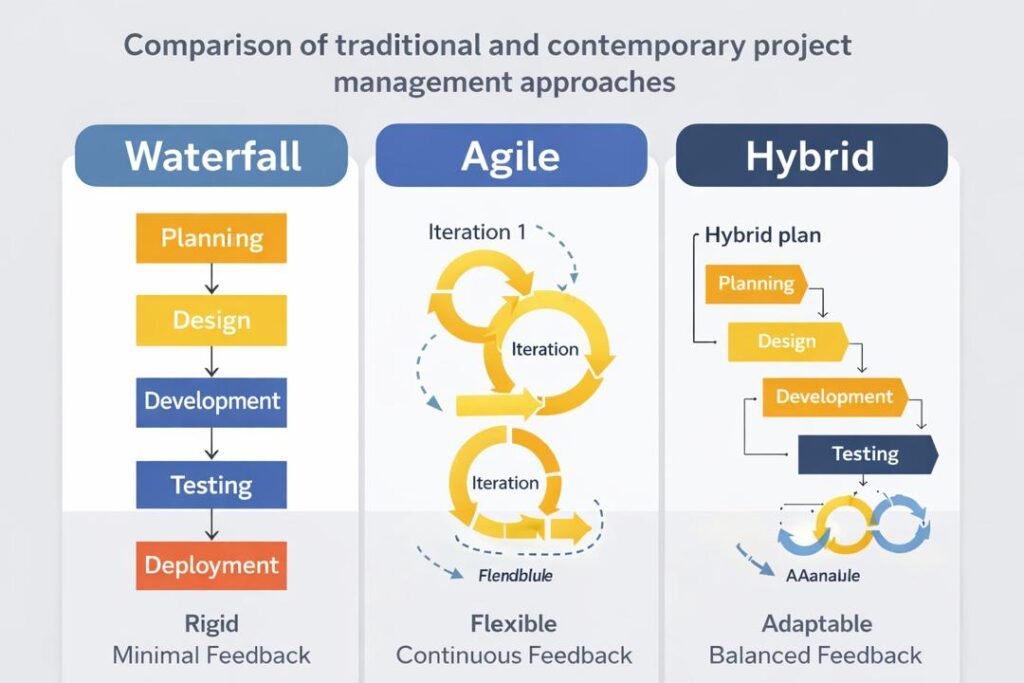
The hybrid project management models join conventional and modern models. They understand that there is no universal approach to projects. Rather, organizations borrow components of other frameworks to ensure their needs are met.
Indicatively, a hybrid model can:
- Plan the general planning with Waterfall.
- Use Agile in stages of development.
- Use Kanban for task tracking.
Reasons behind the Popularity of Hybrid Models
The reason why hybrid models are increasingly being embraced is that they:
- Flexibility and balance structure.
- Facilitate the long term planning as well as the short term adaptation.
- Adapt to complex organization set ups.
Projects in most industries like construction, healthcare, finance, and engineering need to be documented formally and to comply with regulations as well as flexibility. The hybrid models offer a viable solution.
Involvement of customers in the modern approaches
Among the most important distinctions between the traditional and contemporary project management, there is the degree of customer involvement.
In traditional models:
- The point of entry and exit involves customers mostly.
- The feedback is taken at the end of project implementation.
In contemporary approaches:
- Customers are engaged during the project.
- Feedback can be provided instantly.
- New changes are embraced and accommodated.
This ensures that:
- Finished products address actual customer requirements.
- Risks of failure are reduced.
- Satisfaction with customers is enhanced.
Customer collaboration is a way to change projects where technical activities are done in isolation to collaborative value-creation processes.
Dealing with Rapid Change and Uncertainty
Modern projects are subjected to all time uncertainty because of:
- Technological disruptions.
- Market volatility.
- The changing customer demands.
- Global economic conditions.
Modern project management techniques can deal with these issues by:
- Encouraging experimentation.
- Simulation supporting learning with iteration.
- Enabling the re-evaluation of priorities on a regular basis.
These approaches understand uncertainty as a state of normalcy, as opposed to thinking that it is stable. This attitude change is very vital towards innovation and success in the long term.
Contemporary Project Management and Technology
In project management today, technology is core in facilitating the management process. Digital tools such as:
- Jira
- Trello
- Asana
- Microsoft Project
- Monday.com
Support cooperation, instant communication, task tracking, and performance tracking.
These tools:
- Enhance transparency.
- Enhance the collaboration between remote teams.
- Facilitate evidence-based decision-making.
Technology-driven systems of project management are required in a global and digital economy in order to be efficient and competitive.
Advantages of Flexible and Iterative Approaches
Iterative and flexible approaches have a number of benefits:
- Faster Delivery: The projects are presented in small chunks, which enable the release of value within a short time in an organization.
- Reduced Risk: Issues are detected at an early stage minimizing the cost of failure.
- Higher Quality: Constant testing and feedback enhances the quality of products.
- Greater Innovation: The teams are supported to be creative and experiment.
- Greater Stakeholder Satisfaction: Constant communication creates a sense of trust and alignment.
The above benefits support the reason why contemporary project management methods are ever becoming popular in various industries.
Problems of Modern Techniques
The contemporary project management methods have their own issues despite the benefits:
- Lack of change by traditional managers.
- Agile skills and training deficit.
- Difficulty in managing big projects.
- Hierarchical organizations have cultural barriers.
Adoption should be successful and this involves:
- Organizational commitment.
- Leadership support.
- On-going learning and enhancement.
Such approaches can be ineffective without a proper implementation.
Conclusion
The Contemporary project management methods are a radical change in the planning, execution, and evaluation of project. Agile, Scrum, Kanban, and hybrid approaches are aimed at addressing the realities of the contemporary business environments uncertainty, changes in a very short period, and customer involvement.
The modern world does not have stiff planning and control as the traditional methods but favors flexibility, teamwork, and never-ending learning. They help organizations to react fast to change, create value in a gradual manner, and have good relations with the stakeholders.
With the constantly changing industries and more dynamic markets, flexible and iterative project management will continue to gain importance. Those organizations who embrace modern practices of project management are in a better position to innovate, compete and perform well in a world that is dynamic.
Get more well researched information about Contemporary project management methods here.