Abstract
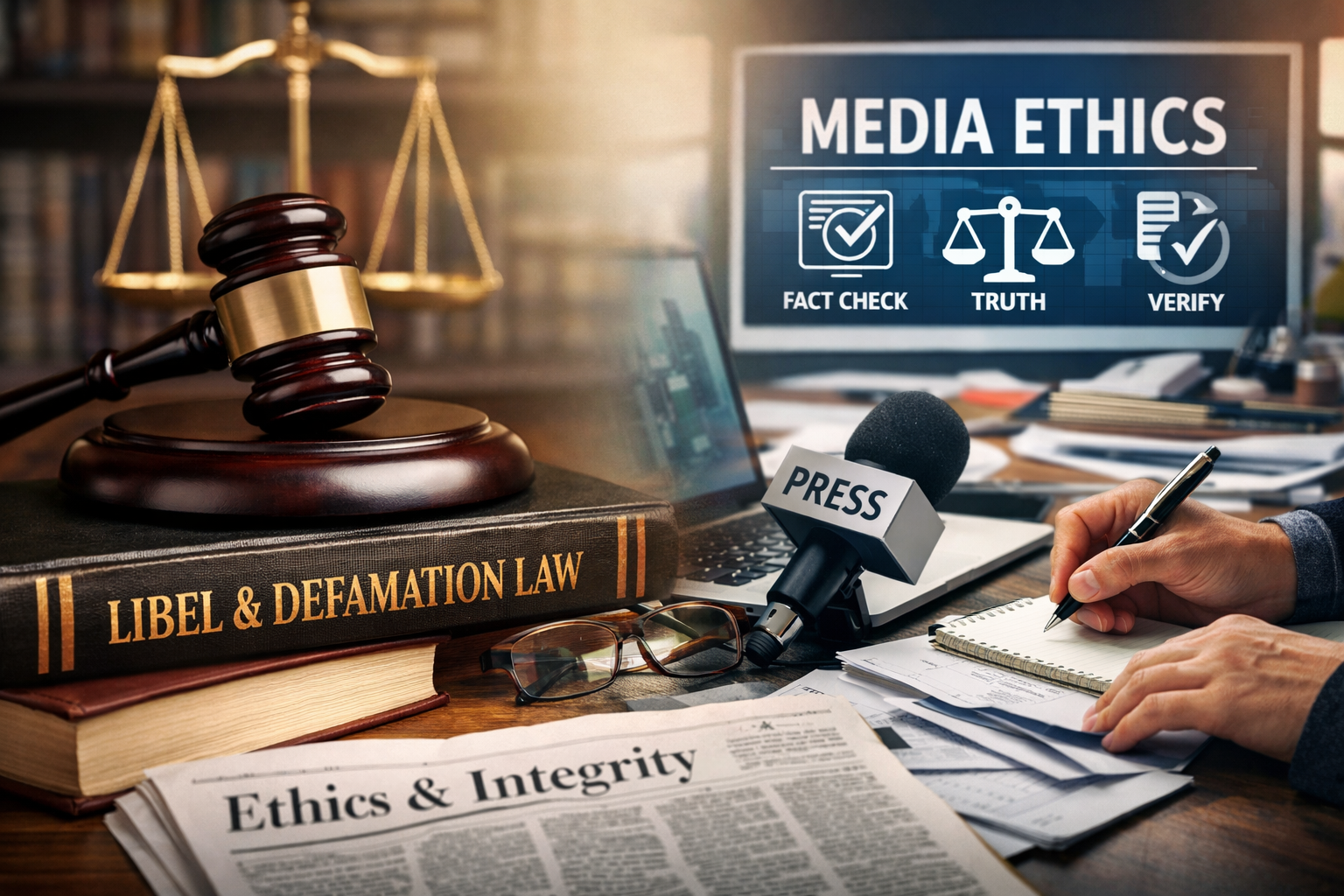
Defamation and libel are still important issues in legal and ethical aspects of modern journalism, especially at the time when digital publishing and social media amplification happen at a high rate. This paper discusses libel and defamation laws and its ethical consequences on the journalistic profession. The study employs the qualitative approach of doctrinal and conceptual studies on understanding the roles of journalists in ensuring that defamatory news is avoided by checking and verifying facts and exercising good moral judgment. The article also examines the implications of libel on the individuals, organizations and the credibility of the media and has highlighted the need to be ethical so as to build trust in the population. The results indicate that the likelihood of defamation decreases considerably when the professional ethics and the knowledge of legal regulations are observed and the journalistic integrity is reinforced.
keywords: libel and defamation laws, media ethics, journalism, verification, press responsibility.
1.0 Introduction
The role of journalism in democratic societies is that it informs the masses, forms opinion and holds the institutions and individuals accountable. With this strong position, there exist ethical and legal obligations, one of which is to state the truth and be truthful. Defamation, particularly libel, is one of the greatest legal risks that journalists can incur and it entails the making of written or published untrue statements that ruin reputation.
The pace of spreading the news has become much more accelerated with the advent of digital media. Internet news sources, blogs and social media websites enable the spread of information all over the world in a few seconds. Although this increases the availability of information, it increases the chances of publishing misleading or unconfirmed statements. One defamatory report can have long-term effects which are hard to undo even when they are corrected or apologized.
It is therefore vitally important to have some knowledge of libel and defamation laws to engage in ethical journalism. This is because these laws are meant to safeguard individuals and organizations against reputational losses with consideration of the freedom of speech. This paper will discuss the impact of libel and defamation on journalism, the effect of ethical decision making on the defamatory coverage, and the impact of libel on the individuals, institutions and media credibility.
2.0 Literature Review
The current literature on defamation brings out the fact that there is a permanent conflict between the freedom of the press and the right to reputation. According to Barendt (2013), the purpose of defamation law is to make sure that people speak responsibly and do not repress an acceptable public discourse. This is especially so in journalism, which may often require criticism, investigating, and breaking open of what is wrong.
Accuracy, truthfulness, and accountability are the foundations of ethical journalism, and McQuail (2010) stresses that these three elements must not be disregarded. In case of neglect of these principles, there is likelihood of defamatory reporting. According to Frost (2015), the negligence and the lack of proper verification and the lack of time at newsrooms are the reasons why many libel cases occur not out of intentional falsehood.
Kenyon (2016) also adds that defamation laws differ depending on the jurisdiction, but the following factors are commonly used: falsity, publication, and harm. Research also indicates that legal and ethical training of journalists enable them to identify the potentially defamatory content and address it in a responsible manner. All in all, it can be seen that the literature upholds the position that good ethical judgment and knowledge of the law are crucial mechanisms of preventing defamation in journalism.
3.0 Methodology
The qualitative research methodology used in this article is the doctrinal and conceptual research. It is based on secondary data, which entails the courts of law, academic publications, books on media ethics, and reported defamation cases against journalists and media houses. The strategy enables a critical analysis of the convergence of libel laws, ethical journalism and professional practice.
4.0 Theoretical Framework
The social responsibility theory of the press will direct the study, as it states that media freedom should be coupled with social responsibilities to society. This theory states that the press is expected to deliver truthful, balanced and full information without being involved in information that will result in unjustified harm. Defamation is a social responsibility failure since it negatively affects the public and hurts individuals without the benefit of the people.
5.0 Conceptual Review
5.1 Libel and Defamation Laws
Defamation is when a false statement is communicated about an individual or an organization to the detriment of their reputation. It is widely categorized as libel and slander. The definition of libel is a permanent or recorded defamatory statement which may take the form of newspapers, broadcast or online publications, whereas slander is a verbal defamatory statement.
Libel is a more pertinent issue in journalism since information related to the news is normally printed or posted in written or electronic forms. According to the legal discourse of libel and defamation laws, the statement should be false, published to some third party and able to damage reputation in order to make a successful claim.
Ethically, defamation is not only concerned with legal liability, but it is also about moral responsibility. A report that does not carry the high legal standard of defamation can still be unethical in that it confuses the audience; it is out of context or is taken out of context on a subject unfairly.
5.2 Ethics and Journalistic Responsibility in Media
Media ethics gives parameters in which journalists act responsibly. The fundamental values of the ethical principles are truth, accuracy, fairness, independence, and the reduction of harm. Defamatory reporting breaches such principles by reporting misleading or untrue information that harms the reputation.
Journalists are supposed to be careful especially when making allegations, accusations or reporting about sensitive personal information. The moral duty has it that journalists need to draw the line between facts and opinions and cannot pass speculation as truth. This is more so when they cover the personal lives of individuals who lack governmental forums to argue their own case.
5.3 Evading Defamatory Reporting in Journalism
5.3.1 Fact-Checking and Accuracy
An essential ethical requirement in journalism is fact-checking. The reporters also need to verify any factual assertion, particularly those which may tarnish the image of an individual. Mistakes in names/titles, dates, or quotations are likely to result in negative consequences.
5.3.2 Confirmation and Source Appraisal
Checking is conducted by means of verifying information from various sources of information which are reliable sources. Journalists ought to be keen with regard to single or anonymous sources, but more on allegations of mischief. The transparency on the limits of available information is needed in ethical reporting.
5.3.3 Musical Taste and Critical Supervision
The editorial control is very important in the prevention of libel. The issue that editors are required to evaluate includes the question of whether the story is of public interest and whether the harm might be warranted. Facts must not be overstated or falsely presented by headlines, pictures and framing.
5.4 Defamation and Libel in the Digital Age
Online journalism poses some new challenges to ethical journalism. The internet and other online media promote speed, interaction with listeners and readers, and eye-catching headlines, at the cost of truthfulness. Defamation may become much wider than it was initially through social media sharing.
The content of digital media is available forever, unlike in traditional print media, which enhances the permanency of libel. Journalists should be more cautious, rectify mistakes in a timely and update stories on the internet when new facts are found out. Digital journalism involves being ethical, and this means that the news cycle must be slowed down so as to be accurate and fair.
5.5 Consequences of Libel
5.5.1 Impact on Individuals
Defamation may inflict great damages on persons, such as emotional distress, termination, and stigma. The online records might leave a lasting impact even after legal vindication has been carried out.
5.5.2 Impact on Organizations
Organizations that have fallen victims of libel can lose money, tarnished reputation, and trust of their stakeholders. Criminal trials are also very expensive and time-consuming.
5.5.3 Impact on Media Credibility
In the case of media houses, libel suits damage credibility and trust among people. Frequent ethical misconducts may undermine the credibility of journalism in the society.
6.0 Findings
The review demonstrates that poor verification, rush publication, as well as poor editorial control are the causes of most libel lawsuits against journalists. Media companies that have good ethical codes and those that have fact checking mechanisms have less cases of defamation. Ethical consciousness contributes to fewer legal and professional threats.

7.0 Discussion
The results validate the fact that libel is a legal and ethical concern. Ethical journalism is not a question of lawsuits, it is also about the respect of truth, dignity, and trust of the people. In an era of falsehood, journalists have to re-establish their historic values on ethical ideals as a way of securing credibility and social relevance.
8.0 Conclusion
The laws of libel and defamation are very crucial in influencing ethical reporting. Although these laws give legal constraints, ethical standards can be more integrated to give better direction of responsible reporting. Ethical judgment, fact-checking and careful verification can help to prevent the problem of defamatory reporting and help to protect the subjects and the profession of journalists. It is ethical journalism that keeps people believing in and discussing democracy.
References
Barendt, E. (2013). Freedom of Speech. Oxford University Press.
Frost, C. (2015). Journalism Ethics and Regulation. Routledge.
Kenyon, A. (2016). Defamation and freedom of expression. International Journal of Communication Law, 12(2), 45–62.
McQuail, D. (2010). McQuail’s Mass Communication Theory. Sage Publications.