Modern construction is experiencing a renaissance in welding technologies, with innovation driving improvements in project speed, structural integrity, safety, and cost-effectiveness. As construction demands become more complex, it’s essential for contractors and project managers to stay up to date on the latest welding advancements. Companies like Elite Weld & Fab are leading the way, incorporating cutting-edge solutions that set new standards for quality and efficiency in the industry.
Technological advancements, from collaborative robots to new training methods, enable tackling tough builds and exceeding expectations. Welding now leverages data, advanced materials, and adaptable machinery to meet evolving needs. These innovations help address labor shortages by using automation and improved training to maintain high standards. Additionally, precision tools and AI quality checks promote safer sites and more reliable results across both simple and complex projects. In terms of sustainability and resource efficiency, welding innovations also play a vital role by reducing material waste, energy use, and overall project costs. Investing in these solutions not only prepares construction operations for the future but also helps companies respond to changing client demands and regulatory requirements.
Cobots in Welding
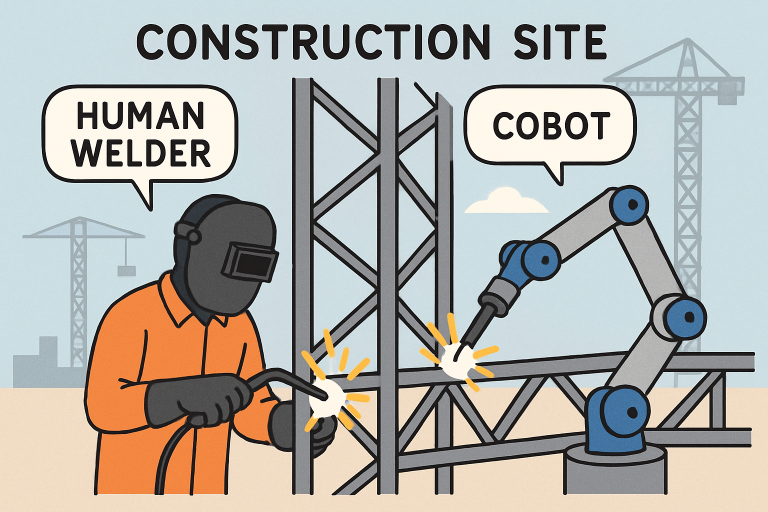
Collaborative robots, or cobots, are revolutionizing welding in today’s construction landscape. Unlike conventional robots, cobots are designed to safely share workspaces with human operators and are particularly valuable to small- and mid-sized businesses. Their straightforward programming enables quick integration into production lines, and their ability to handle repetitive, precise tasks helps teams achieve standardized, high-quality welds consistently. Cobots also improve safety by taking over hazardous or ergonomically challenging tasks, making them a smart investment for forward-thinking construction firms.
Cobots offer adaptability, as they can be redeployed easily for different tasks or projects. This flexibility, coupled with tangible productivity gains, underscores their growing prominence across the sector.
Handheld Laser Welders
The introduction of handheld laser welders marks a transformative leap in the realm of precision welding. These tools use powerful fiber lasers to deliver concentrated heat to a small area, enabling specialists to achieve high-strength, visually clean welds without the broad heat exposure associated with traditional methods. This results in significantly reduced distortion and rework, particularly when joining sensitive materials such as stainless steel, aluminum, and titanium.
Handheld laser welders are typically four times faster than alternatives like TIG or MIG welders and generally require less operator skill to achieve high-quality results. This not only shortens project timelines but also reduces operating costs and personnel training expenses. The portable design enables work on-site or in tight spaces, an asset for repair jobs and complex fabrications alike.
The adoption of laser welding has grown rapidly, especially in industries that demand both strength and aesthetics, including architectural metalwork, automotive repair, and custom fabrication.
Augmented Reality in Welding Training
Augmented reality (AR) has become a game-changer in the training and development of welding professionals. AR-based tools allow trainees to practice welding techniques in realistic, virtual environments, where they receive immediate feedback on every action. This immersion accelerates skill acquisition, letting students refine their techniques and identify common issues before they ever strike an arc on a real piece of metal.
By utilizing AR, training programs can minimize the consumption of expensive raw materials and reduce safety risks during the learning process. Not only does AR bridge the gap between classroom theory and hands-on practice, but it also creates opportunities for remote and scalable instruction, which is particularly important during periods of high demand or workforce turnover.
Friction Stir Welding
Friction stir welding (FSW) is a solid-state process where a rotating tool generates frictional heat, softening and mixing the joined materials without melting them. This distinctive method eliminates many of the flaws common to fusion-based welding, such as porosity, cracking, and molten contamination, resulting in exceptionally strong and durable bonds. The process has been embraced in sectors such as aerospace, automotive, and shipbuilding, where the ability to join dissimilar metals and fabricate complex geometries is essential.
Advancements in FSW technology have expanded its applications, enabling manufacturers to tackle materials previously deemed “unweldable,” such as certain high-strength aluminum alloys. Moreover, recent research and innovation have increased FSW automation, ensuring precise process control in mass-production environments.
AI and Machine Learning in Welding
The fusion of artificial intelligence (AI) and machine learning with welding operations is ushering in an era of real-time, data-driven optimization. Contemporary welding systems integrated with AI algorithms constantly monitor factors such as temperature, joint alignment, and arc stability, making dynamic adjustments as needed. This level of automation reduces the risk of errors, ensures consistency, and improves overall output quality.
AI-powered systems can also learn from large datasets to predict potential defects before they occur and recommend corrective actions to human operators. Such features are particularly beneficial when managing complex welds in critical infrastructure or high-value manufacturing.
Conclusion
Welding innovations continue to drive remarkable progress in the construction industry. From cobots and handheld lasers to AR training and AI optimization, these advancements make modern buildings more efficient, precise, and sustainable than ever before. The ability to adapt, embrace new technologies, and invest in ongoing workforce development will remain essential for construction professionals who seek to excel in a highly competitive marketplace.