Key Takeaways
- Safety measures are critical for anyone working at height, regardless of industry.
- Choosing the right equipment is essential to maintain both productivity and worker protection.
- Training, compliance, and technology are fundamental in reducing the risk of accidents.
Table of Contents
- Importance of Safety Measures
- Equipment Options for Safe Working at Height
- Training and Compliance
- Emerging Technologies in Height Safety
- Case Studies of Effective Implementation
- Conclusion
Ensuring the safety and efficiency of employees working at height is essential in industries ranging from construction and maintenance to warehousing and logistics. Risk mitigation should always begin with a strong safety culture that prioritizes worker well-being, supported by the right equipment and systematic practices. Using specialized products such as Warehouse Ladders can greatly minimize hazards and improve the workflow, making treacherous tasks more manageable. Businesses that take proactive measures not only protect their workforce but also benefit from fewer operational interruptions and increased productivity.
The variety of work environments at height, whether in narrow warehouse aisles or atop expansive industrial facilities, requires tailored solutions for both safety and efficiency. Innovative access platforms, robust training protocols, and compliance with safety standards all play crucial roles in preventing incidents and creating a safer workplace. Equipping staff with knowledge and modern technology ensures organizations meet legal mandates and foster a culture of continuous improvement.
Furthermore, new developments in safety harnesses, alert systems, and mobile access tools are reshaping how workers complete tasks in elevated spaces. Industry statistics consistently show that falls remain one of the top causes of workplace injuries, underscoring the ongoing need for reliable safeguards.
A comprehensive strategy for at-height work should marry traditional best practices with emerging technologies and worker training. This balanced approach protects employees while also maximizing efficiency, which is essential for companies facing tight schedules and competitive benchmarks.
Importance of Safety Measures
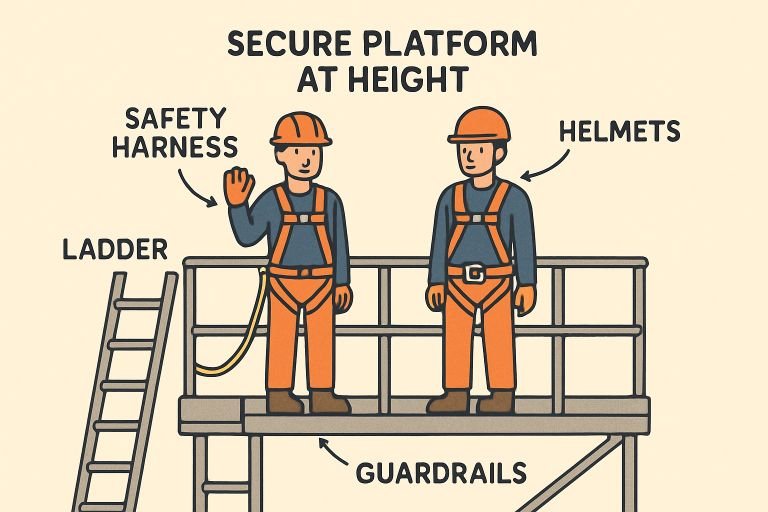
Falls from height are among the most frequent and severe occupational hazards worldwide. According to the National Safety Council, falls accounted for over 20 percent of all workplace fatalities in the United States in recent years. Implementing thorough safety measures is vital for legal compliance and, more importantly, for preserving lives. Proper risk assessment, routine inspections of equipment, the use of safety harnesses, and the implementation of fall arrest systems are baseline standards identified by organizations such as OSHA and the Health and Safety Executive.
Leadership must invest in safety planning and foster open communication about hazards and incidents to ensure ongoing improvement. Worker participation in identifying potential problems and sharing feedback about equipment increases accountability and encourages best practices throughout the organization.
Equipment Options for Safe Working at Height
The reliability and versatility of the equipment used are crucial for working at height. Selecting the right tools can prevent a significant number of incidents while simultaneously increasing the efficiency of tasks completed in elevated locations. Traditional ladders have long been used, but they are not always the best solution as they can be unstable or unsuitable for lengthy tasks. That is why many industries have shifted towards more advanced and stable alternatives.
- Low-Level Access Solutions: Nowadays, push-around lifts and mobile platforms are favored over ladders for repetitive or lengthy tasks at lower heights. These lifts provide stable bases, hands-free operation, and allow workers to keep both hands free for their job, rather than holding onto a ladder. For example, JLG’s 1230P push-around lift is a popular choice among professionals for its stability and ease of use.
- Rope Access Systems: When working on building exteriors or in places without access for traditional platforms, rope access allows skilled technicians to operate safely and efficiently while suspended. These systems are designed with redundancy in mind and require rigorous training, but offer unparalleled flexibility in hard-to-reach spaces.
- Fall Prevention Systems: Modern fall prevention devices, such as the FASTN system for MEWPs (Mobile Elevating Work Platforms), enhance operator safety by confirming proper harness attachment and alerting users if detachment occurs, significantly reducing the potential for incidents.
Training and Compliance
Having top-of-the-line equipment is only effective if employees receive comprehensive training on its correct usage. Training programs should combine theoretical learning with practical exercises to reinforce safe working practices. Virtual Reality (VR) in safety training is gaining traction, providing lifelike environments for workers to practice hazard identification, emergency procedures, and proper use of fall arrest systems, all without real-world risk.
All workers must understand applicable regulatory standards and employer requirements. Regular refresher courses and performance reviews help ensure that protocols are continuously upheld. Adopting the latest in training technology can make a tangible difference in both accident rates and job confidence.
For a deeper understanding of industry best practices and emerging equipment, consider reviewing resources provided by Safety+Health Magazine, which offers guidance on compliance and risk management strategies.
Emerging Technologies in Height Safety
The continued advancement of safety technologies has revolutionized how professionals approach working at height. Predictive analytics, machine learning, and artificial intelligence are now being used to identify hazardous situations before they escalate into incidents. The HARNESS system, for example, uses AI to process operational data and forecast risky behaviors or unsafe conditions, thereby enabling proactive interventions. Wearable devices and smart sensors provide real-time feedback and automate the monitoring of worker locations, lanyard attachment, or even fatigue levels, ensuring that corrective action can be taken promptly.
Construction and industrial leaders are increasingly turning to these state-of-the-art systems to not only remain compliant with ever-evolving regulations but also to set new standards in workforce safety. For more information about recent safety innovations, news outlets such as the BBC Business frequently cover advancements affecting global industries.
Case Studies of Effective Implementation
One notable example comes from a roofing contractor in Scottsdale, Arizona. By integrating advanced fall protection systems, reinforcing scaffolding, and establishing strict material handling protocols, the company experienced a dramatic reduction in incidents and improved overall project efficiency. This highlights how strategic investments in safety and equipment can yield significant returns, not only in fewer workplace injuries but also in productivity and employee morale. Publicizing these successes encourages broader adoption of best practices across the industry.
Organizations that benchmark against top performers in their industry can identify practical action steps to achieve safer, more efficient at-height operations. Real-world stories make the case that safety is not just about compliance, but about achieving excellence at every level of the business.
Conclusion
Protecting employees who work at height is a responsibility that endures as long as vertical work environments exist. A blend of up-to-date equipment, ongoing training, and unwavering commitment to safety protocols is the foundation for substantial improvement in both accident prevention and operational output. Staying aware of technological advances and industry-leading strategies keeps organizations ahead of the curve and illustrates a commitment to worker safety and well-being. Adhering to these practices is not only the right thing to do; it is integral to maintaining a sustainable and productive business.