Abstract
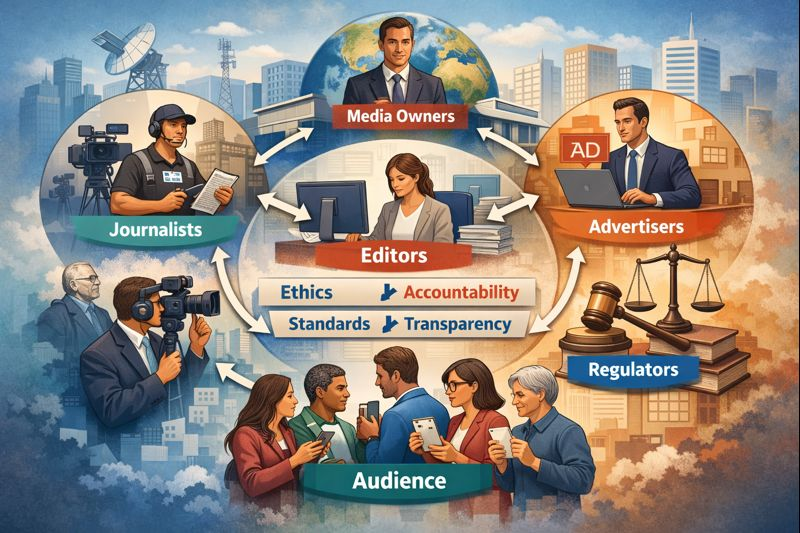
The subject of ethical responsibility in mass communication does not just stop at journalists but is also applicable to media owners, editors, advertisers, regulators, and audiences. This paper examines the impact of collective responsibility in media practices, which would shape responsible content: accountable, fair, and socially responsible. The paper, based on the literature of media ethics, regulatory frameworks and case studies, highlights the interdependence of all media stakeholders in ensuring that ethical standards are upheld. The results show that a cooperative approach to ethics increases credibility, societal well-being, and trust of the population. The paper will also discuss how both stakeholders struggle to keep ethical standards and how to reduce the occurrence of an ethical failure to ensure a complete picture of the ethical responsibility in contemporary media.
Keywords: mass communication ethical responsibility, media ethics, media ownership, editorial ethics, audience accountability.
1.0 Introduction
The media ethics debate has always focused on media journalists’ responsibilities. Although the role of the journalist in getting proper and just reporting cannot be ignored, ethical responsibility in mass communication has a wider range of stakeholders, such as media owners, editors, advertisers, regulators, and audiences (Christians et al., 2015).
Every actor helps to create media content, shapes the perception of people and ensures that they trust the media in society. This paper is aimed at discussing the ways these stakeholders jointly maintain ethics, the conflicts of interest that they may face, and the impacts of their actions on the media ecosystem, in general. These dynamics are important in understanding why a strong ethical media practice framework needs to be developed.
2.0 Literature Review
In literature on media ethics, the interaction between professional behavior and corporate policy is emphasized. According to McQuail (2010), most of the ethical breaches in the media are not made by a choice of individual journalists, but by structural pressure, either ownership interests or advertising reliance.
Ward (2018) stresses that editors are gatekeepers whose decisions regarding content framing, selection, and positioning are known to have a major effect on ethical outcomes. Research on the impact of the audience (Livingstone and Lunt, 2013) indicates that the involvement of the population, feedback, and consumption patterns may also pressurize media companies, compelling them to focus on sensationalism as opposed to ethical reporting.
Also, a study by Plaisance (2014) emphasizes the need to implement ethical leadership in nurturing a culture of responsibility at news organizations. All of these findings taken together have highlighted that ethical responsibility is shared between a variety of actors, each of which is responsible for maintaining standards.
3.0 Theoretical Framework
The paper relies on the social responsibility Theory of the press and the Stakeholder Theory. The Stakeholder Theory assumes that organizations should pay attention to the interests and moral anticipation of all stakeholders, whose actions are influenced by their activities, such as employees, shareholders, audiences, and society (Freeman, 1984).
According to the Social Responsibility Theory, the media is an obligation to act in the common good, which is the truthful reporting, the least harming and social welfare (Siebert et al., 1956). These theories must be integrated to have a basis for studying the functionality of collective ethical responsibility in mass communication. Both a structural and a societal perspective allow us to analyze ethical issues through this theoretical integration.
4.0 Methodology
The qualitative approach was chosen, and secondary information was used in the form of peer-reviewed journals, books on media ethics, case studies, and regulatory reports. The analysis of the data was aimed at defining the roles and ethical responsibilities of media owners, editors, advertisers, regulators, and audiences.
Comparative analysis of cases revealed instances of good ethical practices and failures in media procedures in various parts of the world. Cross-referencing of regulatory policies and ethical codes in order to analyze the correspondence between theory and practice was also a methodology. The analysis of the ethical responsibility of contemporary media shows a subtle comprehension of the issue by integrating both empirical and theoretical evidence.
5.0 Findings
5.1 Media Owners
The media owners determine the editorial policy, priorities of the contents, and the allocation of resources. When the ownership is concentrated, it may result in biases or censorship where profit interests are overridden in favor of the population. Media ethics also entail encouraging transparency, editorial independence, and social welfare (Baker, 2007). The examples of media monopolies have proved the impact of concentrated ownership on holding a diversity of opinions and narrowing the field of investigative journalism. On the other hand, ethical owners instill in their organizations the culture of the importance of addressing the interests of the masses rather than focusing on profits alone.
5.2 Editors
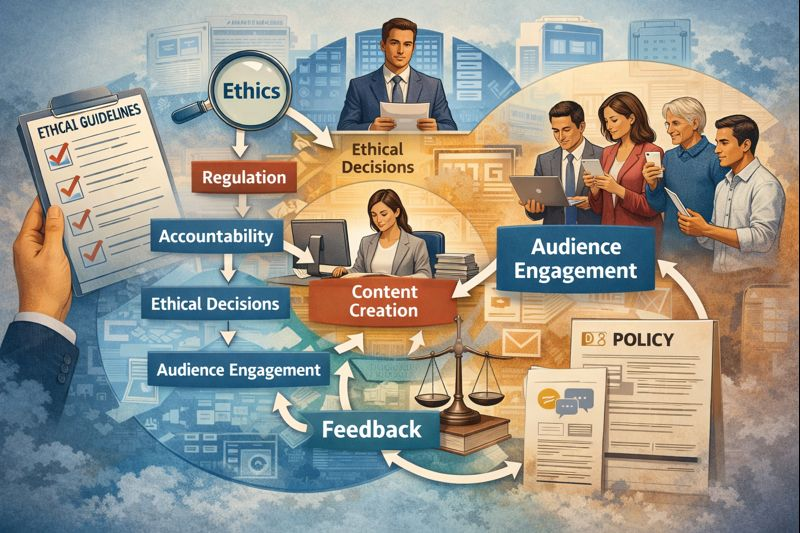
The editors are content gatekeepers who have to balance between journalistic integrity and organizational goals. They control standards of ethics, primary fact-check, and reduce false information. Ethical editors promote a culture of responsibility and codes of conduct in the newsrooms (Plaisance, 2014). They also have to find their way around such complications as covering sensitive matters, being accurate and yet not causing any harm and balancing editorial autonomy and management demands. Ethical practice is maintained through editorial training courses and codes of ethics.
5.3 Advertisers
The advertisement income is essential to the survival of the media, and there is an issue of ethical concerns when advertisers are able to influence content. Responsible advertising is the ability to separate commercial interests from editorial judgment and not to engage in manipulative or harmful campaigns (Moore, 2012). Advertisers are also involved in influencing the general discourse as they finance this content in line with their brand image or social responsibility agenda. Ethical interaction presupposes openness, explicit identification of sponsored information, and the avoidance of tricky or predatory messages.
5.4 Regulators
The media regulators create and implement legal and ethical standards, check their observance, and provide penalties. Good regulation can see to it that the media practices do not go against the societal norms, safeguard the vulnerable populations and encourage healthy competition among them (Napoli, 2011). Regulatory authorities also offer ways of resolving complaints, enhancing media literacy and fostering ethical conduct of the industry in general. The issues involve freedom of speech and the safety of society, and the ability to keep up with the technological changes in the digital media.
5.5 Audiences
Media ethics are determined by audiences in terms of consumption habits, feedback and civic action. Media audiences who are responsible critically analyze the information, reporting the unethical activities, and defending the credible sources. This two-way interaction encourages superior prerogatives and responsibility in the media production (Koltay, 2015). Education of the audience, media literacy projects, and participative platforms enable consumers to become active stakeholders, which shape the content production and ethical standards.
6.0 Discussion
The results reveal that the responsibility of mass communication that relates to ethics is collective. Media proprietors, editors, advertisers, regulators and audiences establish structural, ethical, indirect, indirect, direct, and accountability demands respectively. Ethical responsibility in mass communication can be used to illustrate interrelated activities which keep society trusting. The breach of ethical standards may be achieved through failure at any of the levels, so collective vigilance is important. Ethical compliance in the media environment is improved through collaborative policies, involvement of stakeholders, constant training, and technological protective measures.
Further, the nature of ethical misconduct is more systemic than personal negligence, and thus, there should be structural remedies to ethical conduct as well as personal accountability.
7.0 Conclusions
The responsibility of mass communication ethics cannot be bestowed on journalists. The ethical climate in mass communication is constructed by the media owners, editors, advertisers, regulators, and the viewers. The overall idea of the role of each actor, in conjunction with coordinated actions, will guarantee the integrity of the content, the trust of society, and social responsibility.
Future studies are required to investigate the ways of strengthening the collaboration of stakeholders, the effects of ethical conduct in terms of the perception of the audience, and the formulation of adaptive regulatory frameworks that would be appropriate in the context of digital media. The media can enhance democracy, promote social unity and enhance confidence that the media has in disseminating information by adopting collective ethical responsibility.
References
Baker, C. E. (2007). Media concentration and democracy: Why ownership matters. Cambridge University Press.
Christians, C. G., Fackler, M., Richardson, K., Kreshel, P., & Woods, R. H. (2015). Media ethics: Cases and moral reasoning. Routledge.
Freeman, R. E. (1984). Strategic management: A stakeholder approach. Pitman.
Koltay, T. (2015). Media literacy: Research and policy. Journal of Media Literacy, 3(1), 7-20.
Livingstone, S., & Lunt, P. (2013). The mass media, democracy and the public sphere. Media, Culture & Society, 35(1), 1-16.
McQuail, D. (2010). McQuail’s mass communication theory. Sage Publications.
Moore, M. (2012). Ethical issues in advertising. Journal of Business Ethics, 105(4), 467-478.
Napoli, P. M. (2011). Audience evolution: New technologies and the transformation of media audiences. Columbia University Press.
Plaisance, P. L. (2014). Media ethics: Key principles for responsible practice. Sage Publications.
Siebert, F. S., Peterson, T., & Schramm, W. (1956). Four theories of the press. University of Illinois Press.
Ward, S. J. A. (2018). Ethics and the media: An introduction. Cambridge University Press.