The healthcare ethics is a general and a highly needed subject, yet, as a dental student, the ethical issues have a different shape. Although such basic tenets of ethics like autonomy, beneficence, non-maleficence, and justice are universal, the application of these principles into practice when undertaking dental training should be taken into consideration. Whether in the classroom or during practical clinical experience, dental students encounter ethical dilemmas that challenge their ethical judgment and their new technical competency as well. It is important to develop an ethical mind and clinical skills so that future dentists will be ready not only to treat patients efficiently but also to act professionally.
Dental Ethics Training: The Understanding of Ethical Challenges
Dental education is also unique in the fact that the students move out of theory very early to start dealing with patients. Contrary to more purely academic subjects, dentistry involves instantaneous decision-making in which ethical concerns have a direct effect on the patient. Patient rights, informed consent, and confidentiality are two common ethical issues in the classroom. On the one hand, these ideas might seem quite simple during lectures, on the other hand, the use of these ideas is complicated during the work when a student meets a patient with unusual medical, cultural, or individual conditions.
As an example, a patient can refuse treatment because of cultural beliefs, or a student can feel unready to attempt to perform a procedure that the supervisor wants him to attempt. When this occurs, the students have to find a balance between their obligation to the patient and the educational requirement of their instructors. Ethical competence then becomes an aggregate of knowledge, judgment and experience.
Interactions between Students and Patients: Informed Consent and Communication
Direct interaction with patients is one of the most frequent places that bring ethical issues to the minds of dental students. Students do not have the confidence to engage in delicate discussions regarding treatment plans, potential risks or the procedure option as the experienced practitioners. Informed consent is not a mere formality obtained, but it is one of the pillars of ethical practice. Before consenting to any treatment, students should be very sure the patients are aware of the method, options, and potential consequences of the treatment.
Besides, students should acquire good communication skills that do not violate patient autonomy. Patients might possess questions or issues that cannot be answered with technologies only; they need or should be empathized with, patient, and honest. Inability to communicate appropriately may undermine trust and even breach the ethical standards even though the clinical work may be competent.
To reinforce this development, dental programs frequently have simulated patient interactions or use standardized patients, in which students are free to practice ethical communication in a regulated context. This experience aids in inculcating in the student the ethical value of transparency, respect and patient-centered care.
Supervision Dynamics: The Dynamic between Learning and Responsibility
The other area that is specific to dental students is the relationship that exists between supervision and autonomy in clinical practice. Learners shall be required to operate under different degrees of supervision, and this may cause some ethical conflicts. As one instance, a student might be under the pressure of doing something that is well outside his/her competence to satisfy curriculum demands or to win the favor of the supervisor.
At that, the ethical notions of non-maleficence, or, in other words, non-harm, should be used. Students have to be aware of their weaknesses and seek advice where it is required even though it might seem to slow down their process or manipulate assessments. Another ethical concern that supervisors should ensure is that students should not sacrifice patient safety to gain skills.
Such a dynamic explains why moral courage is worth nurturing in students. Taking a stand when in doubt, asking clarification to any instruction that can pose any threat to the patient, and seeking further assistance are all moral acts that safeguard patients and encourage authentic learning.
Clinical Competence and Accountability
Technical competence is closely related to ethics in dental education. Not only a student who carries out a procedure wrongly exposes the patient to the risk of harm, but also questions of responsibility. Ethical accountability means accepting errors, notifying negative incidences and gaining lessons out of the errors without blaming.
In the case of dental students, this can include reporting an incident, talking to supervisors, and considering ways in which it can be prevented. It also involves taking constructive criticism and making improvements. In this regard, ethical development cannot be considered without technical development; students that do not accept accountability will endanger patient safety and their own professional growth.
One of the issues related to the promotion of accountability is the culture of mistakes being viewed as learning experiences instead of a failure only. Dental schools having a focus on reflective practice help students not only look at the moral side of every case but also at the clinical one, which ensures that the idea of competence and integrity should be built simultaneously.
Professional Conduct and Confidentiality
A dental student should also cope with the moral duty of confidentiality and professionalism which is especially important in learning clinics. Through students, patients give confidential details regarding their health and it is a moral responsibility to keep this confidentiality. Violation of confidentiality, both intentionally or unintentionally, in the process of casual communication or use of social media, can be costly at the ethical and legal level.
Professional conduct is perceived not just on the aspect of confidentiality, but also on the aspect of professional demeanor, respect towards colleagues and staff and compliance with the internal policies of the institution. Students should keep in mind that they always represent the dental profession so whatever they do affects the reputation of the training program and the profession in general. Being professional in personal relations with patients, colleagues, and bosses is an essential part of ethical growth.
The Issue of Ethical Dilemmas in Limited Resources
Ethical dilemmas that are associated with resource constraints are common among dental students. As an example, during community clinics or public health rotations, students might be faced with the circumstances in which optimal treatment cannot be provided because of equipment shortage, a lack of time, or financial limitations. Such situations need close ethical consideration: how will the student be most able to give the best care with the resources at hand and be sincere about constraints?
This highlights the need to be just in dental ethics, which means being fair and providing equal access to care. Students have to think not merely according to what is clinically possible but also according to what is ethically responsible. A major component of training is the development of strategies that can balance these conflicting demands to equip the students with real world practice.
Making Ethical Reflection a Part of Life
Dental students are encouraged to think continuously in order to develop good ethical reasoning. They include having to critically examine the choices they make, acknowledge possible bias, and discussing difficult cases with mentors. Numerous dental courses include reflective journals, ethics courses, and case study discussions to promote this practice.
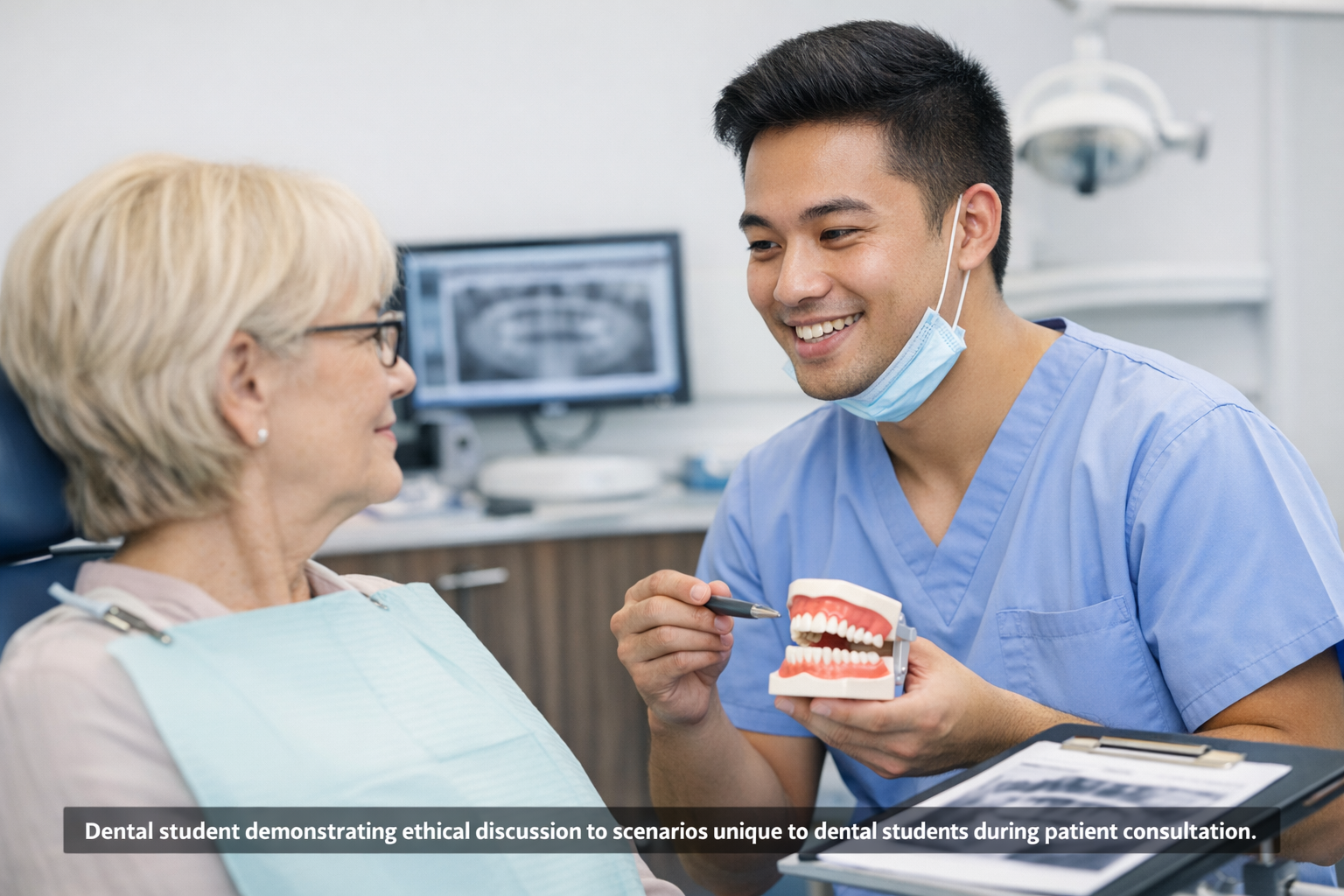
The idea of ethical discussion to scenarios unique to dental students, is an advantageous tool to guide the students through these situations as it offers practical examples of the dilemmas that the dental trainees face. Through the analysis of these scenarios, students are able to predict ethical issues, analyze how they would react, and become more efficient decision-makers in a positive setting.
Frequent thinking makes the students internalize ethical values, and abstract rules would be applied into practical action. In the long run, the practice will instill moral strength that will empower the students to deal with complicated clinical cases with confidence and integrity.
The Mentorship and Ethical Development
Mentorship is an important tool to accompany dental students in assisting with ethical issues. Seasoned dentists and instructors are able to demonstrate ethical behavior, to give advice in some ambiguous cases and to provide feedback both on technical and moral performance.
A mentor would assist a student in overcoming a problematic encounter with a patient, explaining the process of informed consent, or simply suggesting how to cope with the mistakes at work. Mentorship does not only strengthen the connection between ethical reasoning and clinical excellence, but also increases ethical awareness.
In addition, through the mentors, students can be assisted in building moral courage by making sure that they can focus on patient welfare, rather than personal convenience or academic stress. This advice is priceless, considering the fact that habits one develops in school are transferred to the workplace.
Ethical Practice Preparation Outside School
The moral maturity developed in the course of dental training is the basis of lifetime professional integrity. Students are able to face ethical issues early enough and build a model of decision-making that is not limited to the classroom and clinic. Informed consent communication, accountability, confidentiality, and justice in care provision are the skills which become embedded and future practitioners are ready to manage complex situations in a responsible way.
Notably, ethical competence is not terminated upon graduation. Similar to any other profession in healthcare, dentistry is a constant learning and reflection process. Students with experience in ethical thinking and clinical ability are more likely to adjust to the changing standards, technologies and expectations of the society.
Conclusion
Dental student-specific ethics is an essential part of learning enabling the student to fill the gap between the abstract knowledge and clinical work with patients. There are distinctive difficulties in the transition between classroom education and patient care, such as student-patient relationships, supervision relationships, competence and accountability, confidentiality and professionalism.
Combining the ethical reflection, mentorship and practical experiences, dental students will grow into the moral judgement to practice responsibly. Being able to identify and act on ethical dilemmas during training will mean that, in addition to technical competency, integrity, empathy, and professionalism are achieved. Finally, the ethical base created in dental education does not only equip students to develop them to excel in their academic pursuits, but also to maintain confidence in services to patients in a way that is trustworthy, respectful, and excellent in their lives.