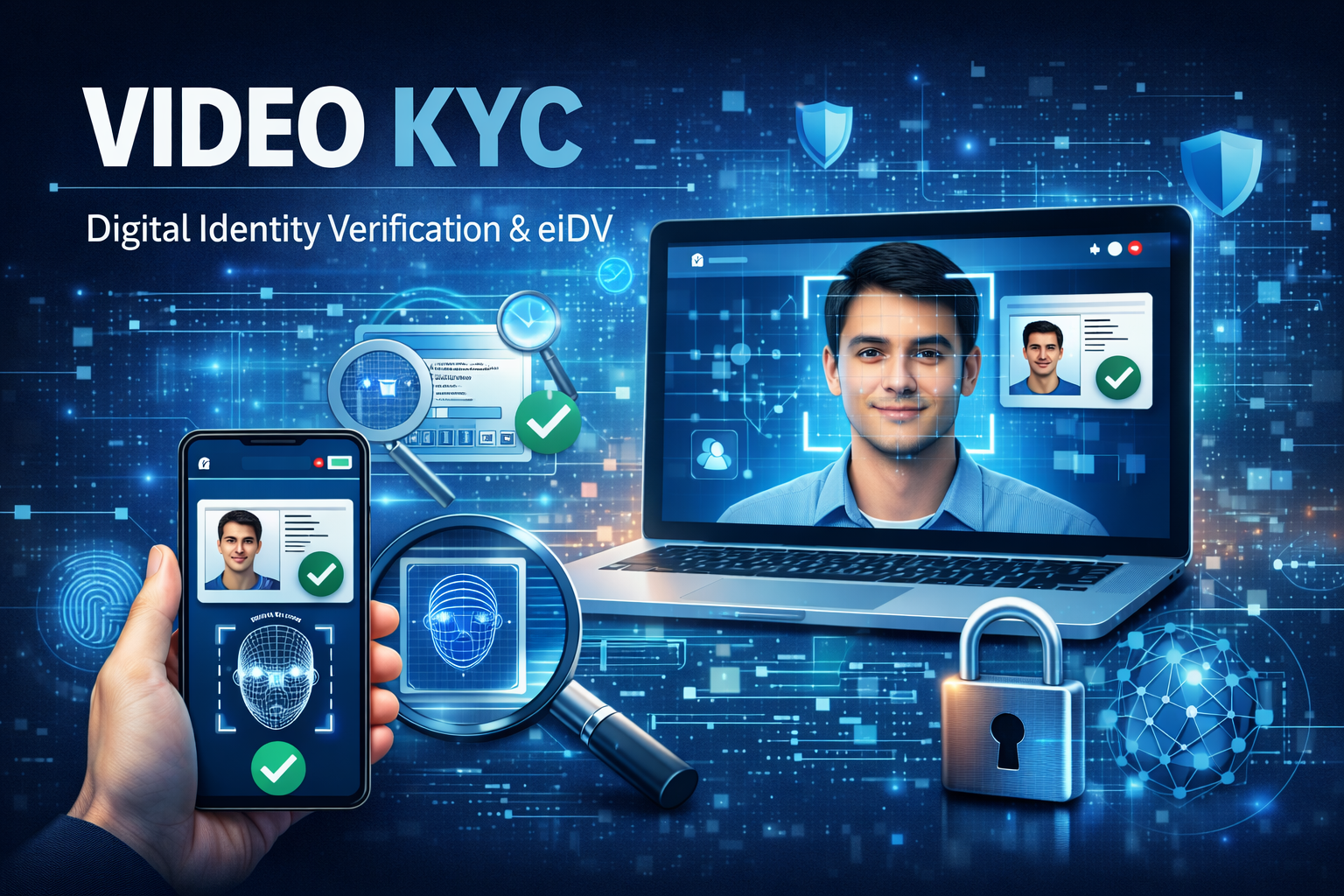
The emergence of online banking, online wallets, and remote financial solutions has compelled the process of identity verification into the digital world. The traditional KYC practices that involve physical submission of documents and personal interaction are not viable anymore to address the requirements of a high-paced security-aware world. Introduction to video KYC, which is technology-based and enables businesses to verify identities remotely without compromising compliance and minimizing the risk of fraud.
How Video KYC Works
Video KYC allows a person to go through the identity-verifying process in real-time via a video call, most commonly by using a smartphone, tablet, or computer. It usually includes a live video chat with a human agent or an artificial intelligence system. In the process, the user is directed to show IDs issued by the government, answer verification, and face check. The technology compares the live faces of the user and document photo, which is authentic and will eliminate any attempts of impersonation.
In addition to face matching, video KYC incorporates some features of eIDV (electronic identity verification), including automated document verification, database cross-referencing, and biometric liveness checking. The combination of live interaction and automated validation makes sure that there is strong identity verification that does not need physical presence.
Advantages of Video KYC
Video KYC has its advantages on the security, compliance, and user experience levels. First, it saves a lot of time in boarding as opposed to the traditional ones. The process can be completed anywhere the user does not have to take long waits and travel. Second, it enhances security by verifying faces and preventing frauds like liveness checking, which ensures that the individual is in physical presence and not a person with a tampered image and video.
Compliance wise video KYC is compliant with the international regulations. Video KYC is accepted as a valid form of identity verification in many countries such as India, UK and Singapore provided that it is done through secure and audited processes. It also provides elaborate logs of verification sessions, such that regulatory reporting and audit are smooth.
Face Recognition: An Essential Element
The key to video KYC is face verification. It makes sure that the individual presented in the video is the same as the ID document being presented. The current face verification technologies use machine learning algorithms to map facial features, identify minute features, and assess distances between points on the face. The algorithm is too accurate to notice that they attempted to circumvent verification by use of photos, videos, or masks.
Face verification is an effective defense against identity fraud when it is used together with liveness detection. Liveness detection can be used to determine that the real person is communicating with the system by examining eye movements, facial expressions and head orientation. This provides the much needed extra security that is not limited to the checking of documents.
The Role of eIDV in Video KYC
Whereas video KYC is the process of remote verification through video, eIDV (electronic identity verification) is a larger technology system that supports the process of secure digital identity validation and that includes document verification, automated database verification, risk scoring, and facial verification. eIDV operations are embedded into the process of video KYC to verify the identity documents delivered, cross-reference with databases of fraud, as well as to comply with anti-money laundering (AML) and counter-terrorism financing (CTF) laws.
Organizations can combine video KYC with eIDV to establish an overall verification ecosystem. This makes sure that not only is the identity verified visually, but also compared to the valid digital records and minimizes the chances of fraudulent onboarding.
Emerging Trends in Video KYC
AI-Driven Automation
Video KYC is still taking a revolution by artificial intelligence. Complex verification of identity features like facial recognition, an OCR (Optical Character Recognition) scan of ID papers, and risk analysis can now be performed by AI algorithms. Automation saves time on human involvement, the onboarding process is fast, and high rates of accuracy are enjoyed in large levels of verifications.
Digital Identity Platforms integration
Video KYC is being absorbed into larger digital identity systems. The users may attach their verification sessions to digital IDs or e-wallets and eID systems issued by the government. These integrations facilitate the process making it easy to identify oneself across various services and even minimizes the friction of end users.
Privacy-First Verification
With the shift to identity verification via the Internet, privacy becomes a significant concern. The current video KYC systems focus on data security by encrypted transmissions, secure data storage and limited retention policies. The use of data can be often disclosed to users and their personal data is provided with control, which is consistent with the laws, including GDPR, and promotes trust.
Regulatory Adaptation
In line with changes in the regulation, video KYC technologies change. With the governments improving KYC and AML regulations in online channels, video KYC platforms have added audit trails, granular session recordings, and automated compliance reporting features. This makes businesses stay in line with them and offers an effective onboarding process.
Challenges in Video KYC
Although video KYC has benefits, it has some challenges. Video demands a good internet connection, and this is not a stable one, and the video may not be available everywhere. User comfort can also be influenced by the cultural differences and the lack of familiarity with video interaction. Technically, video KYC can be difficult to integrate into legacy banking systems or enterprise systems.
The issue of security is a sensitive topic. Face verification and eIDV offer high protection, though, attackers still work on high-technology approaches to bypassing controls. Constant monitoring, updating of AI models, a hybrid system of automatic checks and supervision by a human can be seen as essential elements of maintaining trustworthiness.
The Future of Video KYC
The future state of video KYC is significantly related to the development of AI, biometric technologies, and digital identity ecosystems. Video KYC will also be quicker, more effective, and more secure as face verification technologies are enhanced along with eIDV technologies. Its popularity will be increased with the implementation of mobile-first, integration with the global digital ID systems, and privacy-first designs.
The adoption of video KYC will not only enhance the security and compliance of the organization but also provide the organization with a competitive advantage due to a better user experience. At a time when digital trust is the key, video KYC is not just a convenience but a significant part of a modern identity checking strategy.