Stress is a normal biological reaction that helps the brain to respond fast to challenges and threats. Temporary stress can be beneficial in brief periods of time, making one alert and focused in order to perform better. But, under the case of chronic stress, the brain changes the effects of stress to harmful rather than adaptive. Long-term stress hormone exposure changes the brain structure, neurotransmitters, and cognitive and emotional control.
It is the brain that is especially susceptible to the chronic stress due to the fact that it is the source of the stress, as well as the main object of the stress. Areas that are involved in memory, concentration, emotional regulation, and motivation are directly influenced by the long-term hormonal signalling. With time, these have an accumulating effect of anxiety, depression, lack of concentration and cognitive impairment.
This article discusses the neurological and psychological consequences of chronic stress on the brain. It explains why early intervention is critical to safeguarding the mental health by exploring alterations in the major brain areas like the hippocampus and amygdala, as well as neurotransmitter and neural plasticity dysfunction.
Stress as a Biological Process That Is Driven by the Brain
The onset of stress starts in the brain way before the body starts feeling it. Whenever a person perceives danger, either physically, emotionally, or psychologically the brain raises an organized activity that is meant to enhance survival. The hypothalamic pituitary adrenal (HPA) axis is what controls this response and connects the brain to the endocrine system.
After being stimulated, the HPA axis causes release of stress hormones such as cortisol and adrenaline. These hormones can affect the brain activity by changing blood circulation, availability of energy and the transmission of neurotransmitters. This procedure increases alertness and response time in acute conditions.
Stress signals do not disappear easily, which leads to problems. Chronic stress maintains the brain in a hyper vigilance state and does not allow the brain to recover and leads to impairment of normal functions of the neural system.
Stress Circuitry of Chronic Stress and the Brain
The stress circuitry of the brain functions excessively under chronic stress. Fear and emotional threat processing is amplified in the amygdala, which is sensitive to it. Concurrently, reasoning and memory, as well as emotional control, areas start to degenerate.
This disproportion strengthens a process where the brain gets more responsive to stress and loses control over emotional reactions. Consequently, these people might develop chronic anxiety, hyperactivity and lack of concentration even in non-threatening circumstances.
Studies conducted on the neurological and psychological implications of living under chronic stress have revealed that these developments are not only emotional but structural and even chemical, which influences the manner in which the brain interprets information and feelings.
The Hippocampus: Stress and Memory Disability
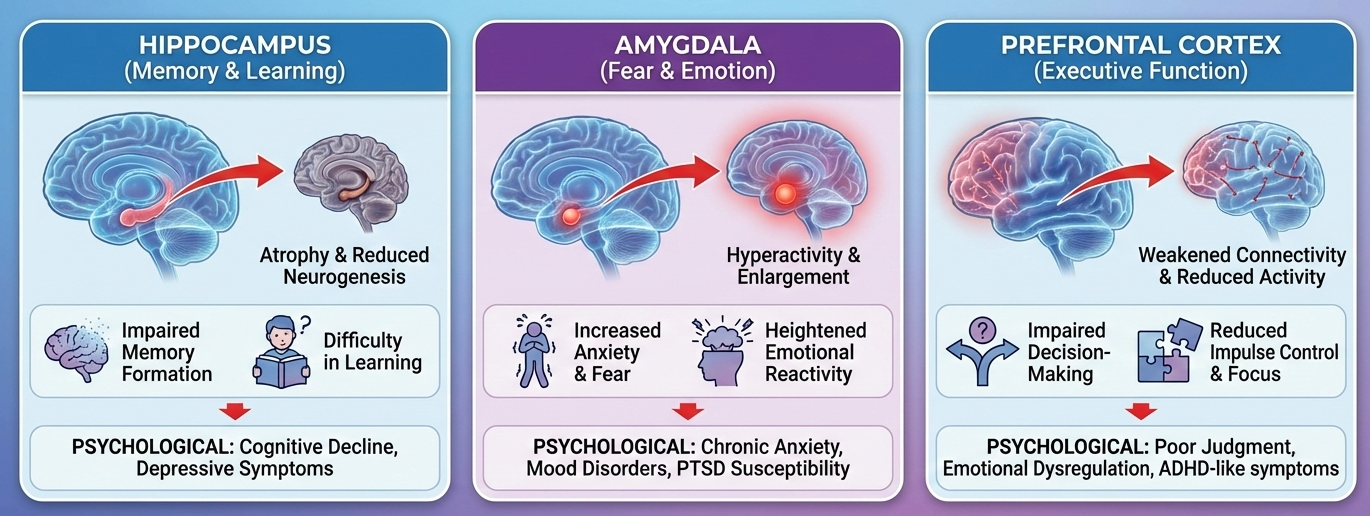
The hippocampus is a crucial part of the brain that is involved in learning and memory formation and controls emotions. It is also considered to be one of the most stress sensitive parts of the brain because it is extremely concentrated to cortisol receptors.
Cortisol has the ability to promote memory encoding in the short term. But on prolonged exposure it works in the other direction. The neurogenesis process, during which new neurons are created in the hippocampus, is decreased by chronic stress. It also disrupts synaptic plasticity which is critical in learning and memory consolidation.
Due to this, people who are or will be subjected to chronic stress tend to have memory losses, retention difficulties, and lack of cognitive flexibility. The volume of hippocampal can reduce with time and more damage cognition.
The Amygdala: Hyperirritability to Fear and Emotional Reactivity
On the one hand, the hippocampus degenerates in the conditions of long-term stress; on the other hand, the amygdala is overactive. Amygdala is the part of the brain that detects dangers and creates emotions like fear and anxiety.
Constant stress enhances the neural connections in the amygdala making it more sensitive to danger. This hyper-focused sensitivity reduces the threshold of stress activating, i.e. small problems can cause unreasonable emotional responses.
This receptor change is the reason why stress as a chronic condition is related closely to anxiety disorders and emotional instability. This causes the brain to be biased to the threat detection and lowers the emotional resilience.
Prefrontal Cortex Disfunction and Lapse of Concentration
The executive functions of the brain that are performed by the prefrontal cortex include attention, impulse control, decision-making, and emotional regulation. This region is greatly impaired by chronic stress.
High cortisol distorts neural transmissions in the prefrontal cortex, impairing the working memory and attention control. This results into inability to concentrate, lack of good decision making and problem-solving skills.
With a weakening of the prefrontal control, the amygdala gains more influence; emotional responses become more difficult to control. This unequal condition leads to moodiness, annoyance, and impulse actions.
Neurotransmitter Imbalance in Case of Chronic Stress
Neurotransmitters refer to chemical substances that enable the neurons to interact. The experience of chronic stress changes the ratio between a variety of major neurotransmitters of mood and cognition.
Serotonin, a mood stabilizer and emotional regulator is usually depleted with the effects of chronic stress. The dopamine (motivation-reward) is dysregulated, which contributes to apathy and decreased pleasure. Norepinephrine that promotes alertness can be sustained which can result in restlessness and anxiety.
Such chemical adaptations underlie the close association of chronic stress with depressive, anxious, and emotionally exhaustive states. The chemical condition of the brain alters and becomes detrimental to the psychological health.
Neural Plasticity and Stress
Neural plasticity can be described as the ability of the brain to change, restructure and establish new connections. This is the learning capacity, memory and recuperating the psychological challenges.
The chronic stress impairs neural plasticity by preventing the development of new brain cells and undermining the existing ones. High levels of cortisol disrupt brain, derived neurotrophic factor (BDNF) which is a protein vital in the survival of neurons and their synaptic performances.
The decrease in plasticity impairs the brain to adjust to change and overcome emotional stress and makes them vulnerable to mental health disorders.
Stress, Mood Disorders and Emotional Health
These factors (combined effects of hippocampal destruction, hyperactivity of the amygdala, neurotransmitter imbalance and decreased plasticity) provide a neurologic milieu that supports mood disorders.
Chronic stress makes one more susceptible to anxiety and depression, because it changes the way emotions are processed, and also makes people less resilient. The emotional reactions are more vivid and sustained and hard to control.
Such changes are not perceived as personal weakness but as the quantifiable biological changes in the functioning of the brain. Knowing this will assist in eliminating the stigma and emphasizing the need to deal with stress at an early stage.
Cognitive Long-term Brain Health and Long-term Cognitive Decline
With time, chronic stress leads to cognitive impairment through deterioration in memory, attention and executive functions. Prolonged inflammation and hormonal imbalance enhance the aging of the nervous system and predisposition to neurodegenerative disorders
Although stress in itself does not lead to cognitive disorders, it is a powerful risk factor since it undermines protective mechanisms in the brain.
To safeguard brain health, it is thus important to deal with stress as a long-term prevention measure.
The significance of Early Intervention
Stress-related changes in the brain are not immediately noticeable since the changes are built over time, and would only be realized when the symptoms are too extreme. Timely treatment is important to avoid a long-term harm.
Early intervention can regulate the level of hormones, promote neural plasticity and safeguard damage prone brain areas. Coping strategies that are healthy, sufficient sleep and favourable environments minimize stress activation at its point of origin.
The ability to perceive stress as a biological process and not an emotional event only allows individuals to find support in time.
Conclusion
The brain is in a state of persistent stress, which remodels the brain, modifies its structure, chemistry, and functioning. Stress interferes with the memory, concentration and mood through its impact on the function of the hippocampus, amygdala, prefrontal cortex, and the neurotransmitter systems.
The psychological and neurological effects of chronic stress proves that the psychological well-being cannot be separated by physiological reactions to stress. The preservation of cognitive functioning, emotional, and long-term brain health requires the use of early intervention and stress management.
The knowledge of the effects of stress on the brain offers a strong basis of safeguarding the mind in a world which is becoming more and more stressful.