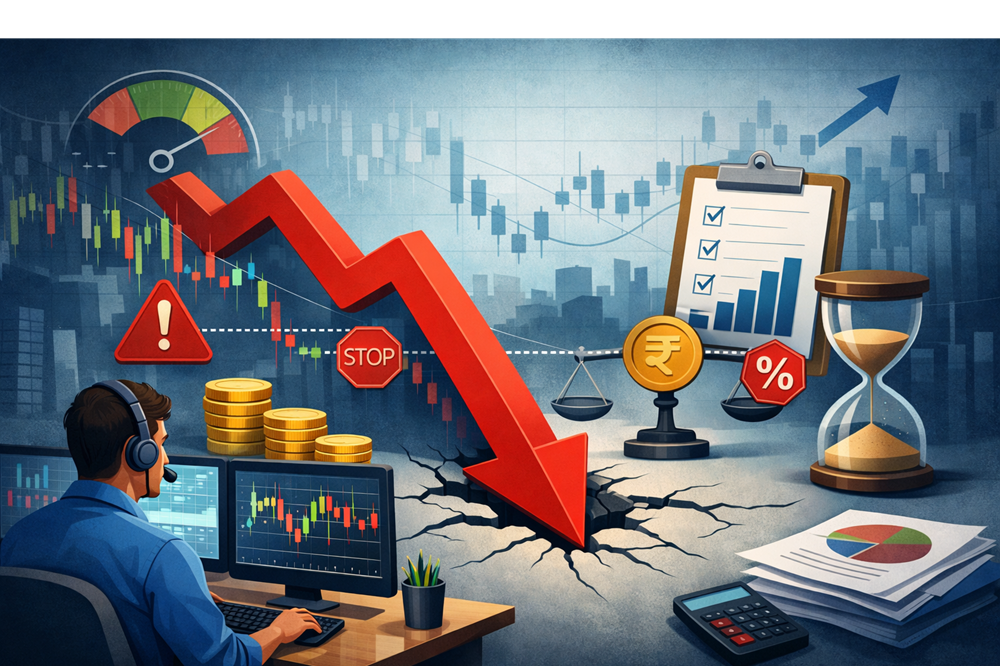
Drawdowns are one of the biggest risks in futures and options trading, even for traders who follow rules and manage positions carefully. In F&O, losses can grow faster because margin and price movement can turn a running trade into a loss quickly. A drawdown is not only about one bad trade. It is about the fall in total account value during a losing phase.
This blog explains what drawdown means in F&O and how it is controlled through risk limits, trade-size controls, and disciplined entry and exit rules.
What Drawdown Means in F&O Trading
In F&O trading, drawdown refers to the drop in total account value from a recent high to a later low, before a new high is achieved. Total account value includes booked profit or loss, the running profit or loss on ongoing trades, and trading charges.
Drawdown is useful because it shows the impact of a weak phase, not just the result of a single trade. In F&O, drawdowns can deepen faster due to leverage, where margin allows control of a larger trade value than the cash available, sharp price swings, and the way available margin can tighten as account value falls.
Key Drawdown Metrics Used By Traders
Traders do not look at drawdown in only one way. Different metrics show different parts of risk, so they are often tracked together.
Maximum Drawdown
Maximum drawdown is the largest decline from a peak in account equity to the lowest point that follows, measured over a chosen time period. It tells traders the worst decline the strategy has shown so far.
In F&O, maximum drawdown is important because it shows how much damage can occur when volatility rises or exposure is too large. Traders use this number to check whether their risk limits are realistic and whether trade amounts are aligned with their account value.
Percentage Drawdown
Percentage drawdown measures the decline in equity as a percentage of its earlier peak. This makes it easier to compare drawdowns across traders with different capital levels. In F&O, percentage drawdown often provides a clearer picture than rupee drawdown, as it shows how severe the decline is relative to total capital. It also highlights the recovery challenge.
As the drawdown becomes larger in percentage terms, the gain needed to return to the earlier peak becomes harder to achieve with controlled risk.
Time-Based Drawdown
Time-based drawdown measures how long the account stays below its earlier equity peak. It focuses on duration, not only the depth of the decline. This matters because long recovery periods can signal that market conditions have changed or that the approach is not working well in the current environment.
In F&O, long drawdowns can also increase the risk of mistakes, as traders may become impatient and trade more often or take setups that do not fit their rules.
Why Drawdown Management Is Non-Negotiable in F&O
Drawdown management is important in F&O because a falling account value can quickly reduce flexibility. As losses grow, available margin can tighten, potentially restricting the ability to keep trades open through normal market movements or to exit calmly.
Drawdowns also affect judgment. During a losing phase, attention can shift from following rules to trying to recover losses fast, which can increase risk and deepen the decline. Clear drawdown rules add structure during stress and help keep decisions steady and repeatable.
Structural Causes of Large Drawdowns in F&O Trading
Large drawdowns in F&O are often driven by repeatable structural issues. A common cause is using a trade amount that is too large for the account, so even ordinary price movements lead to heavy losses. Another cause is weak exit discipline, such as delaying an exit or raising risk after the trade turns unfavourable.
Concentration is also a factor, where too many trades depend on the same underlying, the same direction, or the same expiry cycle. Over many trades, these frictions can widen drawdowns, especially when markets are moving quickly.
Drawdown Thresholds and Risk Limits
Drawdown thresholds are pre-set levels that trigger a planned response when the account value falls. The purpose is to prevent a manageable decline from becoming a damaging one. Many traders use layered limits. A smaller threshold may lead to reduced trade amount and stricter selection, while a larger threshold may lead to pausing trading and reviewing rule-following.
Risk planning is best done early, including before choosing to open a free demat account and enabling F&O access, so limits are ready before capital is put at risk.
Drawdown Control Methods In F&O
Drawdown control is built through consistent rules that reduce risk when equity declines. These methods aim to limit damage, prevent emotional decisions, and maintain a stable trading process.
- Reduce Trade Amount After a Decline: Lower the number of lots or the capital used per trade when the account value falls.
- Use a Firm Daily Loss Limit: Stop for the day when the limit is hit, instead of trying to win it back.
- Follow Exit Rules Without Delay: Exit when the trade is invalid, rather than holding and hoping.
- Cap Combined Risk Across Trades; Limit how much total loss is possible if several trades move against the account.
- Lower Risk When Price Swings Widen: Reduce risk per trade when markets become unusually sharp and fast.
- Control Avoidable Costs: Choose liquid F&O contracts so entries and exits are smoother, and avoid frequent switching that increases charges and execution loss.
Conclusion
In F&O trading, drawdowns are a normal part of the journey, but unmanaged drawdowns can become a serious threat to capital and discipline. Understanding drawdown clearly, measuring it in multiple ways, and setting firm thresholds help traders respond with structure rather than emotion. Strong control methods such as equity-based sizing, loss limits, disciplined exits, exposure caps, and volatility-aware risk adjustment can reduce the damage of losing phases. When drawdown management is treated as a core rule set, traders improve their ability to stay consistent and protect long-term participation in the markets.