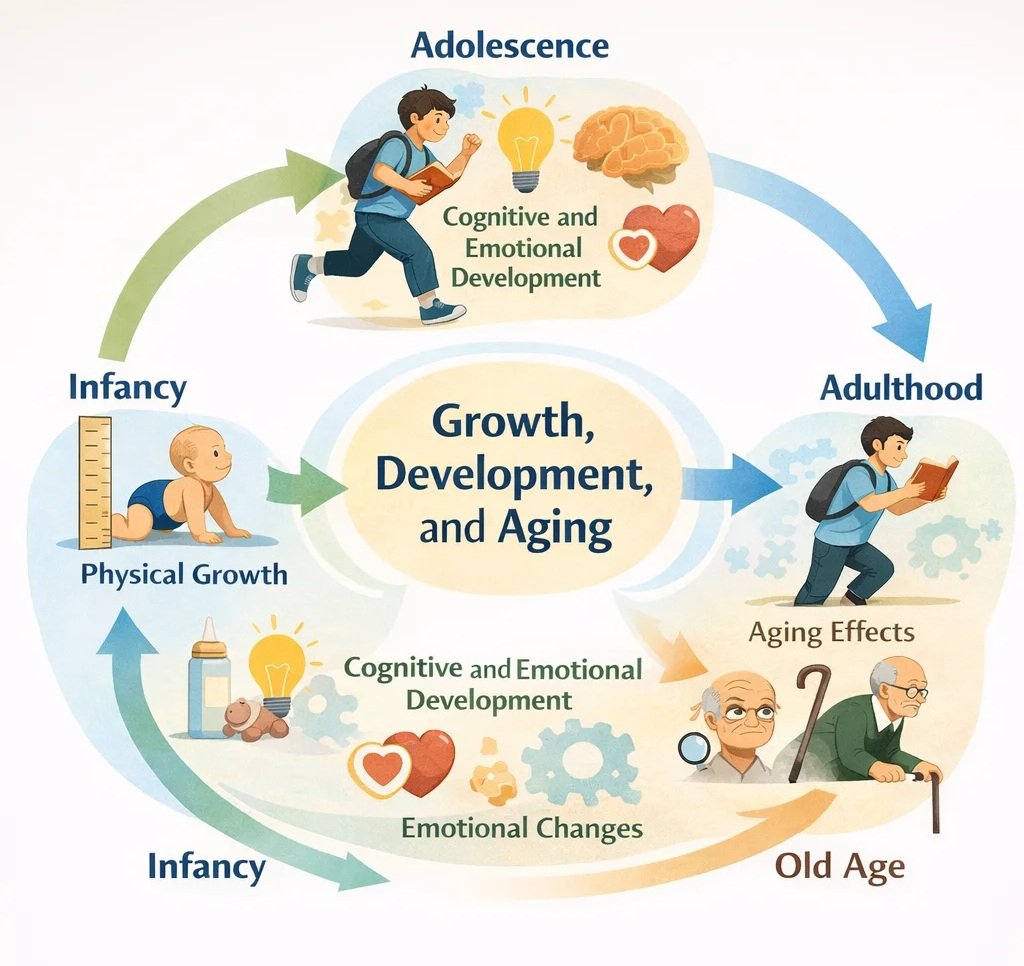
Human life can be studied in terms of the processes controlling our physical, mental and emotional transformations. Growth, development, and aging are some of the most essential concepts of the biology and health sciences. Although the terms are usually used interchangeably, they are two different biological processes. These concepts are critical and require a good insight among students, teachers, and other healthcare practitioners. This paper discusses the meaning of growth, development, and aging, their correlations with one another and their distinctive features using practical examples.
What is Growth?
The quantitative rise in size or mass of something or somebody is called growth. It is an objective procedure which is commonly measured in respect to height, weight, organ size or number of cells. Growth is a process that takes place due to cell division, cell enlargement and accumulation of organic material. It is a natural and continuous process that starts at conception up to adulthood but the pace of development varies at various stages of life.
Characteristics of Growth
- Measurable: The growth can be measured by measuring height, weight, body mass index (BMI), or organ volume.
- Irreversible: Once tissues or organs are developed, they do not in normal conditions replace themselves by becoming smaller.
- Predominantly Physical: Growth mainly involves the structural and anatomical characteristics and not the functional or psychological characteristics.
Example of Growth
Take an example of a child who has increased in height at birth, 50 cm and 170 cm in adolescence. This height gain is an indication of physical development which can be projected and monitored over time. On the same note, the gain of weight of an infant as he or she grows through the period of childhood is also an example of a growth.
What is Development?
Development constitutes a qualitative process which entails the progressions of an organism which would give rise to a higher level of complexity and functionality. Development, unlike growth, includes physical and psychological changes such as cognitive, emotional, and social development. Development is a life long process that incorporates both a biological, psychological and social aspect.
Development Characteristics
- Qualitative: Development is focused on the increase in abilities, skills, and functional competence, and not on the measurable size.
- Progressive: There is a certain order of the development, which is sometimes known as developmental milestones, which dictates the development of new abilities.
- Continuous: Despite making a plateau after adolescence, the development process is continuous throughout life in one way or another, among them emotional maturity and intellectual capacity.
Example of Development
The well known one is language acquisition in children. A baby goes through the stage of cooing to the stage of coming up with simple words and then complex sentences. Though their physical development in the brain can be measured, the qualitative advancement in communication skills is an indication of development. The other instance is the emotional development of teenagers as they get to learn how to cope with interpersonal relations and self-identity.
What is Aging?
The process of biological, psychological and functional loss and deterioration which follows the highest point of growth and development is natural and gradual, and is called aging. Aging unlike growth and development which are mainly concerned with building capacity captures the changes that culminate to reduced functional efficiency as age increases. Genetic factors, lifestyle and environmental exposure are considered to affect aging.
Characteristics of Aging
- Age: Aging is a natural process that can never be prevented but the consequences can be postponed.
- Progressive Decline: Aging is the process by which cellular functions, tissue elasticity and organ efficiency are lost gradually.
- Multi-dimensional: Aging has implications on physical health, cognitive and emotional stability.
Example of Aging
The person may lose muscle strength and be slower at cognitive processing, as well as, the skin may become less elastic with age. As an example, an elderly of 70 years old cannot run as fast as a 20-year-old because of the lack of bone density and muscle mass, which demonstrates the physical elements of aging. Other more examples of how aging influences mental capabilities are cognitive slowing and memory changes.
Comparison of Growth, Development and Aging
Even though growth, development and aging are coupled, each possesses distinct characteristics that characterize it differently. It is important that students of biology, medicine, and health sciences know these differences.
| Feature | Growth | Development | Aging |
| Definition | Increase in size and mass | Functional changes which are progressive. | Gradual decline in function |
| Type | Quantitative | Qualitative | Functional/biological decline |
| Measurement | Height, weight, organ size | Miles, cognitive and emotional skills. | Muscular functioning, recollection, organ activity. |
| Direction | Builds up | Builds complexity | Gradual deterioration |
| Timeframe | Starts in early life, peaks in teenage. | Lifelong process | Onset of growth and development is reached. |
| Examples | Children increase in height and weight. | Acquisition of languages, skill development. | Skin wrinkles, loss of movement. |
The Relationship between Growth, Development and Aging
These processes are sequential and though different, they are interrelated. Development is based on growth as a structural basis. As an illustration, cognitive development is facilitated by physical development of the brain. Likewise, aging predetermines the level of development since it predetermines the highest possible level of functional capacity, which will decrease in the future.
The relationship between growth, development, and aging may be represented in the form of a graph:
- Growth Phase: Celts increase, organs develop, and growth takes place.
- Development Phase: Sharpening of skills, intelligence, emotional and social skills.
- Aging Phase: Progressive loss of functioning, loss of efficiency and mortality.
The continuum is vital in the areas of pediatrics, gerontology, and health education.
Life-Time Situations that define the differences
Physical Growth vs Development
A 10 year old might be physically tall compared to his age mates because he might have passed through early growth spurts but he might not be equally social or mentally developed as his age mates. This confirms the fact that development does not necessarily mean growth.
Development Without Growth
Take an example of an adult learning a new language or musical instrument. Their physical growth has remained stagnant but their mental and emotional abilities are still in the process of maturation which points out that growth can be achieved even without the necessity of growth.
Aging After Development
A sports star can achieve his or her best physical and mental abilities at the age of 20s or 30s. With the next decades, muscle mass, reaction speed, and cardiovascular efficiency become more and more weaker, which is an indication of the natural aging process after the growth and development stage.
Significance of Differentiating the Concepts
The knowledge of the differences between growth, development, and aging can be used in many spheres:
- Education: Teachers will have the opportunity to focus the learning strategies according to the developmental levels and not only the physical size.
- Medicine: Pediatrics and gerontologists use such differences to measure health and formulate interventions.
- Psychology: Developmental milestones are used by professionals working in the field of mental health to assess cognitive and emotional health.
- Public Health: The policy-makers will be able to create age-specific health-promotional interventions that will take into account the needs of children, adults, and the elderly.
Influencing Factors, Growth, Development and Aging
Genetic Factors
Genes help in the determination of the growth potential, the time of developmental milestones, and the rate of aging. As an example, genetic disorders may limit growth, slow development or speed up aging.
Environmental Factors
The processes are affected by nutrition, socioeconomic status, education and exposure to toxins. Malnutrition may retard growth, the absence of stimulation may retard cognitive development, and the stresses of the environment may increase the aging process.
Lifestyle Factors
Exercise, mind, and socialization have a positive influence on growth, developing results, and aging. To illustrate, physical activities at an early age allow bone density (building), motor (development), and age (aging) reduction.
Conclusion
Although growth, development and aging are processes that occur together in the lifespan, they vary greatly in nature, measurement and impacts. Growth is a quantitative physical change, development a qualitative change in functional progression and aging is a gradual deterioration of biological and cognitive functions. The identification of these differences aids both students and teachers and other health practitioners to understand the stages of human life and implement the right interventions.
Through learning the two processes simultaneously, we get to have a clear picture of human life, and we get to value the way we grow, evolve, and at the end, we age. Incorporation of knowledge regarding these stages is critical in the development of health sciences, better patient care and lifelong well being.