Your rankings aren’t improving.
You’re publishing content. Building links. Optimizing pages.
Yet nothing moves.
Here’s the problem: You’re probably doing three things that actively hurt rankings while thinking they help.
Let’s fix that.
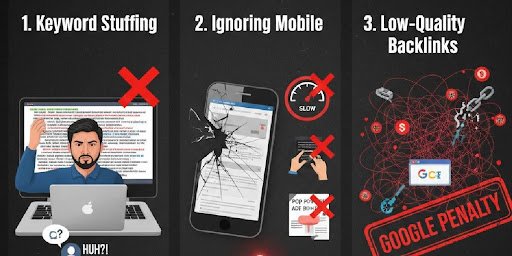
1. Stop Keyword Stuffing and Over-Optimization
You know what keyword stuffing looks like.
“Looking for the best plumber in Karachi? Our Karachi plumbing services provide expert plumbing services in Karachi for all your Karachi plumbing needs.”
It’s painful to read.
Google agrees.
Why This Destroys Rankings
Search algorithms in 2026 understand natural language, context, and semantic relationships. They don’t need you to repeat “plumber in Karachi” seventeen times to understand your page is about… plumbing services in Karachi.
When you keyword-stuff, three things happen:
- Users bounce immediately because your content reads as if a robot wrote it for other robots.
- Google’s spam detection flags your page as manipulative, low-quality content designed to game rankings rather than help users.
- You tank your own rankings because engagement metrics (bounce rate, dwell time, pages per session) signal that your content provides a terrible user experience.
Keyword stuffing is a one-way ticket to getting penalized.
What Actually Works
Write naturally for humans.
Use your primary keyword once in the title, once in the first 100 words, and 2-3 times naturally throughout 1,000+ word content.
Then use synonyms. Related terms. Different ways of expressing the same concept.
“Karachi plumbing expert” instead of repeating “Karachi plumber.”
“Emergency pipe repair” instead of “emergency plumbing services” for the fourth time.
“Licensed professionals serving Karachi’s DHA and Clifton neighborhoods” instead of “Karachi plumber DHA Karachi plumber Clifton.”
Google understands these are related.
Your readers will actually finish reading.
That’s how you rank.
The Brutal Truth About Over-Optimization
Most Pakistani businesses hurt themselves trying too hard.
They think more keywords = better rankings.
Reality: More keywords = worse user experience = lower rankings.
Some SEO agencies in Pakistan still push keyword density targets because it’s easy to measure and looks like they’re doing something.
It’s outdated advice from 2010.
Stop following it.
2. Stop Ignoring Mobile-First Performance
Here’s something that should terrify you:
Google doesn’t even look at your desktop site anymore.
Not for ranking decisions.
With full mobile-first indexing adopted globally, Google exclusively uses your mobile version to determine rankings. Even for desktop searches.
Is your mobile site slow, broken, or difficult to use?
You don’t rank. Period.
The Mobile Performance Crisis
60% of local searches happen on mobile.
53% of mobile users abandon sites taking over 3 seconds to load.
Yet most Pakistani business websites load in 8-15 seconds on 4G networks.
Do the math.
You’re losing more than half your potential customers before they see a single word of your carefully optimized content.
Minor Mobile Issues = Major Ranking Damage
This isn’t just about being “mobile-friendly.” It’s about mobile excellence.
Buttons too small to tap accurately? Users leave. Google notices.
Text requiring zooming to read? Terrible experience. Lower rankings.
Images not sized for mobile, causing horizontal scrolling? Frustrating. Penalized.
Pop-ups covering content on mobile? Google explicitly demotes these pages.
Minor mobile UX issues can impact visibility significantly.
Not “might impact.” Will impact.
What Mobile-First Actually Demands
Test your site on an actual phone. Not just Chrome DevTools. A real phone on a real mobile network.
Can you easily tap every button? Read every line without zooming? Navigate without frustration?
If not, you have work to do.
Prioritize Core Web Vitals:
- LCP (Largest Contentful Paint) under 2.5 seconds
- FID/INP (Interactivity) under 200ms
- CLS (Layout Shift) under 0.1
These aren’t suggestions. There are requirements for competitive rankings in 2026.
Compress images aggressively. Use modern formats (WebP). Enable lazy loading. Minimize JavaScript. Use browser caching.
Or hire developers who actually understand mobile performance.
Because your desktop-optimized site is irrelevant if Google never looks at it.
3. Stop Chasing Low-Quality, Mass-Produced Backlinks
“We’ll get you 500 backlinks in one month!”
Sounds great, right?
It’s a disaster!
The Link Building Trap
Here’s what those 500 links actually are:
Directory submissions to sites nobody visits, hosted in Pakistan, India, and random countries, with zero editorial standards, get you listed next to spam sites and adult content.
Blog comment spam on unrelated websites with your keyword-stuffed signature.
Forum profile links from dead forums that haven’t been active since 2015.
Article submission sites Google stopped trusting in 2012.
Low-quality link building doesn’t just fail to help. It actively triggers penalties.
Google’s spam detection algorithms identify these patterns instantly. They know what automated link building looks like. They know which sources are link farms.
And they punish you for it.
What Happens When You Get Caught
Your rankings don’t gradually decline.
They disappear overnight.
Pages that ranked #5 drop to #50. Or vanish from results entirely.
Recovery requires months of disavowing toxic links, cleaning your backlink profile, and rebuilding authority through legitimate methods.
Meanwhile, your competitors who built links properly are stealing your customers.
That “cheap, fast link building” just cost you six months of revenue.
The Only Link Building That Works
Quality over quantity. Always.
Five editorial backlinks from relevant, authoritative sites beat 500 directory submissions every single time.
How do you earn quality links?
Create genuinely valuable content people want to reference. Original research, comprehensive guides, unique data, and helpful tools.
Build relationships with relevant sites in your industry. Not through spammy outreach templates, but through genuine engagement and value exchange.
Earn media coverage through newsworthy activities. Community involvement, innovative services, expert commentary on industry topics.
Develop shareable resources that others naturally link to. Infographics, calculators, local guides, and industry reports.
This takes time. It requires actual effort.
It costs more than Rs. 5,000/month for automated link packages.
But it works.
And it doesn’t blow up in your face six months later.
The Pattern You Need to See
Notice something about all three mistakes? They’re shortcuts.
Keyword stuffing is easier than writing naturally valuable content.
Ignoring mobile is easier than actually fixing performance issues.
Buying 500 spam links is easier than earning 5 quality links.
Easy doesn’t work anymore.
Google’s algorithms evolved specifically to punish easy shortcuts and reward genuine quality.
The businesses ranking in 2026 aren’t smarter. They’re just willing to do the work properly.
What This Means for Your Business
Stop looking for hacks. Stop believing agencies promising “secret techniques.”
Stop choosing “affordable” services that deliver nothing.
Start investing in SEO that actually works. Even if it costs more and takes longer.
Because here’s the reality:
Shortcuts cost more in the long run through penalties, recovery time, and wasted months with zero results.
Quality SEO costs less over time through compounding returns, sustained rankings, and actual customer acquisition.
Cloudex Marketing built its reputation on one principle: doing SEO the way it should be done, regardless of whether that’s the “easy” way.
No keyword stuffing. No fake links. No outdated tactics dressed as modern services.
Just strategic optimization based on how search engines actually work in 2026.
Your rankings will thank you. Your customers will too.