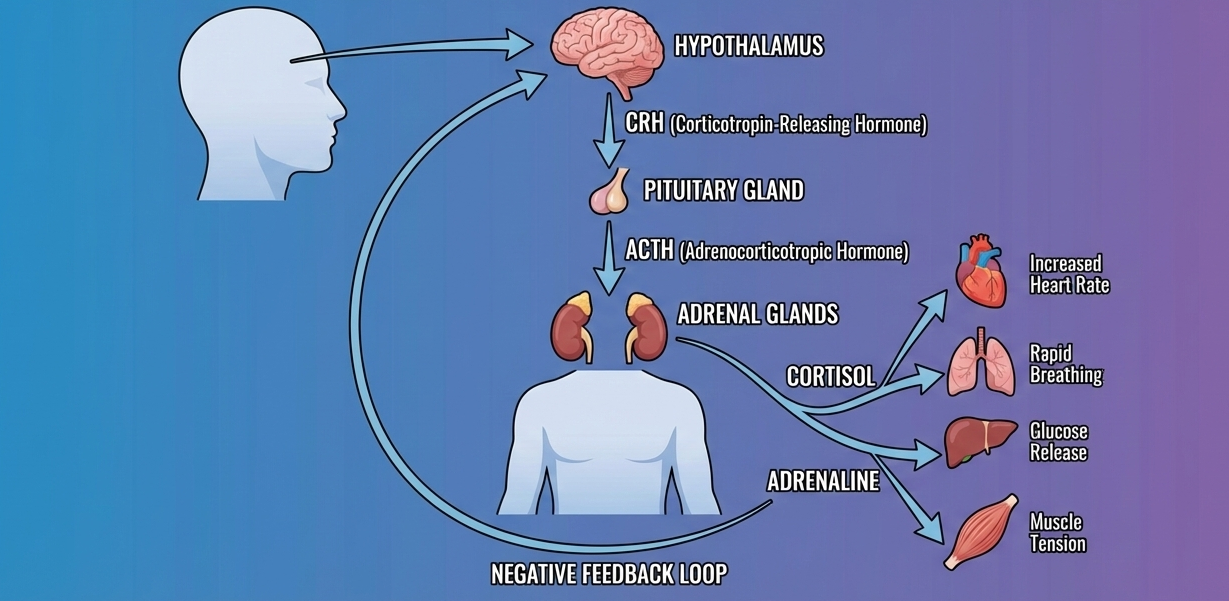
Stress can be defined as an emotional or psychological response to distress, uncertainty or difficulty. Although psychological perception has a part to play, stress is essentially a biological process that is regulated by specific hormonal signal transduction. A coordinated physiological response to ensure survival is activated by the body when it feels threatened, whether due to a threat of a physical, emotional, or environmental nature. The hypothalamic-pituitary-adrenal (HPA) axis is at the center stage of this response.
HPA axis connects the brain and the endocrine system which enables the body to sense danger and release inner resources. This system makes the body ready to deal with the stress factor quickly by releasing hormones like adrenaline and cortisol. Such changes affect the heart rate, blood pressure, metabolism, immune activity, and brain activity.
The HPA axis is an organ system that operates in a certain manner, and this concept is one reason why the effects of stress on the body are so extensive and the impact of stress can have so much prevalence in case of prolonged stress. In a step-by-step way, this article decomposes the biological processes of stress and reveals how perception is translated into physical action and why chronic stress management is critical to long-lasting health.
Stress as a Biological Process, not a Feeling
The origin of stress is in the brain yet the impacts are felt all over the body. In an evolutionary sense, the stress response was developed to defend the organisms against severe danger in the form of predators, injury or threat to the environment. This reaction is fast, habitual and very effective.
When the brain perceives a scenario as something threatening, it does not even stop to differentiate what is physically dangerous and what is pressuring. The same biological systems can be activated by deadlines, emotional conflict, financial uncertainty or illness as life-threatening events. It is as though the life of the body is being threatened.
This is the reason why stress can have physical effects like elevated pulse rate, muscle contraction, digestive disturbance, and breathing alterations. The reactions are not visualized or dramatized, but the immediate outcome of hormonal signalling in the HPA axis.
Exploring Hypothalamic-Pituitary-Adrenal Axis
The HPA axis is a system of communication linking three major parts which are the hypothalamus, the pituitary gland and the adrenal glands. Combination of these structures controls the body reaction to stress by releasing of hormones and feedback circuits.
The hypothalamus is a deep-rooted apparatus of the brain that serves as a central control centre. It constantly checks both inter-organic somatic states and external cues, such as emotional feed-backs of the limbic system. As a hypothalamus senses a threat the hypothalamus triggers the stress response.
The hypothalamus signals the pituitary gland which is commonly referred to as the master gland and magnifies its signals to the bloodstream by releasing hormones. Adrenal glands, which are found above the kidneys, secrete stress hormones, which affect the other organs and tissues in the body.
This axis enables the brain to speedily convert perception to physiological action.
Specifically, Step One is that of Threat Perception and Hypothalamic Activation
The perception is where the stress response starts. The brain, especially the amygdala, processes sensory data and emotional cues and appraises possible dangers. In case a condition is perceived to be threatening or challenging, the amygdala informs the hypothalamus.
The hypothalamus, in its turn, releases corticotropin-releasing hormone (CRH). The initial biochemical process occurring in the HPA axis is the distance covered by this hormone to the pituitary gland.
Meanwhile, the hypothalamus stimulates the sympathetic nervous system that causes adrenaline to be released quickly. Such combined activation guarantees both immediate and long-term reactions to stress.
Step Two: Pituitary Signaling and Amplification of Hormones
When CRH is received, the pituitary gland secretes the adrenocorticotropic hormone (ACTH) into the bloodstream. ACTH is a messenger hormone that is sent to the adrenal glands, which are commanded to synthesize stress hormones.
This is an important step since it increases the original signal. Minimal CRH secreted by the hypothalamus causes the release of ACTH in a bigger response. The pituitary, therefore, plays the role of one of the strong relay stations of the stress reaction.
The ACTH level increases rapidly in times of stress, and the adrenal glands are ready to take effect in minutes.
Step Three: Release of Adrenal Hormone
The adrenal glands react to ACTH by secretion of cortisol, the major long-term stress hormone. The effects of cortisol are far reaching and cut across almost all systems.
Meanwhile, adrenaline (epinephrine) and noradrenaline (norepinephrine) are discharged by the activation of the sympathetic nervous system. These hormones are fast in action and cause the heart rate to go up, the blood pressure to rise and diversion of blood towards muscles.
The combination of cortisol and adrenaline makes the body ready to take action. Adrenaline makes people ready to act at the moment and cortisol guarantees their permanent energy store.
The Mediator of the Stress Response Cortisol and Its Role
Cortisol is vital in surviving stress. It elevates the level of glucose by increasing the breakdown of stored energy to make sure that the brain and muscles have enough energy. Other non-essential processes, including digestion and reproduction are also inhibited by cortisol to help conserve resources.
About the short term, cortisol will improve concentration, decrease inflammation, and boost cardiovascular performance. But its consequences are very time dependent. Cortisol is also known to cause imbalances in normal physiological processes when it is sustained in high levels over a long period of time.
Chronic cortisol level is highly attributed to most of the symptoms characterized by stress such as fatigue, sleeping trouble, stomach problems, poor immunity, and mood swings.
Immediate Survival responses and Adrenaline
The action of adrenaline occurs within seconds and it causes the prototypical fight-or-flight response. It accelerates the heart rate, dilates blood vessels, enhances concentration, and raises the level of reflexivity. The amount of oxygen and glucose that reaches muscles increases whereas blood supply to the skin and digestive system decreases.
These adaptations are made in acute stress. They permit quick response and physical action. Repeated activation, however, without proper rest exerts stress on the nervous system and the cardiovascular system.
Once the release of adrenaline is regularly repeated, people can become restless, palpating, nervous and cannot relax.
Feedback Control of the HPA Axis
The HPA axis has incorporated inbuilt feedback mechanisms that help to ensure that the hormones are not over released. When the level of cortisol increases, they give signals to the hypothalamus and the pituitary gland to decrease the production of CRH and ACTH. This vicious circle plays a role in restoring normalcy after the stressor subsides.
During periods of stress, the cortisol levels are high and then start to decrease in a gradual manner in normal systems. Difficulties get experienced when stress turns out to be persistent and the feedback system is aggravated again and again.
With time, the HPA axis can become either dysregulated and result in either the chronically elevated production of cortisol or the inability to produce cortisol. The two trends can interfere with health.
Stress Acute and Stress Chronic
Acute stress is temporary and is mostly healthy. It improves performance, stimulation, and adaptation. When the stressor is solved, the hormone concentration goes back to normal.
Chronic stress, on the other hand, maintains the HPA axis on long-term periods. This continuous stimulation causes hormonal imbalanced-ness and physiological exhaustion.
The chronic stress is linked to heightened inflammation, metabolic system disruption, immune suppression, and altered brain structure in relation to memory and emotional regulation.
Symptoms of Stress and Biological Interpretation
Symptoms of stress develop when body systems experience hormonal signalling at the same time. High levels of cortisol change the glucose metabolism, which leads to energy crashes and weight fluctuation. Weakened immunity makes one prone to disease.
There are digestive symptoms that come about due to diversion of blood flow to the gastrointestinal tract due to stress. Disturbances in sleep are due to the distortion of cortisol and melatonin cycles. The mood alteration is an indicator of a change in the activity of neurotransmitters due to the effects of stress hormones.
The symptoms are not individual issues but related effects of long-term stimulation of the HPA axis.
Stress and Long-term Health Consequences
Chronic stress is a contributor to severe health problems in case it is not controlled. Exposure to prolonged stress is correlated with cardiovascular disease, diabetes type 2, depression, diagnosis of anxiety disorders, and autoimmune diseases.
The cortisol is especially sensitive to the brain. Exposure over a long period can lead to impaired memory, concentration and emotional regulation. Biological aging is another cause of stress, which changes the process of cellular repair.
The knowledge of the biological origins of stress emphasizes the fact that stress management is not a choice but a requirement of long-term health.
The reason why Stress Management Promotes Physiological balance
The methods of stress management will assist in the recovery of normal HPA axis functioning. Sleep is beneficial to hormonal rhythms. Exercise enhances cortisol levels, as well as minimizing the levels of stress hormone baseline.
Social support, relaxation practices, and mindfulness decrease the amygdala activation, which makes the occurrence of stress reactions less frequent. Nutrition is a contributing factor as well since it stabilizes blood sugar and aids in adrenal functioning.
Stress management is known to protect more than one body system by decreasing the unneeded activation of the HPA axis.
Conclusion
Stress is a complicated physiological procedure that is controlled by hypothalamic-pituitary-adrenal axis. The body works through accurate hormonal messages, which involve cortisol and adrenaline to convert the perceived threats into synchronized physical reactions.
Although it is a necessary system to survive, its chronic stimulation imposes an imbalance of hormones, and it is one of the reasons behind the prevalence of stress-related symptoms. This knowledge of the biological processes of stress will help members to better comprehend their symptoms and the significance of pre-emptive management of stress.
Individuals are able to prevent long-term health, enhance resilience and physiological balance in the ever-challenging world by contributing to the healthy functioning of the HPA axis.