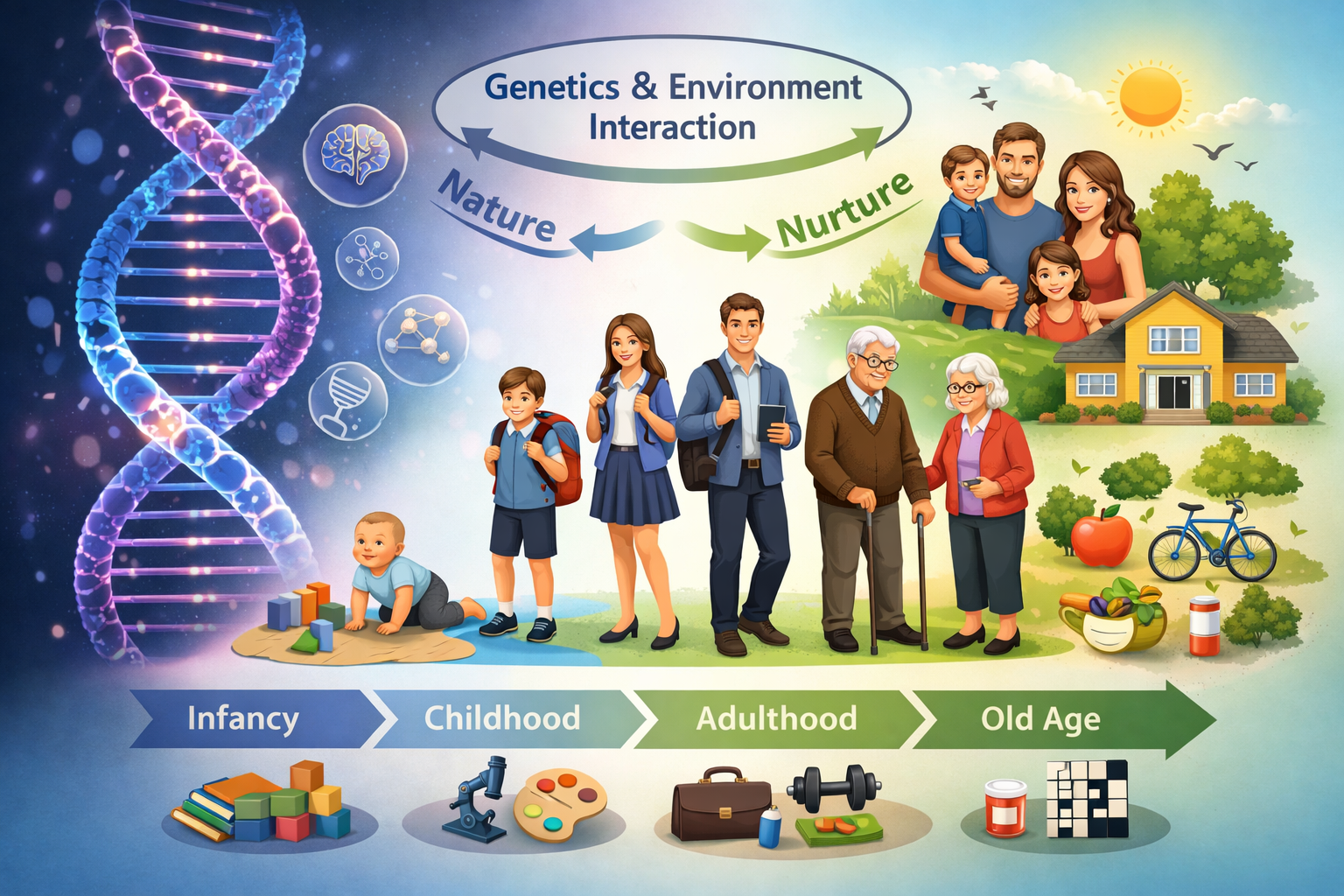
Human development is a dynamic process and that is affected due to a combination of biological, psychological and social factors. The development of every person from the moment of birth to the developmental stage to adulthood is a complicated interaction between the genetic inheritance and environmental factors. Although genetic makeup gives a phenomenon of what capabilities and attributes can be developed, the environment determines the way these attributes are played out and manifested. It is important to know how the environment interacts with genetics in order to understand why people are diverse in their physical, cognitive, and emotional growth.
Genetic Role in Human Development
Genetics can be defined as the study of heredity which is the transmission of some traits and characteristics by the parents to the children via the genes. Every human being is a carrier of a distinct set of genes inherited by their parents and this genes helps one to determine his or her physical traits, e.g. height, color of his/her eyes and even his/her vulnerability to some diseases. Genetics is also relevant in personality, intelligence and behavioral tendencies even in addition to the physical characteristics.
Indicatively, twin and family studies have established that most characteristics including intelligence and temperament have a genetic aspect. Even when raised separately, identical twins exhibit exceptional similarities in terms of cognitive abilities and personality traits due to sharing 100% of the DNA. This observation explains why genetic factors are important in the development of humans.
It is however necessary to note that genetic potential is not pre-determined. Even though genes are the framework, the manifestation of the environment can be a key factor in their expression. It is at this point where the genetics and environment interact come into play because even the same genetic make-up would result in different things based on life experiences and the environment.
Development as an Environmental Reaction
Environment is a collection of all external circumstances and experiences that influence the growth of an individual. The effects of the environment start in the womb where the mother’s nutrition, rate of stress and exposure to toxins may influence fetal development. Physical, cognitive, and emotional development is further influenced by the environment after birth, and these factors include family, education, peers, and culture.
Family Environment
One of the most influential and early environmental factors is family. The styles of parenting, emotional support and the home environment stability are all important in the development of the child. Studies show that children brought up in supportive and challenging backgrounds are better in school, are healthy in their socialization and have better coping mechanisms. On the other hand, careless or abusive family setups may impair cognitive growth and become the risk factor of emotional and behavioral disorders.
Education
Another important environmental factor that determines the development of humans is education. The availability of good education increases cognitive skills, problem-solving, and social competence. Genetic potential also interacts with educational experiences. An example is a child, who has a genetic pre-disposition towards high intelligence and who may need a challenging learning environment in order to achieve maximum potential. On the same note, good teachers and challenging curricula will assist children to acquire a set of skills that otherwise might not have been vigorously affected by the genes.
Socioeconomic Status
Socioeconomic status (SES) is a significant factor influencing development based on resource availability and healthcare and opportunities. Children with higher SES backgrounds may have better nutrition, safer living environment, and richer learning opportunities, which may lead to cognitive and emotional development. Low SES on the other hand may subject children to stress, malnutrition and restricted opportunities in education which might limit their developmental potential. The environment, socioeconomic and genetic, can have an influence on the level to which inherited abilities are manifested.
Lifestyle Choices
The lifestyles, such as food, exercise, sleep habits, and social relationships, still influence human development throughout the lifespan. As an example, exercise contributes to physical wellbeing and cognitive abilities whereas unhealthy diets or drug abuse may interfere with development and learning. Genetic inclinations are usually reinforced or suppressed by environmental factors. An individual with a genetic tendency towards high resilience might also find it difficult to cope in cases subjected to long term stress or poor living habits which shows that nature and nurture continue to interact.
Interplay of Genetic and Environmental Interaction
It cannot be said that human development can be explained entirely by looking at genetics or the environment alone. Rather, it is the combination of these two which influence individual differences. This interaction can be termed as the interaction of the genes with the environmental factors where genetic inclination can be favorable or repressed by certain environmental conditions.
As an example, a child can be genetically gifted in terms of his/her verbal skills. With the environment where the child is surrounded with plenty of language in terms of books, thought-provoking conversation, and educative teachers, then chances are that this genetic potential may be achieved. On the other hand, when the same child is brought up in a setting whereby language exposure is minimal, the verbal skills of such a child may not grow fully. This proves the point that genes predetermine the possibilities, but the environment identifies the result.
The activation of genes can also occur in a molecular fashion because of the environment factors. The new science of epigenetics, which examines the modifications of gene activity without causing a change in the DNA sequence, has demonstrated that development during life may be influenced by stress, nutrition and toxins turning the genes on or off. This demonstrates that the traits that are greatly affected by the genes are not predetermined, and it is very important to mention the role of the environment in the development of the human being.
Genetic and Environmental Contributions throughout the Lifespan
Early Childhood
Early childhood is an important developmental phase because the brain grows so rapidly and it is extremely sensitive to environmental input. Inherited temperaments and learning ability are affected by genetic factors, however, care provided by parents, nutrition, and early schooling are critical in cognitive and emotional developments. Indeed, as an example, children who have an inborn susceptibility to anxiety can become resilient when brought up in a good environment, hence the environment can moderate genetic risk.
Adolescence
Within the adolescence period, a person goes through a lot of physical, emotional, and cognitive developments. Genetic factors, including hormonal control, significantly determine puberty, although environmental factors, including peer connections, experiences at school, and cultural norms, determine behavior and identity development. More lifestyle decisions such as food, activity, and drug use also influence development, proving that the interactions between genetics and the environment still result in complex interactions.
Adulthood
During adulthood, genetics still have some impact on factors like metabolism, disease prone nature and cognitive skills. Nonetheless, occupation, social networks, and health behaviors are some of the environmental factors that contribute significantly to physical and mental well-being. To illustrate, a person with genetic predisposition towards cardiovascular disease can cut the risk of developing the disease with the help of a healthy lifestyle, which means that the role of the environment cannot be neglected.
Older Age
During later age, the genetic and environmental factors play a role in longevity and quality of life. It is possible that genetics will establish predispositions towards ailments like Alzheimer and that environmental conditions such as diet, social activity and exercise may slow the development or reduce the severity of the aging process. The experiences that an individual goes through all life long add up and the interaction between the environment and genetics is more apparent.
Examples of Case Studies of Nature and Nurture
Studies have always shown that neither environment nor genetics can be used to explain human development alone. The interaction between them is convincingly shown in twin studies, adoption studies as well as longitudinal research.
- Twin Studies: Separated identical twins tend to show incredible similarities in such characteristics as intelligence and personality, which highlights the impact of genes. However, the variation in the interests, career, and health results indicates the influence of the environment.
- Adoption Studies: Adopted children will give information on the effect of the environment. Research indicates that adopted children are likely to be similar to their biological parents in traits such as IQ but their behavior as well as their social and values closely follows their adoptive families and this indicates the effect of nurture.
- Longitudinal Studies Long-term cohort studies are those that follow individuals over decades to determine the interaction of their early-life environment, education, and lifestyle choices with their genetics to predict their adult outcomes in terms of health, career success, and psychological well-being.
Education and Policy Implications
The practical significance of genetics and environment interaction to the areas of education and healthcare, as well as social policy, is understood. An appreciation of the fact that children are not all the same because of inherited factors but also because of their exposure to the environment can guide individualized learning strategies, early interventions and support systems. Developmental potential is to the fullest in all people and this can be achieved through the establishment of policies that lessen socioeconomic disparities, enhance access to high quality education and healthy lifestyles.
Conclusion
The reason is that human development is a permanent process that is created by the complex interplay of environmental and genetic factors. Genetics gives the roadmap of the possible characteristics and talents, and the environment defines how the characteristics are manifested and turned into reality. During early childhood to old age, genes interact with the environmental conditions, which affect physical development, cognitive functions, emotional state, and even social behavior.
With the knowledge of how genetics and environment interact, we can learn very important information about the diversity of humans and individual differences. This understanding highlights the significance of enabling conditions, equal opportunities to resources, and healthy decisions that make a difference in determining the path of human development. Finally, the outcome of the ongoing interaction between nature and nurture is human development, which proves that the two play a vital role in the formation of the intricate web of the lives of individuals.