Stress is something present in human life and is natural. Out of unexpected threat to continuous daily stress, the body has to continuously evolve to new challenges within and outside the body. The heart of this adaptation is a complicated set of hormones which are aimed at safeguarding survival. The hormones associated with stress are very vital in making the body ready to counter threat, control of energy consumption, and internal balance. Although it is crucial and usually helpful to have short-term responses to stress, prolonged stimulation of stress hormones may have severe health outcomes.
This article describes the role of stress operating hormones especially cortisol and adrenaline in the fight-or-flight mechanism of the body. It describes how acute stress is good to performance and resilience, whereas chronic stress impairs immunity, sleep and cardiovascular wellbeing. The knowledge of these processes makes it easier to explain why the management of stress is crucial to the physical and mental health in the long term.
Learning about Stress and the Hormonal Response
Stress is experienced when the body feels that there is a threat, some form of challenge and/or demand which is disturbing the normal balance. This danger can either be physical, e.g., harm or sickness or psychological, e.g., anxiety, stress, or insecurity. The body reacts to the source, no matter its origin, in a complex system of hormones that is aimed at stabilizing the situation and survival.
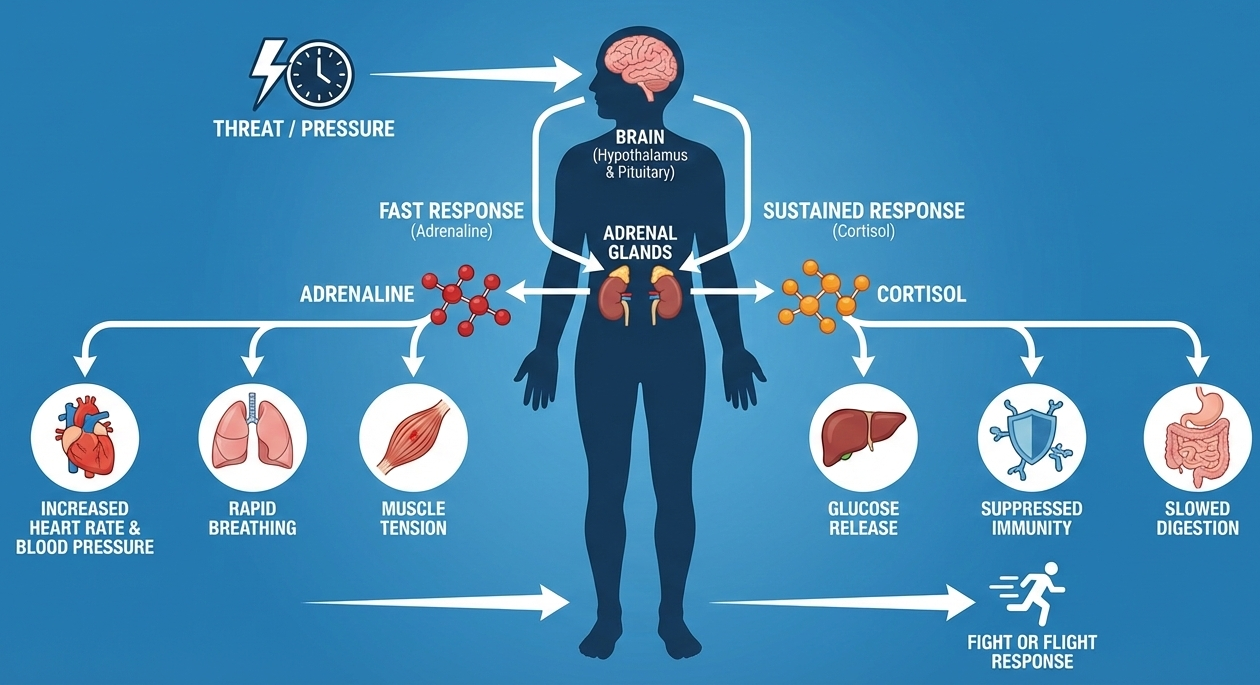
On detecting stress, the brain sends out signals that stimulate the hypothalamic-pituitary-adrenal (HPA) axis and sympathetic nervous system. These systems provoke the hormonal discharge which prepares the body to do something quickly. Cortisol and adrenaline are the most important of them; they collaborate in the fight-or-flight response.
During the early part of this article, one should remember that the stress-related hormones are the chemical mediators that enable the body to react swiftly and effectively to a threat.
The Fight-or-Flight Response: An Explanation
The fight-or-flight is a survival mechanism that is automatic and developed to handle human beings in case of direct danger. In cases where there is the feeling of danger, the brain transmits the signal to the adrenal glands, which in turn quickly release adrenaline into the blood. This hormone causes instant physical modifications making the body ready to act.
The heart rate is enhanced to supply more oxygen to the muscles, breathing rate is elevated in an effort to enhance the intake of oxygen, redistribution of blood occurs as the blood is directed out of other non essential systems like the digestive system. Meanwhile, the stored energy forms are discharged to supply the muscles and the brain.
Cortisol or the so-called primary stress hormone comes next to adrenaline. Adrenaline is fast acting but with short-term effects whereas cortisol is long lasting. It assists in keeping the glucose level high in the blood stream, inhibits the activities that are not directly important, and aids in keeping alertness during stressful circumstances.
These hormones work together to enable the body to respond promptly to the situation, and the likelihood of survival during the hazardous circumstances is higher.
Cortisol: The Stress Regulator in the Body
The adrenal cortex produces cortisol which plays a leading role in the management of stress. It assists in the process of metabolism, blood sugar levels, inflammation, and immunity. Cortisol provides enough energy needed to satisfy high levels of physical and mental requirements during stress.
Cortisol works well in the short-term stress. It improves the development of memory, aids the cardiovascular performance, and assists the body to overcome difficulties. Cortisol also restricts inflammation and overreaction of the immune system which may destroy tissues.
Nevertheless, the effect of cortisol is supposed to be short-term. When stress is prolonged, the level of cortisol is high during a long period, affecting the normal physiological functioning. Continuous high levels of cortisol may damage the immune system, disrupt sleep behaviour and complicate metabolic diseases.
Adrenaline and Immediate Stress Response
Adrenaline or epinephrine is what causes the stress response to manifest within a short period of time. Adrenaline is set free within several seconds of any perceived threat and it speeds up the heart rate, elevates blood pressure and enlarges airways in the lungs. With these effects, the body is able to respond swiftly and intensely.
Adrenaline further increases the focus and the speed of reaction and makes it easier to react to danger. The effects come in handy especially during short-lived stressful crises like emergencies, competition or unexpected challenges.
The effects of adrenaline appear to be short-lived and dissipate after the danger is no longer present (as compared to cortisol). The bodily system then starts to come back to normalcy. When adrenaline is stimulated too often, the body stays in the high alert state of adrenaline.
Short term stress and its positive impacts
Not all stress is harmful. Acute stress is also applicable as long as it is experienced in brief because it enhances performance and resilience. Temporary stimulation of stress hormones may boost motivation, boost concentration, and improve physical stamina.
As an example, stressful situations during a exam or a presentation, though mild, can enhance alertness and recall. Stress hormones aid in mobilizing energy and enhancing strength and coordination in the physical activity. It is these adaptive mechanisms that show that stress hormones can be crucial to good performance provided that they are controlled appropriately.
Acute stress also contributes to activation of immunity. Temporary surges in cortisol may boost immune patrol, which allows the body to realize and react to infections in a more efficient manner.
Chronic Stress and Hormonal Imbalance
Chronic stress happens when there are stressors and there is no sufficient recovery. When this happens, the body will not be able to restore balance as the constant discharge of cortisol and adrenaline may alter its usual state. The prolonged activation of hormones exerts stress on various systems.
In the long run, chronic stress compromises the immune system, which exposes a person to infections and slows down the recovery process. High cortisol levels inhibit the activity of immune cells and enhance inflammation, which leads to health issues in the long run.
Also, the persistent exposure to stress hormones may change the brain functioning, making it incapable of remembering, concentrating, and controlling emotions. This brings out the role of recovery and stress management in ensuring hormonal balance.
Effects of Stress Hormones on the Immune System
Stress-associated hormones are especially sensitive to the immune system. Although the release of cortisol in the short term can increase the readiness of the immune system, extreme exposure of cortisol deactivates the immune system. Stress that is chronic decreases the effectiveness and production of white blood cells decreasing the body capacity to resist infections.
Constant inflammation of the stress hormones also leads to auto immune diseases and susceptibility to diseases. Patients with chronic stress complain of repeated infections, slower wound recovery as well as growing fatigue.
Balanced stress hormone levels therefore play a crucial role in immunological resistance and prevention of diseases.
Sleep Disruption and Stress Hormones
There is a close relationship between sleep and stress hormones. The cortisol has a natural daily cycle with highest levels in the morning to keep one awake and reducing at night to induce sleep. Stress has an adverse effect on this rhythm and keeps the level of cortisol elevated rather than reducing it.
Excessive night cortisol disrupts the process of falling and maintaining sleep, causing insomnia and low quality of sleep. Poor sleep also prompts more stress hormones, which is a vicious cycle with both psychological and physical well-being.
In the long run, stress hormones lead to sleep deprivation, which is also a cause of fatigue, poor thinking, and potential chronic disease.
Cardiovascular Effects of Long-lasting Stress
Hormones that are associated with stress greatly affect the cardiovascular health. Cortisol affects blood vessels operation and the level of cholesterol, whereas adrenaline raises heart rate and blood pressure. When dealing with short term scenarios, these are changes that are adaptive and temporary.
But chronic stress maintains the cardiovascular system in a continuous stress condition. Continuous high blood pressure ruins blood vessels, raises the chances of atherosclerosis, and elevates the chances of heart disease and stroke.
Excessive exposure to stress hormones is closely linked to heart diseases, and there should be efforts to deal with stress in order to keep the heart healthy.
Stress Hormones and their Effects on Emotions and Psychological Effects
Hormones of stress do not only affect the physical health but also the emotional health. High levels of cortisol influence the levels of neurotransmitters in the brain leading to anxiety, mood swings and depression.
Chronic stress changes the parts of the brain that control emotional control, and people become more vulnerable to negative stimuli and incapable of dealing with adversities. This may later result in burnout, emotional exhaustion and low quality of life.
It is important to deal with stress on a physiological and psychological level to create emotional stability.
Fighting Stress Hormones to Get Healthy
It is through stress management that one can control the level of stress hormones and put the situation back to its normal state. Exercise, sleep and proper nutrition are also significant in decreasing excessive secretion of cortisol and adrenaline.
The deep breathing, meditation, and relaxation methods are mindfulness practices that engage the parasympathetic nervous system in the face of stress response. The hormonal effect of stress is also minimized by social support and healthy coping strategies.
Stress management will allow people to safeguard immune systems, sleep better, and minimize cardiovascular risk.
Conclusion
Stress related hormones are quite necessary in the survival as the body reacts adequately to strain and danger. The functions of cortisol and adrenaline are crucial in energy mobilization, alertness-enhancement, and short-term adaptation. These hormonal responses make stress responses good in brief periods and resilience.
Chronic stress however causes long term release of hormones which disturbs the immune system, sleeping patterns and even cardiovascular conditions. With time, such imbalance makes an individual more prone to disease and decreases the overall well-being.
The idea of balance and rest is explained by the way stress hormones work. Resilience, protection of vital systems, and long-term health can be maintained by the effective management of stress by the body.