Abstract
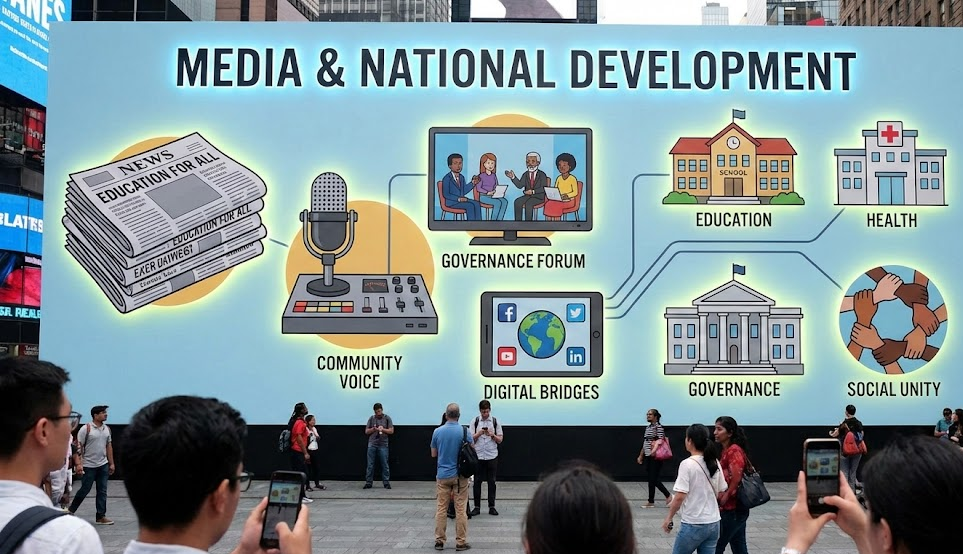
The mass media have taken the centre stage in modern societies as one of the focal points of social change and the development of a country. Mass media can also shape people’s consciousness and collective behavior through the systematic flow of information, education, advocacy, mobilization, which can lead to economic growth, political stability, social cohesion and a better quality of life. This article discusses the role of the mass media as a driver of social and national growth, particularly in the enlightenment of the people, health awareness, political empowerment, the reduction of poverty, and national integration. A qualitative methodological approach based on the analysis of secondary data is used to conduct the study, which relies on the developed theories of communication and development to describe how the media can lead to developmental outcomes. The results indicate that the mass media have a multidimensional and strategic position in the formation of attitudes, behavior and policy priorities, but efficiency depends on structural, moral, and technological conditions.
Keywords: mass media, mass media and development, mass media and social change, mass media and national development, mass media and public enlightenment
1.0 Introduction
Communication is generally considered as one of the pillars of the development processes in contemporary societies. Today, development is beyond economic growth and also covers social inclusion, democratic governance, cultural integration and human well-being. In this context, the mass media is an influential institutional instrument for informing the citizens, forming the opinion of people and organizing a collective action towards the national objectives.
The mass media acts as the mediator between the state and the population by publishing information on the policies, social programs of the country and national issues. According to the scholars, the availability of reliable media content helps to increase civic awareness and boosts the ability of citizens to engage in meaningful development programs (McQuail, 2010). Mass media can take the place of formal education and governance systems in the developing world, where people are not literate and institutions hearten reach.
This paper discusses the strength of mass media in social and national development in a systematic academic structure with literature review, analysis of the theory, methodology, findings and discussion.
2.0 Literature Review
2.1 Mass Media and Development Communication
Development communication literature has written a lot about the relationship between mass media and development. Early modernization theorists considered the media as a channel of conveying modern values, technological information and development-oriented attitudes (Lerner, 1958). This view was further extended by later scholars who focused more on participatory communication and empowerment of the local people (Servaes, 2008).
The mass media can be used to enhance the spread of information, technology, and change in behaviors, especially in health, education, and agriculture, with empirical studies showing that mass media have a significant role in this (Melkote and Steeves, 2015). Exposure through media has been associated with better knowledge and adoption of the development programs especially within rural and marginalized communities.
The media, governance, and political development represent an issue that must be tackled.
There has been a large body of literature that has emphasized the importance of mass media in democratic governance and political development. Norris (2010) is of the view that political learning, participation, and accountability are impossible without media systems. Mass media helps citizens make informed decisions through election coverage, investigative reporting and political debates.
Nevertheless, researchers are also warning that an undermining of the developmental role of the media as a result of media commercialization, concentration of ownership, and political interference may occur (Voltmer, 2013). These issues influence the independence and credibility of media institutions, especially in developing democracies.
2.3 Social Integration and Media
The studies on national integration lay stress on the capacity of the media to facilitate unity of identity and social unity in pluralistic societies. The mass media help us to understand each other and belong together by reflecting different cultures and stories (Castells, 2009). On the other hand, prejudiced or attention-seeking news can only widen social divisions, and thus, there is a necessity for ethical news.
3.0 Theoretical Review
3.1 Development Media Theory
Development Media Theory supports the idea that the media systems in developing nations must emphasize national development ideals rather than commercial perspectives that are not controlled. According to the theory, the mass media bear a duty of helping in social progress, economic growth and unity in the nation (McQuail, 2010). It is a framework where the role of the state during the development of media is justified, and social responsibility is also stressed.
3.2 Agenda Setting Theory
The agenda-setting theory serves to explain how the mass media shape the perception of people by establishing the issues that are given the limelight in society. McCombs and Shaw (1972) suggest that the issues, which are highlighted in the media, will be perceived by people as significant. This theory emphasizes the potential of the mass media to focus the attention of the nation on issues of development like health, poverty and governance.
3.3 Social Responsibility Theory
The Social Responsibility Theory is based on the idea that media freedom should be complemented with responsibility and ethics. The media houses are supposed to deliver truthful, fair and beneficial content that augur well with democratic ethics and social conditions (Siebert et al., 1956). The theory is especially applicable in the context of development when the media’s impact is significant.
4.0 Methodology
The proposed research has a qualitative research design, which is a secondary data analysis. The role of the mass media in social and national development was analyzed by reviewing relevant academic books, peer-reviewed journal articles, policy documents, and authoritative reports. The qualitative research method allows a deep analysis of theoretical and empirical knowledge that is available.
The data were examined on a thematic level, enlightenment of the population, awareness of health, involvement in political activities, alleviation of poverty, and social integration of the country. This approach is good to understand the development caused by the media without primary data collection.
5.0 Findings
In the study, some major findings are presented.
- The mass media improves the enlightenment of the masses by raising awareness on issues of social and development policies.
- The health campaigns through media go a long way in enhancing health knowledge and positively changing behaviour.
- Elections, governance issues and civic education through the media strengthen political participation.
- One of the impacts of the mass media on poverty reduction is the broadcasting of economic information and promoting social inclusion.
- Through media representation of common values and cultural diversity, national integration is encouraged.
6.0 Discussion
The results support the available literature and theoretical concepts that underline the developmental possibilities of mass media. The agenda-setting theory is a model that describes how the media’s emphasis on social issues shapes the discussion and policy reaction of the population (McCombs, 2014). Development Media Theory also argues in favor of the fact that media content based on national interests can hasten social change.
However, the mass media is not as effective as it could be due to misinformation, lack of accessibility to communication technologies and political pressure. To deal with these challenges, there is need to have powerful media institutions, moral values and better media literacy levels among people.
7.0 Conclusion
This paper has seen the strength of the media in facilitating social and national growth using a holistic scholarly construct. Through the analysis, the mass media is important in enlightening the masses, creating awareness on health, political development, poverty alleviation and integration of the nation. The media could become an instrument of transformative power of sustainable national development when it is directed by ethical standards and development-related aims.
Future research may use empirical evidence and compare it with other nations and countries to develop the relationship between media and development further.
References
Castells, M. (2009). Communication power. Oxford University Press.
Lerner, D. (1958). The passing of traditional society: Modernizing the Middle East. Free Press.
McCombs, M. (2014). Setting the agenda: Mass media and public opinion (2nd ed.). Polity Press.
McCombs, M. E., & Shaw, D. L. (1972). The agenda-setting function of mass media. Public Opinion Quarterly, 36(2), 176–187. https://doi.org/10.1086/267990
McQuail, D. (2010). McQuail’s mass communication theory (6th ed.). Sage Publications.
Melkote, S. R., & Steeves, H. L. (2015). Communication for development: Theory and practice for empowerment and social justice (2nd ed.). Sage Publications.
Norris, P. (2010). Public sentinel: News media and governance reform. World Bank.
Servaes, J. (2008). Communication for development and social change. Sage Publications.
Siebert, F. S., Peterson, T., & Schramm, W. (1956). Four theories of the press. University of Illinois Press.
Voltmer, K. (2013). The media in transitional democracies. Polity Press.