You know how a buy-to-let mortgage can look affordable on paper, then the booking fee, rental stress test, and follow-on rate hit your cash flow.
What matters is not just the headline interest rate, but the deal structure behind it: loan-to-value (LTV), fees, and what happens when the initial rate ends.
That is why you will see a big gap between “best buy” rates and the UK averages.
Below, I will show you what the latest averages look like, how lenders price buy-to-let mortgages, and how mortgage advisors and mortgage brokers compare deals in a way that is practical for landlords.
Key Takeaways
- As of the Moneyfacts UK Mortgage Trends Treasury Report (December 2025), the average buy-to-let two-year fixed rate is 4.86% and the average five-year fixed rate is 4.91%.
- The same report puts the average two-year tracker rate at 4.66% and the average standard variable rate (SVR) at 7.27%, which is the risk zone for cash flow if your rent is tight.
- Low headline rates often come with large percentage fees. A mainstream example in December 2025 shows a five-year fix at 3.44% paired with a 3% arrangement fee, and a revert rate near 8%.
- For portfolio landlords, “four or more distinct mortgaged buy-to-let properties” is the widely used definition in UK underwriting standards, so expect extra questions about your whole portfolio and rental coverage.
What is a Buy-to-Let Mortgage?
Buy-to-let mortgages fund rental property investment, not owner-occupation.
A buy-to-let mortgage is designed for rental properties, where the rent helps cover the mortgage interest and running costs. It sits apart from residential mortgages because the lender underwrites the deal around rental income and landlord risk, not just your salary.
In practice, many buy-to-let mortgages are set up on an interest-only mortgage basis, because it keeps monthly repayments lower. That can suit landlords, but you need a clear plan for repaying the capital at the end of the term (sale, savings, or another refinance).
Personal vs limited company (SPV) buy-to-let
If you have been told companies do not qualify, that is out of date for the UK market. Many lenders actively offer limited company buy-to-let (often via a special purpose vehicle, or SPV), and product choice has been growing in this area.
The trade-off is usually in the detail: lender criteria, fees, and how rental coverage is assessed. If you are choosing between personal and company borrowing, get a broker to run both options side by side with tax figures, not guesses.
Where regulation and standards matter
Most buy to let borrowing is treated as business lending. That said, there is a specific UK framework for “consumer buy-to-let” where the borrowing is not wholly or predominantly for business purposes, and firms must follow the relevant rules for that category.
On the property side, energy efficiency can affect both lettability and lending. Government landlord guidance in England and Wales keeps the minimum standard at EPC band E for domestic private rented homes unless a valid exemption applies, so check the EPC early, before you pay for a valuation.
Factors Affecting Buy-to-Let Interest Rates
Buy-to-let mortgage rates move for the same broad reasons as residential mortgage rates, but lenders price in extra landlord-specific risk. In a typical underwriting review, these are the levers that change the interest rate and the fees you are offered.
- Loan-to-value (LTV): your deposit (or equity) band.
- Rental coverage: whether the rent comfortably covers the stressed interest payment.
- Credit history and existing debt: missed payments, high utilisation, and heavy borrowing can push you into pricier products.
- Property type and condition: flats above commercial units, non-standard construction, and HMOs can mean higher rates or fewer lender options.
- Portfolio status: if you hit the portfolio landlord definition, lenders often assess your whole book, not just the new deal.
How does the Loan-to-Value (LTV) ratio impact rates?
LTV is the simplest pricing lever. If a property is worth £100,000 and you borrow £80,000, the loan-to-value is 80%.
In the Moneyfacts UK Mortgage Trends Treasury Report (December 2025), the average two-year fixed rate across all LTVs is 4.86%. At 60% LTV, the average is lower at 4.32%. That difference is why, in buy-to-let, your deposit is often your best “rate negotiation”.
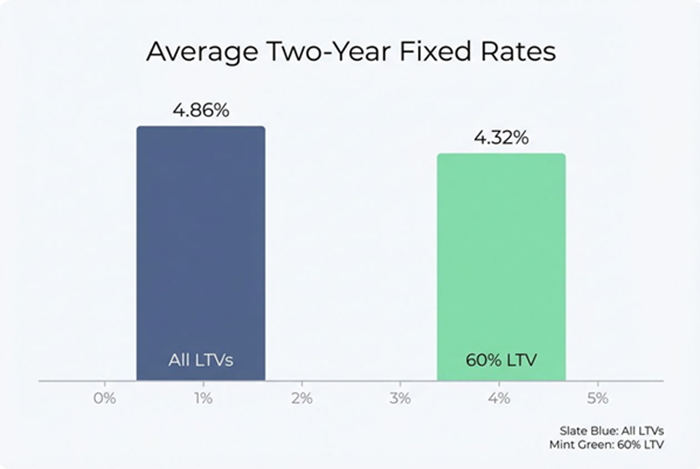
| LTV snapshot (Dec 2025 averages) | Average two-year fixed | Average five-year fixed |
| All LTVs | 4.86% | 4.91% |
| 60% LTV | 4.32% | 4.57% |
If you are close to a band edge, it is worth pricing both sides. Even a small deposit top-up can shift you from, say, 75% to 70% LTV and open up a cheaper slice of the market.
Why is credit history important for buy-to-let mortgages?
Lenders check credit for all applicants before they approve a buy to let mortgage.
Credit history affects pricing in two ways. First, it influences whether you pass the lender’s policy checks. Second, it influences which tier of mortgage interest rate you land on.
If you have adverse credit, you may still find bad credit mortgages in the specialist market, but the lender will usually offset the risk with higher interest rates and tighter fees. In that situation, you should focus on the full cost of the deal and your exit plan, not just getting a “yes”.
- Check your credit reports for errors before you apply, because simple mismatches can trigger delays or declines.
- Reduce revolving balances (credit cards and overdrafts) where you can, as high utilisation often causes avoidable underwriting friction.
- Do not stack multiple hard searches in the weeks before application, as it can make your credit score look stressed.
What are the differences between fixed and variable rates?
A fixed-rate mortgage keeps the interest rate unchanged for a set period, commonly two or five years. You get predictable repayments, which is useful when you are matching rent collection to outgoings.
A variable rate mortgage changes over time. With a tracker mortgage, the rate usually moves in line with the Bank of England Bank Rate plus (or minus) a margin, and your monthly payment changes as the base rate changes.
As of the Bank of England’s decision on 17 December 2025, Bank Rate is 3.75%. That matters because trackers typically reprice quickly when the base rate moves.
- Fixed: stability, but expect early repayment charges if you exit during the fixed period.
- Tracker/variable: flexibility and potential benefit if rates fall, but you must tolerate payment swings.
APRC, fees, and why “cheap” deals can still cost you more
APRC stands for annual percentage rate of charge. The Financial Conduct Authority describes it as a percentage measure of the annual cost of the mortgage over its lifetime, including relevant fees.
In buy-to-let, APRC is useful as a sense-check, but landlords still need to do a simple cash-flow view: initial rate, monthly payment, fees, and the follow-on rate if you do nothing at the end of the deal.
Current Average Interest Rates on Buy-to-Let Mortgages
If you want a clean “where are rates right now?” benchmark, start with the market averages and then work out how far you can realistically beat them based on LTV, property type, and credit score.
In the Moneyfacts UK Mortgage Trends Treasury Report (December 2025), the average buy-to-let two-year fixed rate is 4.86% and the five-year fixed rate is 4.91%. The average two-year tracker rate is 4.66%, and the average SVR is 7.27%.

| Rate type (Dec 2025 UK averages) | Average rate | Interest-only payment on £200,000 (approx.) | What to watch |
| Two-year fixed | 4.86% | £810/month | Fees and what the rate reverts to after the fix |
| Five-year fixed | 4.91% | £818/month | Longer certainty, but check early repayment charges |
| Two-year tracker | 4.66% | £777/month | Payment moves with base rate (0.25% change is about £42/month on £200,000) |
| Standard variable rate (SVR) | 7.27% | £1,212/month | The “do nothing” rate, it can squeeze profit fast |
What are the current two-year fixed rates?
Two-year fixed rates are popular when you want a near-term reset, especially if you expect rates to fall further. The trade-off is refinance risk: you will be shopping again sooner, and your next deal depends on where house prices, interest rates, and your credit history land.
One practical point from the same Moneyfacts report is how quickly products change. In December 2025, average shelf life was measured in days, not months, so you should gather documents early (ID, proof of deposit, portfolio schedule, tenancy details) before you start chasing a headline rate.
What are the current five-year fixed rates?
Five-year fixed deals usually suit landlords who value stable repayments and want to reduce refinance frequency. They can also reduce the stress of remortgaging during a weak rental market or a tough valuation.
Even so, do not ignore the fee structure. A consumer guide update in December 2025 highlighted a five-year buy-to-let fix at 3.44% at 60% LTV with a 3% arrangement fee, and a revert rate just under 8%. That can be a strong deal for some landlords, but only if you run the fee maths and you are confident you will not need to exit early.
- If you are borrowing £200,000, a 3% arrangement fee is £6,000.
- Fee-free deals are less common in buy-to-let, and that same update noted only about 14% of deals had no fee.
- Many “lower fee” products cluster around four-figure fees, so the best choice depends on loan size and how long you plan to keep the mortgage.
What are the typical variable rates today?
Tracker mortgages can work well when you expect base rates to trend down, or when you want flexibility. The risk is that your payment can rise quickly if inflation or market pricing changes.
To keep this practical, run a sensitivity check. On a £200,000 interest-only balance, a 0.25 percentage point rise adds about £42 per month. If that wipes out your monthly profit, a tracker may be too tight for your current rent and running costs.
How to Find the Best Buy-to-Let Mortgage Rates
The best rate is the one that fits your property, your tax position, and your plan. A cheap initial interest rate can be a poor deal if the fee is huge, the revert rate is punitive, or the rental stress test forces you into a smaller loan than you need.
A good process is simple: compare like-for-like, model the fees properly, and get advice when the case is complex (HMOs, portfolio lending, limited company borrowing, or any adverse credit).
How can I compare deals across different lenders?
Start with a shortlist from a reputable comparison table, then sanity-check it with a broker’s sourcing system. This is where mortgage brokers earn their keep, because many buy-to-let lenders distribute primarily through intermediaries, and criteria shifts can be just as important as the interest rate.
- Compare true costs: rate, arrangement fee, valuation fee, legal costs, and the follow-on standard variable rate.
- Match the LTV band: compare 60% with 60%, 75% with 75%, and so on.
- Test rental coverage: do not assume the rent will “obviously cover it”. Run the lender’s stress calculation before you commit to a purchase price.
- Plan your exit: fix end date, refinance plan, and whether early repayment charges could trap you.
If you want a second set of eyes on the numbers, a broker such as Revolution Finance Brokers can also help you model scenarios, including portfolio diversification and specialist property types.
How do I improve my credit score for better rates?
Creditworthiness is one of the few things you can control before you apply. Even small improvements can widen your options and reduce pricing friction.
- Check all three UK credit files (Experian, Equifax, and TransUnion) and challenge any errors.
- Pay on time and keep utilisation low, because missed payments and maxed-out limits tend to be the fastest route to higher mortgage interest.
- Avoid taking new credit shortly before a mortgage application, unless you have a clear reason and it is unavoidable.
- Keep your paperwork clean: stable income evidence, clear rental income trail, and consistent bank statements reduce underwriter concern.
- If you have adverse marks, speak to a mortgage broker early. The right specialist lender can be a better route than taking an expensive bridging loan with no clear refinance path.
Conclusion
To answer the core question, the current interest rate on a buy-to-let mortgage depends on your LTV, fees, and whether you choose fixed or variable. As a benchmark, Moneyfacts reported average rates of 4.86% for a two-year fix and 4.91% for a five-year fix in December 2025.
Do not stop at the headline. Compare APRC, fees, and the follow-on standard variable rate, and make sure your rental income still works under the lender’s stress test, so you reduce the risk of missed payments and being repossessed.
FAQs
1. What is the current interest rate on a buy-to-let mortgage?
There is no single current rate for a buy-to-let mortgage, rates change across lenders and over time. Lender rules, loan-to-value, and borrower history all shape the rate on a mortgage loan.
2. How can I find today’s buy-to-let mortgage rates?
Check lender sites and price comparison services, or call a specialist broker for live quotes.
3. Is it true that all buy-to-let loans have the same rate?
That is a myth, it is false. Rental mortgage rates differ by product type, such as fixed term or tracker, and by how much deposit you can put down.
4. What can I do to get a better mortgage loan rate?
Boost your deposit, fix problems on your credit file, and compare offers from specialist landlords, banks and brokers, they often have different deals.