
You know the choice, your room needs to feel properly warm, but you also want the radiators to look right and run efficiently.
This is where the decision between traditional column radiators and modern panels gets real, especially if you are comparing options like Planet Radiators alongside cheap designer radiators and higher-end designer radiators.
In this guide, I’ll compare looks, output (BTUs), hot water heating systems, metals (from steel to cast iron, plus bronze-style finishes), and the practical steps that stop you buying a radiator that is either oversized, underpowered, or awkward with your interior design and blinds.
Key Takeaways
- Column radiators are chosen for their period look and steady warmth, with outputs commonly spanning roughly 1,000 to 8,000+ BTU depending on size and column depth.
- Panel radiators warm up fast and suit short heating cycles, especially with thermostatic radiator valves and smart controls that reduce boiler cycling.
- For heat pumps and low-temperature heating, always check the radiator’s delta rating (for example, ΔT30 output), not just the headline BTU figure.
- Panel radiators are usually lighter and quicker to fit, while column units can be heavy enough to need stronger fixings or floor-mount feet.
- Pick columns for character and heat retention, pick panels for minimal projection, fast response, and a cleaner modern profile.
Planet Radiators: Overview of Traditional Column Radiators
Traditional column radiators use stacked sections (often cast iron or steel) to hold heat and release it steadily. That “stored warmth” feel suits homes where rooms cool down quickly, such as older properties with higher ceilings or draughtier layouts.
In a typical UK wet central heating setup, you pair a column radiator with thermostatic radiator valves and a room thermostat so you get the style without losing control of running costs.
- Best for: period rooms, bay windows, hallways with limited wall width (vertical columns), and spaces where you want a softer, steadier heat.
- Watch-outs: weight, wall strength, and sizing for lower boiler temperatures or heat pumps.
Design and Appearance
A column radiator is a design feature, not just a heat source. You can go horizontal under a window, or vertical to keep wall space free for furniture, shelving, or tighter room flow.
Finishes often include white, anthracite, raw-metal looks, and metallic styles marketed as brass or bronze. In most cases these are durable coatings rather than solid bronze, which is useful to know if you are matching taps, handles, and other metals across a room.
- For a traditional room, match the radiator colour to woodwork, panelling, or a dominant wall colour, so it looks intentional rather than “added later”.
- If you have blinds or full-length curtains near the radiator, leave enough space for air to rise and circulate, otherwise you trap heat behind the fabric.
- Choose valve shapes (straight, angled, or corner) based on pipework direction first, then pick a finish to suit the rest of the room.
Heat Efficiency and Distribution
Column radiators can give strong heat output because the shape exposes lots of surface area to the room. The detail that affects real-world comfort is the test condition used for the rating.
Under BS EN 442, many UK radiator outputs are quoted at ΔT50 (often shown as 75/65/20), so you can compare models fairly. If your system runs cooler, such as a condensing boiler set lower, or a heat pump, the same radiator will deliver less heat, so you size up or choose a design that performs well at lower temperatures.
| What you see on a spec sheet | What it means for you |
| ΔT50 output | Good comparison point for many gas boiler setups, but can be optimistic if you run lower flow temperatures. |
| ΔT30 output | More relevant for heat pump planning, you may need a larger radiator or extra emitters to hit your room’s heat loss. |
| Watts and BTUs | You can convert between them for quick checks: 1 watt is about 3.41 BTU per hour. |
Pro tip: don’t buy on “big BTU” marketing alone. Check the delta rating, then size for how your system actually runs.
Suitability for Classic and Period Homes
Columns look right in Victorian and Edwardian homes because they echo traditional proportions and detailing. They also work in modern spaces where you want contrast, for example an industrial kitchen or a minimalist room with one strong statement piece.
Be realistic about installation. Product specs show how wide the weight range can be: a 600 x 1000 mm Type 22 panel radiator is listed at about 30.6 kg, while a large cast-iron column example (600 mm high, 10 sections, 5-column) is listed at 150 kg, so wall type and fixing method matter.
- If you have fragile plaster, lath, or questionable masonry, consider floor-mount feet and let the wall brackets stabilise rather than carry the full load.
- For period renovations, check pipe centres and valve positions early, it saves messy rerouting later.
- For painted finishes, use a radiator-safe, high-temperature paint system if you repaint, standard wall paint can discolour or mark.
Overview of Modern Panel Radiators
Modern panel radiators are the default choice in many UK homes because they are slim, fast to heat, and straightforward to size and install. They pair well with today’s boiler controls and room-by-room zoning.
Most panel radiators are steel, and the “type” (for example Type 11, 21, 22) tells you how many panels and convector fins are inside, which directly affects output and depth.
- Best for: modern interiors, tight spaces, quick warm-ups, and homes that run heating in shorter bursts.
- Watch-outs: depth increases with higher-output types, and convector fins need occasional dusting.
Sleek and Minimalist Design
Sleek lines and low profiles help panel radiators blend into contemporary rooms.
Panel radiators suit modern layouts because they keep the wall line simple. In spaces like open-plan living areas, that “quiet” look can matter as much as raw output.
- For a clean finish, plan pipework routes so valves and tails sit neatly below the radiator rather than forcing awkward offsets.
- If you want the radiator to disappear, match it to the wall colour. If you want it to look like a feature, pick a contrasting colour but keep the shape simple.
Space-Saving Features
Panels are space-efficient because they sit close to the wall, and you can choose a type that balances projection against output. This matters under windows, behind doors, and in corridors where every centimetre counts.
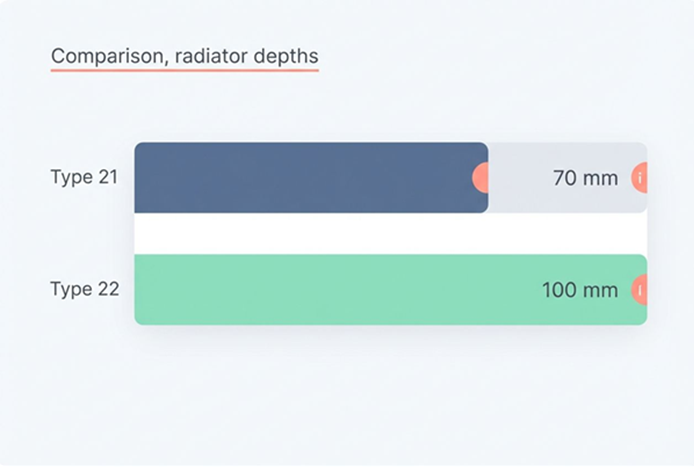
Typical depth differences are noticeable: guides comparing common types describe Type 21 radiators at about 70 mm deep, while Type 22 designs are often closer to 100 mm deep, so your “higher output upgrade” can change how the room feels to move around.
| Panel type | What’s inside | Why it matters |
| Type 11 | 1 panel, 1 fin set | Thinner profile, lower output for the same width. |
| Type 21 | 2 panels, 1 fin set | Good middle ground for many rooms. |
| Type 22 | 2 panels, 2 fin sets | Higher output in the same height and width, with more projection. |
Heating Performance and Efficiency
Panel radiators tend to respond quickly because they have lower thermal mass than chunky cast iron, so they suit smart schedules and “heat it when you need it” routines.
If you use a condensing combi boiler, a simple efficiency win is lowering the radiator flow temperature. Tower Hamlets Council guidance notes that running radiators at 55°C or below on a combi boiler can cut gas use by around 6% to 8% without changing your room thermostat setting.
- If you are investing in smart controls, look for systems that support boiler modulation (often via OpenTherm) and then use smart thermostats and smart TRVs to reduce cycling.
- If your rooms heat unevenly, get the system balanced. It is one of the quickest ways to stop the nearest radiators stealing the heat.
- If a radiator stays cold at the top, bleed it first. If it stays cold at the bottom, you may be dealing with sludge and need a professional clean.
Key Factors to Consider When Choosing
Choosing between a column radiator and a panel radiator is rarely about “which is best”. It is about what works best in each room, with your pipework, your heat source, and how you actually live in the space.
| Decision factor | Column radiators | Panel radiators |
| Look and interior design fit | Period charm, strong presence, works well with traditional detailing. | Minimal, blends in, suits modern refurb and new-build styling. |
| Response time | Slower warm-up, longer heat retention. | Fast warm-up, faster cool-down. |
| Space and projection | Can project further, vertical options help in tight wall widths. | Often slimmer, with type choices to manage depth. |
| Heat pump planning | Often needs careful sizing, check ΔT30 figures. | Easy to scale up with larger panels or higher types, check ΔT30 figures. |
Aesthetic Compatibility with Your Home
Match radiator style to the room’s “visual temperature”. If you have ornate skirting, cornices, or fireplaces, traditional column radiators look coherent. If your room is crisp and uncluttered, panels usually fit better.
If you are already used to tracking specs and price changes in other areas of property, apply the same discipline here: decide the look, then verify the numbers (BTUs, delta rating, and size) before you buy.
- In rooms with blinds, check the drop and stack position so fabric does not sit directly in front of the radiator’s rising air.
- Use consistent metals across visible details, for example chrome valves with chrome door furniture, or brushed tones with warm brass and bronze-style finishes.
- If you want a feature radiator, place it where it can “read” as intentional, such as a clear wall opposite the room entry, not behind a sofa.
Energy Efficiency and Running Costs
Running costs come down to heat loss, flow temperature, and control. Panels often feel cheaper to run because they respond quickly, but a correctly sized column radiator can be just as efficient if your controls and boiler settings are right.
For heat pumps, incentives matter. Ofgem lists the Boiler Upgrade Scheme grant at £7,500 for air source and ground source heat pumps in England and Wales, which is worth factoring in if you are upgrading your whole system rather than swapping one radiator.
- Work out room heat loss first: use a BTU calculator and keep your assumptions consistent (room size, insulation, window area).
- Check delta ratings: compare like-for-like outputs, and look for ΔT30 figures if you plan for a heat pump or low-temperature flow.
- Use controls properly: set TRVs by comfort. Many guides treat “3” as roughly 20°C, which is a sensible starting point for living spaces.
- Set the boiler to suit the house: if you can run a condensing boiler with a lower flow temperature and still hit comfort, you reduce waste.
Installation and Maintenance Needs
Panels are usually quicker to fit because they are lighter and come with standard brackets. Column radiators can involve more careful levelling, stronger fixings, and sometimes feet, especially with cast iron.
For long-term performance, system water quality matters. BS 7593:2019 sets out a clear approach, clean the system, protect it with inhibitor, maintain it, and test it regularly. Brands like Fernox sell inhibitors designed to reduce corrosion and limescale in mixed-metal systems, including aluminium.
- Ask your installer whether your system needs a clean or powerflush before fitting new radiators, especially if your old ones had cold spots.
- Fit a magnetic filter if you do not already have one, it is a practical way to catch circulating debris before it blocks modern emitters.
- If you find yourself typing “radaitors” into search, take it as a reminder to double-check spec sheets, model numbers, and delta ratings before ordering parts.
Conclusion
Choose traditional column radiators if you want period character, long-lasting warmth, and a radiator that reads as part of the room’s design.
Choose modern panel radiators if you want a slim profile, faster warm-up, and straightforward efficiency gains with smart controls and lower flow temperatures.
If you are comparing Planet Radiators with other designer radiators, size each room by heat loss first, then pick the style that suits your interior design, blinds, and how you heat your home day to day.
FAQs
1. What are the key differences between traditional column radiators and modern panels?
Traditional column radiators hold more water and give steady, lasting heat, while modern panels heat up faster, free up wall space and usually cost less to install.
2. Which is better for a small room or open-plan home?
Choose panel heaters for small rooms or open-plan homes, they warm the space quickly and sit flat to the wall. Traditional radiators can take more space and may look heavy in tight areas.
3. Are column radiators better for efficiency and heat output?
Not always, column radiators keep heat longer, but panel radiators often deliver the needed heat output more efficiently for short use.
4. How should I choose for my home, on cost, look or performance? Start with the room use and required heat output in kilowatts, then compare installation and maintenance costs. Pick traditional radiators for period style and steady warmth, pick panel radiators for quick heat, lower cost and less space use, and ask a heating engineer to confirm.