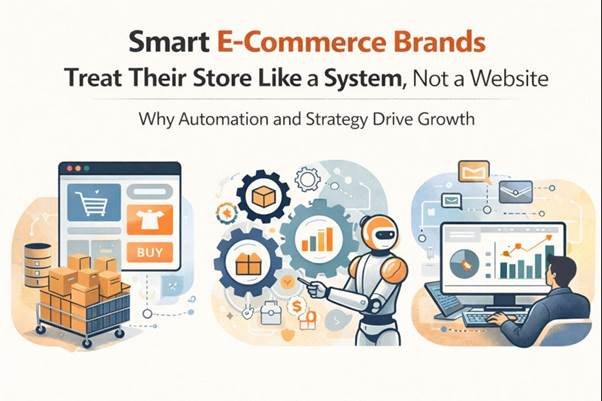
Most people still think of an online store as a website. A homepage, product pages, checkout, and a payment gateway. But the brands that consistently grow online understand something different. An e-commerce operation is a system, not a site. It connects marketing, inventory, fulfillment, payments, analytics, customer service, and long-term scalability into one operational engine.
When businesses approach e-commerce as just design and content, growth eventually stalls. Performance issues appear, manual work increases, and decision-making becomes reactive instead of data-driven. When businesses treat e-commerce as a structured platform, they gain predictability, automation, and operational control.
This is why serious brands invest in professional e-commerce services instead of relying on scattered plugins and short-term fixes that rarely scale well.
The Hidden Complexity Behind Every Online Order
A single customer order looks simple on the surface. Behind the scenes, multiple systems activate simultaneously. Inventory updates, payment validation, shipping rules, tax calculations, confirmation emails, and analytics tracking all happen in seconds. If any part of this chain breaks, the customer experience suffers immediately.
As order volume increases, manual oversight becomes impossible. Businesses begin facing overselling issues, fulfillment delays, inconsistent reporting, and rising support tickets. These problems usually aren’t marketing failures. They are system design problems.
Strong architecture keeps growth stable instead of fragile.
Platform Choice Shapes Long-Term Growth
One of the most common questions store owners face is whether to build on WooCommerce or Shopify. Both platforms are powerful, but they solve different problems. WooCommerce provides flexibility and ownership control, while Shopify offers managed infrastructure and faster deployment.
The decision should reflect long-term growth goals, customization needs, operating costs, and technical resources, not just theme availability or launch speed. A clear comparison such as this WooCommerce vs Shopify comparison helps founders avoid expensive platform mistakes later.
Choosing the right platform early reduces technical debt, improves performance stability, and simplifies future scaling.
Automation Is the Real Growth Multiplier
High-performing e-commerce operations automate wherever possible. Inventory syncing, order routing, abandoned cart recovery, customer segmentation, and reporting should operate with minimal manual effort. Automation increases accuracy while freeing teams to focus on strategy instead of repetitive tasks.
Accurate real-time data also improves forecasting. When systems capture clean data consistently, leaders can optimize stock levels, improve pricing strategies, and respond faster to demand shifts.
What E-Commerce Can Learn from Regulated Industries
Some of the strongest system discipline comes from regulated sectors like healthcare. Blood banks rely on structured platforms such as blood bank establishment system (BECS) to manage traceability, quality controls, audit trails, and compliance workflows. Every step is validated, logged, and monitored.
While e-commerce does not carry clinical risk, the operational thinking is highly relevant. Clear workflows, automated validation rules, and reliable audit data significantly reduce operational chaos. Applying similar discipline strengthens stability and trust in growing online businesses.
Build for Scale, Not Just Speed
Many stores launch quickly but struggle to mature. Performance bottlenecks, plugin conflicts, security gaps, and reporting inconsistencies gradually slow growth. Rebuilding later is far more expensive than designing correctly from the start.
Smart brands prioritize:
- Clean architecture and maintainable systems
- Scalable hosting and performance optimization
- Accurate data and reporting reliability
- Security and governance readiness
- Automation and integration planning
These foundations quietly protect profitability and reputation over time.
E-commerce success today is driven by system thinking, automation maturity, and platform strategy. Brands that invest in reliable digital infrastructure build long-term confidence instead of short-term spikes.
Treat your store like a business system, not just a website, and growth becomes sustainable instead of risky.