Introduction
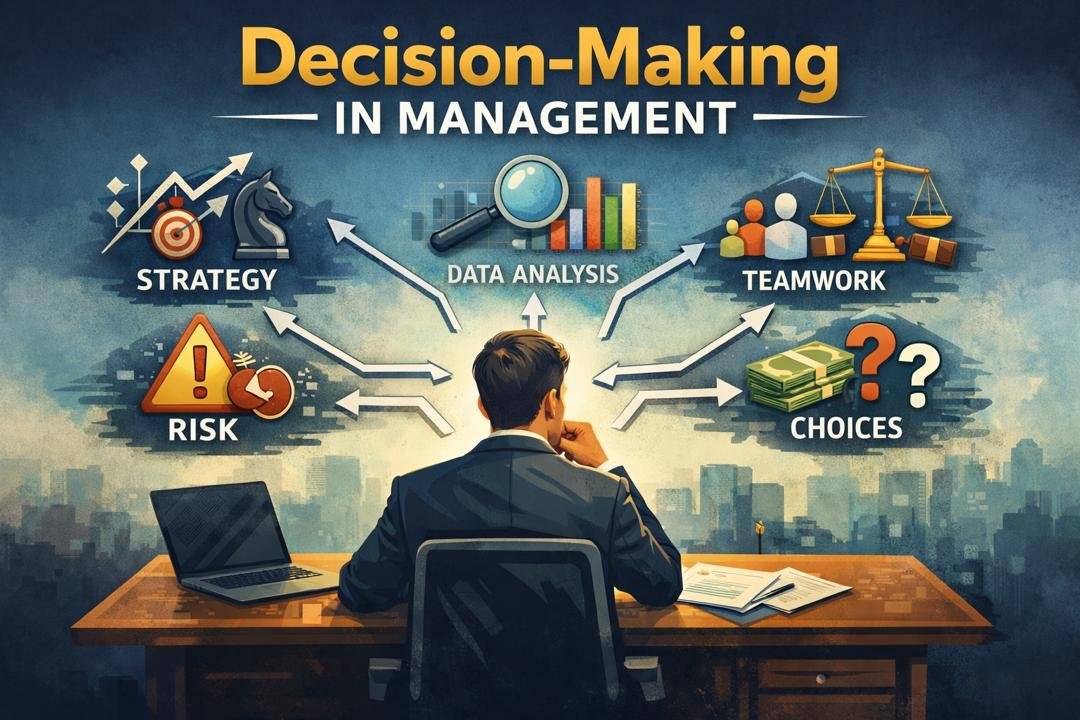
Decision making has become the core of management and is one of the most important tasks of managers of any rank within an organization. The success of every managerial activity including planning, organizing, leading and controlling requires proper decisions to influence actions and to distribute resources in the best way possible. Decision-making will influence organizational performance, competitiveness, and sustainability by determining it in both cases: a mundane operational decision and a complex strategic decision about the future of an organization.
The quality of managerial decisions and their timeliness have become all the more important in the contemporary dynamic business world marked by uncertainty, technological change, and world competition. Managers would not only make decisions by picking the best options, but also a balance of risks, information analysis, interest of stakeholders, and predicting long-term outcomes. Bad decisions can result in loss of money, loss of employee morale and bankruptcy of the organization whereas good decisions result in increased productivity, innovation, and accomplishment of goals.
This paper discusses the subject of decision making in management as one of the fundamental managerial tasks. It talks about the concepts of effective decision-making, the process of making a decision, different decision-making frameworks, managerial decisions, and the pitfalls that a manager may encounter on a daily basis. It also highlights the importance of informed and timely decisions that help achieve organizational effectiveness and success.
Knowing Managerial Decision-Making
Managerial decision-making is defined as the methodical move regarding how managers formulate issues or opportunities and assess alternatives and choose a course of action that would most suitably fit within the organization’s objectives. It does not simply involve making a decision but rather involves decisions that are rational, moral and such that are in short term goals and long-term plans.
Decisions taken by managers are not only daily but also simple (when it comes to simple tasks like task scheduling) or complex strategies (when it comes to entering new markets or reorganizing the company) decisions. These decisions will be successful based on skills and experience of the manager, availability of proper information and capability to predict the consequences. Managerial decisions are central to the successful management of organizations because they affect their employees, resources, and direction.
Responsibility and accountability are also a part of decision-making. Managers have to defend their decisions and take the outcomes (good or bad) into consideration. This responsibility supports the problem of giving critical analysis, consultation, and evaluation prior to making critical decisions.
Philosophies of Good Decision-Making
The decision-making process in the sphere of management is influenced by a number of important principles that can make the decisions better and their consequences.
Goal Orientation
All the managerial decisions are supposed to be in line with organizational goals and objectives. The decisions made without in line with the mission or strategic direction of the organization can also result in resource waste and confusion. Before choosing a course of action, managers are supposed to have a clear picture of what the organization wants to attain.
Rationality
Rational decision making can be defined as logical decision making, objective analysis and a keen evaluation of alternatives. Full rationality usually remains constrained by time and information but as much as possible, managers are supposed to make decisions based on facts, data and systemic analysis and not on emotions or assumptions.
Consistency
Decisions made are not to contradict the existing policies, values and past decisions in order to ensure fairness and stability in the organization. Unstable judgments may destroy trust as well as build uncertainty in the employees.
Flexibility
Although consistency is needed, the managers should be flexible and adaptable. Dynamic surroundings might necessitate having to revisit and modify decisions. Successful managers know when it is time to change and shift gears.
Ethical Consideration
The managers should take care of the ethics of their choices. Moral decision-making fosters trust, organizational reputation and adherence to legal and moral issues.
The Management Decision Making Process
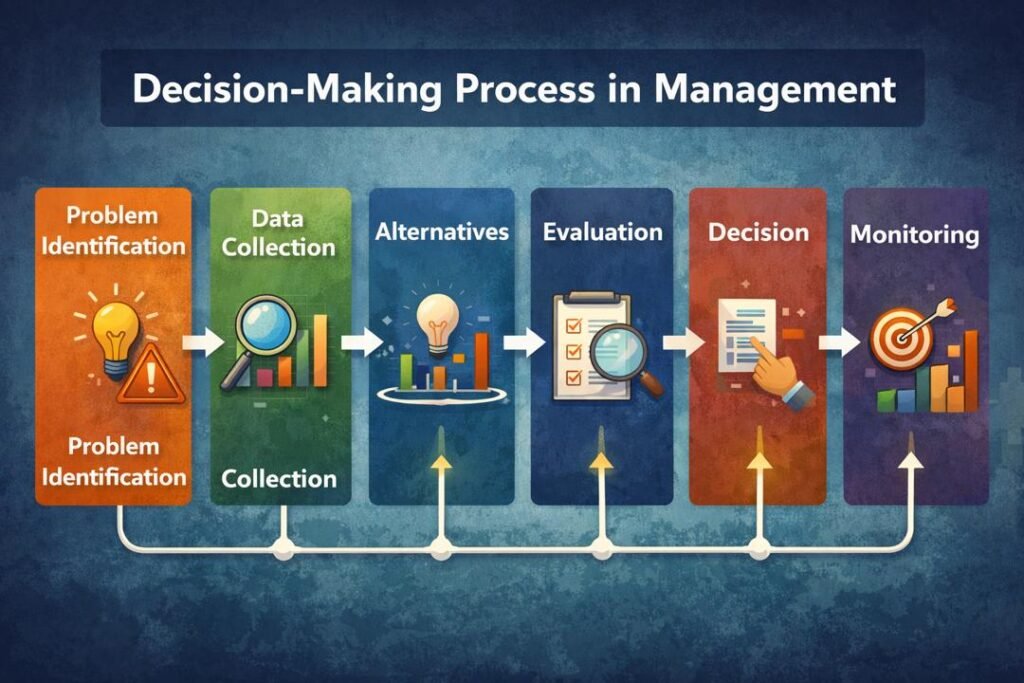
The decision-making process gives a systematic way through which managers can use to make good decisions. Even though it might be different in each situation, it usually entails the following steps:
Problem or Opportunity Identification
The initial phase is the identification of the presence of an opportunity or a problem. Managers need to state the problem that needs to be solved since improper identification of the problem can result in poor solution to the problem.
Collecting the Appropriate Data
After identifying the problem, managers get available data and information. This can be in terms of financial statements, market surveys, employee response and external environmental aspects. Decisions can only be informed when information is accurate.
The Preparation of Alternatives
Potential solutions or courses of action are then generated by the managers. Having a variety of options helps managers to justify various points of view and not to make hasty decisions.
Evaluation of Alternatives
All the alternatives are evaluated according to the criteria of feasibility, cost, risks, benefits and compatibility with the organizational objectives. The tools that are used at this stage include cost-benefit analysis and risk assessment.
Choosing the Optimal Alternative
The manager will then pick the alternative that will suit the decision criteria after analysis. This decision ought to provide the best utility of reasonable risk.
Implementation of the Decision
Effectiveness of a decision can only be achieved when it is implemented appropriately. This phase entails resource allocation, communication of the decision to the concerned stakeholders and responsibility allocation.
Monitoring and Evaluation
Lastly, the managers track the results of the decision to know whether it is yielding desired results. Feedback makes it possible to take corrective measures and improve.
The models of decision making in management
There are different decision-making models used by managers in making their decisions. All the models provide a variant of the decision-making process.
- Rational Decision-Making Model
The rational model presupposes that managers possess all information accessible and will be able to make objective assessment of the alternatives. The decisions are reached in a rational step-wised way with the aim of maximizing the results. Although it is an ideal model, it is usually constrained by real-life issues like time constraint and incomplete information.
- Bounded Rationality Model
This model was proposed by Herbert Simon, and it acknowledges that managers are faced by constraints like limiting information, limitation of thought, and time. Managers are also trying to achieve a satisfactory solution, rather than the best one, and this is referred to as satisficing.
- Intuitive Decision- Making Model
This model pays much attention to the use of experience, instincts and judgment. Managers use intuition in cases where they have to make decisions in a short time or when data is inadequate. Intuition can be useful, but it works best when used with experience and expertise.
- Participative Decision-Making Model
In this model, the managers incorporate the employees or the stakeholders in the decision-making process. Participation may enhance the quality of decisions made, higher levels of employee commitment, and morale. Nonetheless, it can be lengthy as well.
- Incremental Decision-Making Model
In this model, there is the need to make small and incremental changes instead of big changes. The feedback and shift in circumstances help managers to change their decisions over time to minimize risk and uncertainty.
Managerial Decision-Types
There are various types of managerial decisions depending on their nature and impact.
- Strategic Decisions
Strategic decisions are the long-term ones and they give the direction of the organization as a whole. These include such areas as market entry, mergers and significant investments. Top management decides on things of this nature and the consequences are usually enormous.
- Tactical Decisions
Tactical decisions are concerned with the method of doing things and are normally determined by middle-level managers. They include distribution of resources, planning of departments and execution of strategic decisions.
- Operational Decisions
Day-to-day decisions that are made by lower-level managers are called operational decisions. They facilitate smooth operations in the organization, including planning the work shifts and maintaining the inventory.
- Programmed Decisions
Programmed decisions are also repetitive and are guided by set policies or procedures. They are applicable to standardized issues and their solutions.
- Non-Programmed Decisions
Non-programmed decisions are those that deal with unique or intricate issues and need innovativeness and judgment. Such decisions can be found in situations of uncertainty or a fast-evolving situation.
Managerial Decision-Making Problems
In spite of structured processes and models there are various challenges managers come up with in making decisions.
- Uncertainty and Risk
Decisions made by managers are usually based on incomplete or unclear information. The volatility level may make it challenging to predict what will happen, which may result in poor decisions.
- Time Constraints
A lot of managerial decisions are under time pressure, and there is a lack of time to collect information and think over the alternatives.
- Information Overload
Access to information is crucial, but excessive information may overburden the managers and make decision-making more difficult.
- Cognitive Biases
Biases that relate to individuals, including overconfidence bias or confirmation bias, may cause biased thinking and make incorrect decisions.
- Resistance to Change
The implementation can be problematic because the employees and stakeholders are likely to oppose decisions that upset the status quo or jeopardize them.
Managerial Decision-Making Practical Applications
Smooth decision making has practical aspects in every sphere of management. In human resource management, good decisions affect recruitment, training, and performance management. In operations management, the decisions influence production efficiency, quality control and the management of the supply chain. Decision-making in financial management defines budgeting, investment and control of costs.
Managers that employ well-organized decision-making processes and models will be able to enhance the degree of problem solving, coordination and the attainment of organizational objectives more successfully. Culture of collaboration and innovations may also be encouraged by involving employees in decision making.
Value of Decision-Making to Organization Efficiency
The timely informed managerial decisions lead to effectiveness in organizations. They help organizations to react quickly to the changes in the environment, to make the best use of the resources, and to keep the competitive edge. Good decisions also boost the confidence of employees with their leaders, their morale, and stability in an organization.
Companies that have effective decision-making processes are in a better position to deal with risks, exploit opportunities and attain sustainable growth. Decision-making must therefore be constantly underdeveloped using training, experience and through analytical tools.
Conclusion
Making decisions is a core management task, and a key factor of organizational performance. The knowledge of the principles, processes, models, and types of decisions would help managers to enhance the quality and effectiveness of their decisions. Even with some pitfalls facing them, including uncertainty, time constraints and cognitive biases, structured, and informed decision-making leads to improved performance and resilience within an organization.
With a competitive and complex business environment, informed, ethical and timely decision making is more likely to make managers lead their organizations towards long-term success. Thus, managerial decision-making continues to play an important role in management and organizational success.
Get more well researched information about Decision-making in management here.