In 2025, creators move faster than ever—and visuals need to keep up. That’s where an AI deepfake photo maker comes in: a streamlined way to prototype concepts, localize campaigns, and teach media literacy without booking a full studio shoot. Used responsibly—with consent, clear disclosure, and purpose limits—an AI deepfake photo maker can be a powerful accelerator for storytellers, marketers, and educators.
Deepfake Maker takes that promise further with production-ready controls for alignment, tone matching, batch runs, and provenance, so you can focus on craft instead of cleanup. In this guide, you’ll learn what an AI deepfake photo maker is, how Deepfake Maker works step-by-step, what features actually matter, and the ethical guardrails that keep your projects sharp, safe, and scalable.
Table Of Contents
- What Is Deepfake Maker AI Deepfake Photo Maker?
- Why The AI Deepfake Photo Maker Trend Matters In 2025
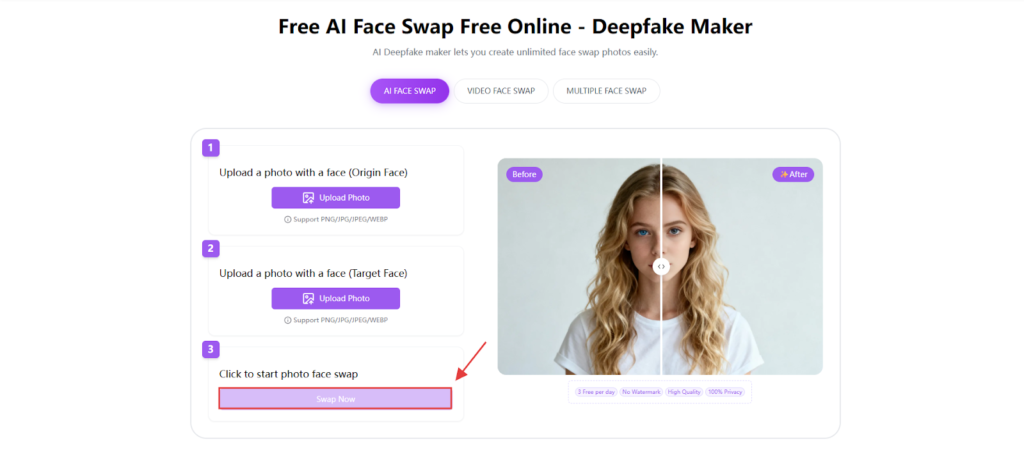
- How To Use Deepfake Maker AI Deepfake Photo Maker Step-By-Step
- What Makes A Deepfake Maker AI Deepfake Photo Maker “Good”?
- Core Features You’ll Love In An AI Deepfake Photo Maker
- Legitimate, High-Value Use Cases You Can Feel Good About
- Quality Tips: Getting Sharper, More Consistent Results
- Responsible Use: Ethics, Law, And Platform Policies
- Troubleshooting & Optimization For Your AI Deepfake Photo Maker Workflow
- Deepfake Maker vs. Alternatives: What To Consider
- FAQs About Using An AI Deepfake Photo Maker
- Conclusion
What Is Deepfake Maker AI Deepfake Photo Maker?
An AI deepfake photo maker is a software tool that uses generative AI and face-editing models to synthesize or alter images while preserving realism—skin texture, lighting, perspective, and expression. Deepfake Maker is a modern, cloud-based platform designed to help creators, marketers, educators, and studios produce responsible visual edits quickly, with controls that reduce artifacts and support ethical guardrails.
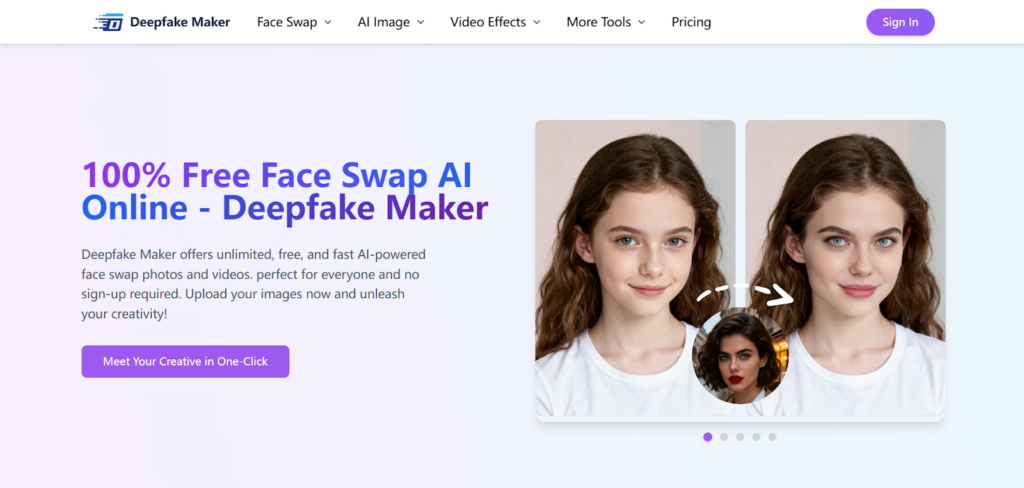
At its core, an AI deepfake photo maker maps facial landmarks, estimates depth, and blends features to create a convincing, stylistically consistent result. Deepfake Maker adds production-friendly features on top of this: batch processing, alignment tools, reference galleries, promptable adjustments, and content labeling options. It’s built for legitimate creative work—character continuity in storyboards, internal concept art, parody with clear disclosure, research, and privacy-respecting transformations (e.g., masking identities when you have permission).
In short: if you need a reliable, transparent, and policy-aware AI deepfake photo maker, Deepfake Maker aims to provide a professional-grade experience while reminding you to follow laws, consent standards, and platform rules.
Why The AI Deepfake Photo Maker Trend Matters In 2025
The adoption of visual AI has accelerated in 2025. Brands, indie creators, and studios now demand:
- Faster Pre-Visualizations: Storyboards and pitch decks often need quick face edits or stylized variants. An AI deepfake photo maker speeds that up without booking full shoots.
- Localized Marketing: With permissions, teams can swap expressions, adjust looks, or adapt visuals to regional tastes while keeping brand consistency.
- Privacy & Safety: Ironically, the same tech—used responsibly—can protect people (e.g., de-identifying study participants or masking a whistleblower’s face with consent).
- Cost Efficiency: Concept iterations happen in hours, not weeks, which is critical for small teams.
- Education & Research: Media literacy courses and labs use controlled demos to teach detection, consent, and provenance.
Deepfake Maker leans into this demand with a toolset that prioritizes quality, repeatability, and ethical use—three pillars any serious AI deepfake photo maker must honor in 2025.
How To Use Deepfake Maker AI Deepfake Photo Maker Step-By-Step
Below is a practical, start-to-finish workflow that balances speed with quality and safety.
Step 1: Prepare Your Inputs (And Permissions)
- Collect Source & Target Images: Ensure clean lighting, frontal angles, and adequate resolution. For best results, capture faces at similar focal lengths and expressions.
- Obtain Consent: If a real person is involved, document permission. This is essential to use any AI deepfake photo maker ethically and legally.
- Set Intent: Decide if this is parody, private mockup, research, or internal concept art. Label working files clearly to avoid misuse.
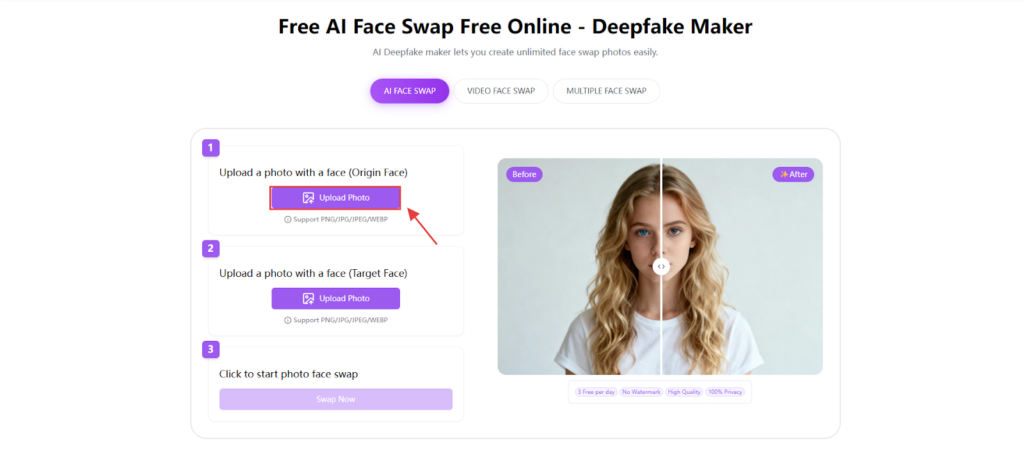
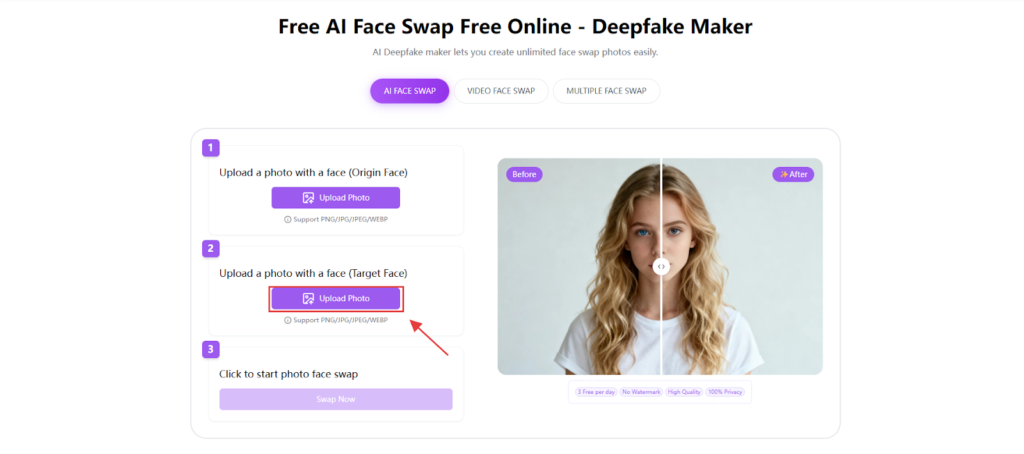
Step 2: Upload To Deepfake Maker
- Create A Project: Organize assets by scene or campaign.
- Upload Images: Use PNG or high-quality JPG. Maintain original filenames for traceability.
- Reference Panel: Pin 3–6 reference images for each identity to stabilize outputs.
Step 3: Align, Mask, And Calibrate
- Auto-Align: Run Deepfake Maker’s alignment tool to lock landmarks and perspective.
- Manual Masking: If needed, refine the face area to avoid spillover onto hairlines or backgrounds.
- Color & Lighting Match: Activate tone matching to harmonize skin temperature and scene lighting.
Step 4: Choose Your Model Preset
- Natural Portrait: Minimal edits, realism first.
- Cinematic Beauty: Subtle smoothing and dynamic contrast.
- Stylized Series: For storyboards, concept art, or comic-style outputs.
- Custom: Expert mode for granular control (blend strength, detail weight, de-aging/aging intensity where appropriate).
Step 5: Run The Face Edit
- Batch Or Single: Process individually for critical shots or in batches for speed.
- Preview Pass: Inspect artifacts around eyes, teeth, and ears.
- Iterate: Adjust blend strength or re-align if the result “slides” under extreme angles.
Step 6: Finishing Touches
- Edge Cleanup: Use feathering and micro-healing brushes to remove seams.
- Grain & Sharpen: Add light film grain and mild sharpening to unify the composite.
- Watermark/Label: If publishing, enable optional “AI-Assisted Edit” disclosure overlays.
Step 7: Export & Document
- Versioning: Save v1, v2, v3… with notes (model preset, strength, references used).
- Formats: Export PNG for masters; JPG/WebP for web.
- Provenance: Keep internal logs (who approved, where it will be used) to stay compliant.
This seven-step flow is simple but robust, making Deepfake Maker an efficient AI deepfake photo maker for collaborative teams.
What Makes A Deepfake Maker AI Deepfake Photo Maker “Good”?
When you evaluate any AI deepfake photo maker, weigh these criteria:
Realism Without Uncanny Artifacts
- Look for consistent eye sockets, occlusions (glasses, hair), and natural skin micro-detail. A good AI deepfake photo maker minimizes plastic sheen.
Identity Consistency Across Batches
- A strong pipeline preserves the same identity over multiple scenes and angles. Deepfake Maker’s reference gallery helps lock this down.
Control & Explainability
- You need knobs for blend strength, tone, shadow match, and masking. A professional AI deepfake photo maker explains what each control does, not just “magic.”
Speed With Predictability
- Fast renders are great—predictable renders are better. Stable outputs reduce rework time across campaigns.
Ethics & Safety Controls
- Consent reminders, optional labeling, and policy tips should be built in. An AI deepfake photo maker without safety rails is not production-ready in 2025.
Batching, Logging, And Versioning
- Teams need repeatable pipelines, not one-offs. Deepfake Maker is designed for iteration with transparent version histories.
Support & Documentation
- Clear help docs, prompt guides, and real examples are signs of a mature tool.
Core Features You’ll Love In An AI Deepfake Photo Maker
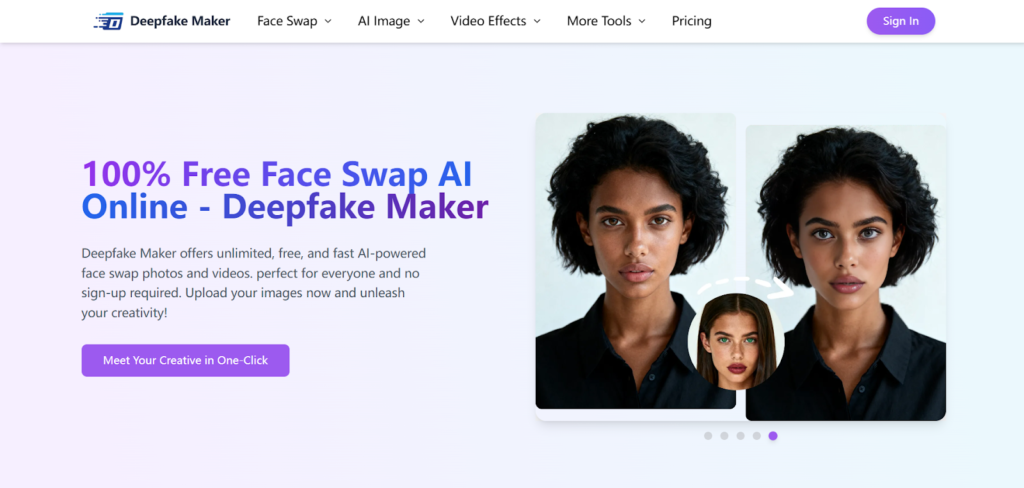
- Smart Face Alignment: Automatic landmark detection with manual overrides for tricky angles.
- Adaptive Blend Engine: Adjust the intensity to balance realism and recognizable identity.
- Tone & Lighting Harmonization: Matches the target scene’s temperature, exposure, and contrast.
- Reference Gallery & Locking: Use multiple source images to stabilize the “look” across a series.
- Batch Processing: Process entire storyboards or campaign variations in one go.
- Non-Destructive Masks: Re-edit edges without starting over.
- Export Profiles: One-click presets for print, web, or social with correct DPI and compression.
- Provenance Aids: Optional watermarking and internal notes so teams can track approvals.
- Guided Onboarding: Tips and checklists that teach ethical best practices while you work.
All of these help Deepfake Maker function as a polished, versatile AI deepfake photo maker for real workflows.
Legitimate, High-Value Use Cases You Can Feel Good About
Concept Art & Storyboarding
- Swap faces on talent stand-ins for quick visualization with permission and disclosure.
Parody & Satire With Clear Labeling
- Comedy and commentary are protected in many regions when clearly identified as parody.
Education & Media Literacy
- Demonstrate how synthetic media works and how to spot it—responsibly and transparently.
Privacy-Respecting Research
- With consent, mask or alter identities in case studies and research publications.
Internal Mockups For Brand Approvals
- Create realistic comps before expensive photo shoots to align stakeholders faster.
Historical Re-Creations For Museums
- Ethically recreate portraits to visualize time periods, with strict provenance notes.
Each use case is strongest when paired with consent, disclosure, and purpose limits—and when you rely on an AI deepfake photo maker like Deepfake Maker that supports transparent workflows.
Quality Tips: Getting Sharper, More Consistent Results
Input Quality Is Everything:
- Capture faces at similar focal lengths; avoid ultra-wide lenses that distort features.
- Maintain consistent lighting between source and target—soft, frontal light works best.
- Use neutral expressions when possible; extreme expressions increase artifact risk.
Matching Matters:
- Match head pose (yaw, pitch, roll) between images.
- Match skin tone and exposure using the harmonization tool before the final blend.
Reference Diversity:
- Provide 3–6 varied references (frontal, ¾ view, smile/neutral) for identity stability.
- Weight your best reference higher if your AI deepfake photo maker offers per-image weighting.
Blend Strength & Masking:
- Start with a medium blend. Increase gradually to avoid plasticky results.
- Feather the mask edges and zoom in on hairlines, ears, and glasses—common failure zones.
Finishing Pass:
- Add a light grain pass to unify textures.
- Subtle unsharp masking can restore perceived detail after compression.
With these practices, Deepfake Maker consistently produces natural-looking edits worthy of professional portfolios.
Responsible Use: Ethics, Law, And Platform Policies
Using an AI deepfake photo maker demands a duty of care:
- Consent & Rights: Always obtain written permission from any identifiable person. Respect talent agreements and model releases.
- Disclosure: Label AI-assisted imagery when sharing publicly. Transparency fosters trust.
- No Harm: Do not impersonate, defame, harass, or mislead. Avoid political manipulation and sensitive contexts.
- IP Awareness: Respect copyrights and trademarks in source and target materials.
- Context & Purpose: Keep edits within the agreed, documented purpose. Don’t repurpose assets without approval.
- Local Laws & Platform Rules: Laws vary by region and platform. Review them before publishing.
Deepfake Maker’s philosophy is simple: a capable AI deepfake photo maker should help you stay compliant, not tempt you to cut corners.
Troubleshooting & Optimization For Your AI Deepfake Photo Maker Workflow
Problem: The Face Looks “Plastic.”
- Reduce blend strength; enable skin-texture preservation.
- Add micro-grain and lower global smoothing.
Problem: Edges Don’t Match The Background.
- Expand and feather your mask; re-align landmarks.
- Use tone matching to equalize exposure and color.
Problem: Eyes Or Teeth Look Off.
- Choose references with similar expressions.
- Re-run with a “Natural Portrait” preset and refine manually.
Problem: Identity Drifts Across A Batch.
- Lock a single, high-quality reference as primary.
- Lower randomness; enable batch consistency mode.
Problem: Color Cast Or Mixed Lighting.
- White-balance both images first.
- Use the harmonization module before the final pass.
Problem: Compression Ruins Detail.
- Export a PNG master and generate web versions from it.
- Use WebP/AVIF with higher quality settings for final delivery.
Treat your AI deepfake photo maker like a production pipeline: test, document, and standardize.
Deepfake Maker vs. Alternatives: What To Consider
When comparing Deepfake Maker to other AI deepfake photo maker options, focus on:
- Output Consistency: How often do you get a keeper on the first or second pass?
- Control Surface: Are there enough controls for pros—masks, blend curves, tone tools?
- Workflow Speed: Batch performance, caching, and preview responsiveness.
- Team Features: Versioning, notes, and project organization.
- Safety Rails: Consent reminders, disclosure overlays, and documentation tips.
- Total Cost Of Ownership: Consider time saved on retakes, not just subscription price.
- Support & Updates: Active documentation and responsive roadmaps.
Deepfake Maker aims to balance creative control with ethical defaults, making it a compelling AI deepfake photo maker for creators who care about quality and responsibility.
FAQs About Using An AI Deepfake Photo Maker
Q1: Is using an AI deepfake photo maker legal?
A: It can be, when you have consent, respect IP rights, and follow local laws and platform policies. Illicit use (impersonation, deception, harassment) is prohibited.
Q2: Do I need model releases for internal mockups?
A: Yes—obtain releases and consent even for internal workflows. This reduces risk and clarifies allowed uses.
Q3: How do I get the most realistic results?
A: High-quality inputs, matched angles and lighting, and careful masking. Deepfake Maker’s alignment and tone-match tools are designed for this.
Q4: Can I process multiple images at once?
A: Yes—Deepfake Maker supports batch processing, which is crucial for storyboards and campaigns.
Q5: Will people be able to tell it’s AI-assisted?
A: If you follow best practices, many edits look natural. Regardless, disclose clearly to maintain trust.
Q6: What image formats should I export?
A: PNG for masters; JPG/WebP for web. Keep layered or versioned files for audits.
Q7: Can I use celebrity faces?
A: Only with proper rights and platform approvals. Many regions restrict commercial use of a person’s likeness without permission.
Q8: Does Deepfake Maker store my data?
A: Treat any cloud service under standard privacy practices—review the provider’s data policy and opt for team workspaces with access controls.
Q9: Why do some results fail around glasses or hair?
A: Occlusions are hard. Provide clearer references and refine masks near glasses frames and complex hairlines.
Q10: How is this different from generic face filters?
A: An AI deepfake photo maker focuses on identity-accurate synthesis and scene-aware blending, not just beautification.
Conclusion
The rise of the AI deepfake photo maker is reshaping how visual teams concept, iterate, and educate. When used responsibly—with consent, disclosure, and purpose limits—it becomes a powerful creative accelerator. Deepfake Maker builds the right kind of tooling around that power: precise alignment, adaptive blending, tone harmonization, reference locking, batch processing, and provenance aids. Together, these features form a repeatable pipeline that saves time and elevates quality while reinforcing ethical guardrails.
If you’re a creator, marketer, educator, or studio looking for professional-grade image edits, choose an AI deepfake photo maker that respects both craft and conscience. With Deepfake Maker, you can move faster without cutting corners: plan your shots, secure permissions, align and mask carefully, dial in your blend, and label your outputs clearly. That workflow doesn’t just produce better images—it builds trust in your process, your brand, and your work.