Abstract
The bondage between the mass media and society is symbiotic in nature as a result of a never-ending interaction and interplay. Mass media do not exist in a vacuum, but on the contrary, it is influenced by the values of society, political structure, and cultural practices, as well as economic factors in society. Meanwhile, mass media is a potent influence on the opinion of the population, the strengthening or weakening of social norms, and social behavior. This paper will discuss the mutual and dynamic relationship between mass media and society by discussing theoretical formulations, empirical data, and real-world practice. Based on a qualitative approach to the study that is based on the analysis of secondary data, the study examines various ways in which the media institutions are simultaneously the mirror of the realities of society, as well as agents of social change. The results emphasize the fact that mass media at once acts as a mirror and a shaper of society, which supports power relationships, as well as acting as a space of social change. The article finally concludes that the nexus of the mass media and society is fundamental to understanding the modern social processes in an increasingly mediated world.
Keywords: society, mass media, media influence, social change, communication studies.

1. Introduction
Mass media hold a significant place in contemporary society because it is one of the key avenues where information, ideas, and cultural meanings are generated and exchanged. The newspapers, radio, television, film, and digital platform influence the way people perceive social reality. The interaction between mass media and society, where it takes place, is not linear but two ways, as the content of media is affected by societal formations and the media affects the social behavior and social consciousness.
The media institutions operate in a social setting. Media regulations, cultural values, and commercialization are determined by political ideologies, content production, and ownership respectively. Mass media, on the other hand, affects society in the sense that it influences political opinion, enhances cultural identities, and determines the agendas of the people. It is such a two-way interaction that makes mass media not only a product of society but also a social agent.
The paper will look into the symbiotic relationship that exists between mass media and the society, based on the literature written on the topic, the perspectives used as theories, and the real-life examples. The thesis takes an academic form of studying that brings out the reflection of the societal norms in the media and, at the same time, redefines the beliefs, values, and power relations.
2. Literature Review
2.1. The Mass Media and Society Conceptualization
The role of mass media in society has been a long-standing study among scholars. According to McQuail (2010), the mass media can be defined as institutionalized channels of communication that have vast and heterogeneous audiences. Society, in its turn, can be defined as the structured human interactions that are regulated by common norms, values, and structures (Giddens, 2013). The relationship between the two entities is an ongoing and self-affirming process.
2.2. Theoretical Approaches to Relations between Media and Society
A number of theories describe the connection between the mass media and society. Functionalism perspective considers the media as a social institution that can help bring sanity by educating, informing, and entertaining the masses (Lasswell, 1948). The conflict perspective, on the other hand, contends that the media exists to protect the interests of the dominant groups through the reaffirmation of existing systems of power (Marx and Engels, 1978).
The agenda-setting theory argues that the media do not inform people about what to think but what to think about through highlighting a particular issue (McCombs & Shaw, 1972). On the same note, the cultivation theory implies that the perception of social reality is shaped under the influence of the media content, which is experienced over a long period of time (Gerbner et al., 2002). All these theories point to how the media influences our social attitudes and behavior.
2.3. Media as a Mirror to Society
The mass media are commonly a reflection of society. The media content displays dominating cultural myths, political values, and societal interests. As an example, gender roles have been depicted in the media based on the expectations of the prevailing culture in society. The media of a given society focuses more on freedom of expression in a democratic society, whereas in an authoritarian society, the media content can be influenced by the ideologies of the state as a result of censorship and control.
2.4. Media as Social Change
In addition to its role of reflection, the mass media does actively re-create society. The Arab Spring and other social movements proved to be instrumental in the mobilization of citizens via the digital media platform and the resulting protest of political power (Castells, 2012). Social behavior and policy making has also been affected by media campaigns which focus on the health issues affecting the population, like HIV/AIDS awareness.
3. Methodology
3.1. Research Design
The research design used in this study is a qualitative research design, which subsists on the analysis of secondary data. There were systematic reviews of academic journals, textbooks, media reports, and policy documents in order to analyze the relations between the mass media and society.
3.2. Data Sources
Peer-reviewed journal articles, authoritative books on communication, and valid online scholarly materials were used to gather data. The sources were chosen according to their relevance, credibility, and suitability to the research objectives.
3.3. Analytical Approach
The research used thematic analysis in order to locate similar patterns associated with media influence, social values, and power relationships. The research examined the mirror of the mass media on the structure of society and, at the same time, the impact of mass media on social speech and actions.
| Social Factor | Impact on the Mass Media |
| Political System | Defines the freedom of the media, regulation, and censorship. |
| Cultural Values | Influences the content topic, language, and representation. |
| Economic Structure | Has an effect on ownership, advertising, and commercialization. |
| Social Norms | Impacts moral guidelines and expectations of the audience. |
Table 1: Shows some of the major societal influences on the operation and content generation of the mass media.
4. Discussion: The Two-way Interaction of the Mass Media and Society
The relationship between society and the mass media can be best described as a perpetual feedback mechanism. Media institutions are dependent on societal structures to legitimize themselves and survive, whereas society is dependent on the media to disminate information and maintain social cohesion.
Mass media shapes the opinion of people by putting issues in a certain perspective. Such events as political campaigns are entirely dependent on media coverage to form the opinions of voters. Meanwhile, feedback of the audience and social movements shape media agendas, which proves the participatory propensity in contemporary communication.
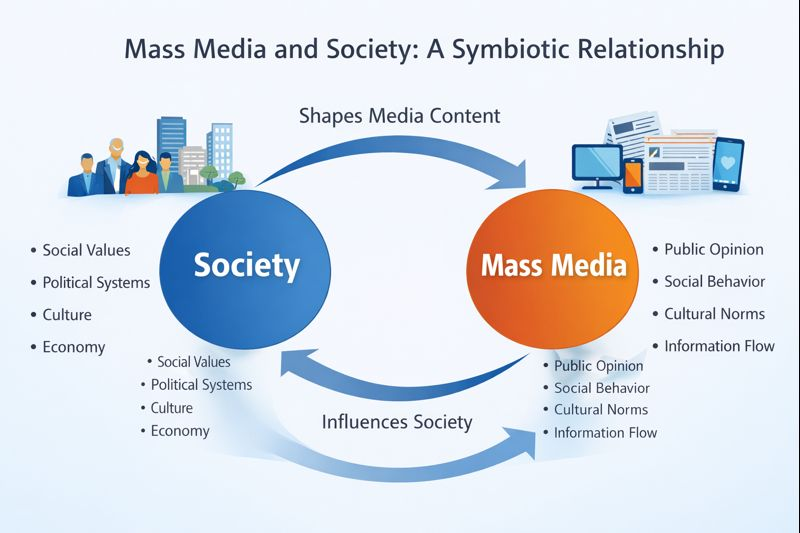
Figure description:
A two-sided diagram of mutual impact, where the first side is labeled Society (social values, political systems, culture, economy), and the other one Mass Media (public opinion, social behavior, norms), and connected by the arrows that denote mutual impact.
5. Conclusion
Mass media and society are symbiotic in nature. Media institutions represent social environments where they are based, and they, at the same time, shape the societal norms, beliefs, and power structures. The mass media is important in determining the discourse and social behavior of the people through agenda-setting, framing, and representation.
This mutual dependence is imperative to scholars, policymakers, and those involved in the media practice, especially in the era of fast technological shift. Since media platforms are dynamic, their impact on society will not diminish, and the importance of the practice of responsible media and media consumption will not be stopped.
References
Castells, M. (2012). Networks of outrage and hope: Social movements in the Internet age. Polity Press.
Gerbner, G., Gross, L., Morgan, M., & Signorielli, N. (2002). Growing up with television: Cultivation processes. In J. Bryant & D. Zillmann (Eds.), Media effects: Advances in theory and research (pp. 43–67). Lawrence Erlbaum.
Giddens, A. (2013). Sociology (7th ed.). Polity Press.
Lasswell, H. D. (1948). The structure and function of communication in society. In L. Bryson (Ed.), The communication of ideas (pp. 37–51). Harper & Brothers.
Marx, K., & Engels, F. (1978). The German ideology. International Publishers.
McCombs, M. E., & Shaw, D. L. (1972). The agenda-setting function of mass media. Public Opinion Quarterly, 36(2), 176–187. https://doi.org/10.1086/267990
McQuail, D. (2010). McQuail’s mass communication theory (6th ed.). Sage Publications.