
Introduction
In the current business world of high competition with a fast changing internal environment, organizations are realizing that the most important asset they have is the workforce. Although technology, capital, and strategy play an important role, it is the human effort that determines the most in the realization of organizational goals. This fact makes motivation theories the focus of efficient management. Motivation determines the behavior of the employees, the level of commitment to their jobs, and the level of willingness to work beyond the minimum. Managers with proper knowledge of motivational principles and their attainment are in a good position to develop high performance, job satisfaction, and long-term success of the organization.
Motivation can be defined as internal and external stimuli that arouse enthusiasm, persistence, and direction in the conduct. In management, motivation describes the reasons why employees will decide to work hard, the extent to which they apply their efforts, and the duration they will maintain the efforts. Even highly skilled employees can perform poorly without proper motivations, and the highly motivated employees would most probably perform better than expected. This paper will review major motivation theories and how they can be relevant to managerial practice, how managers can use the motivational theory to improve employee engagement, job satisfaction, performance and workforce retention and also how motivation is related to the overall organizational performance.
Motivation within the Managerial Environment
Management motivation is not just about giving rewards or punishing but it is about the realization of human needs, expectations and behaviors. The employees come to organizations with different backgrounds, values, goals, and aspirations. Managers should then embrace a strategic motivation approach that will harmonize the needs of individuals with the goals of the organizations.
Motivation has three important roles as a manager. First, it guides behavioral orientation on organizational goals. Second, it defines the level of effort the employees put in their work. Third, it affects tenacity, or the duration to which employees persevere in direction of goals in the face of difficulties. Effective management of motivation will lead to increased engagement among employees, increased productivity and dedication leading to increased organizational performance and reduced rates of employee’s turnover.
Theories of Motivation
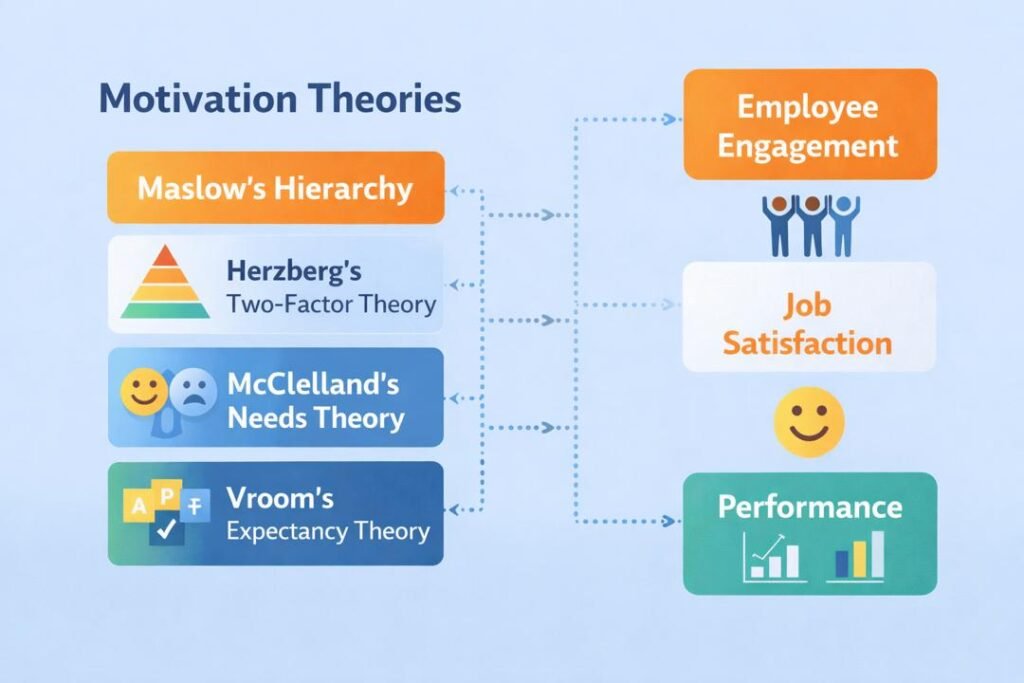
Motivation theories can be used to explain the behavior of people at work in a systematic manner. The theories provide managers with an opportunity to predict the reactions of employees and create effective motivational plans. They can be broadly categorized as content theories, which are concerned with what drives individuals, and process theories, which are concerned with how individuals are driven.
Maslow’s Hierarchy of Needs
One of the most widely known theories of motivation is Hierarchy of Needs developed by Abraham Maslow. It regarding suggests that human needs come in a hierarchy of five levels which include physiological needs, safety needs, social needs, esteem needs, and self-actualization needs. In the hierarchy of needs, Maslow argues that people strive to fulfill their needs of lower level first before advancing to higher levels.
This theory is applicable in managerial practice where the workers with their basic needs unmet are likely to be unable to concentrate on the performance objectives on higher level. This theory can be used by managers by providing employees with fair wages, safe working environment, good working relations, recognition and personal growth. Motivation and engagement should also go up when the organizations meet the various levels of employee needs.
Herzberg’s Two-Factor Theory
The Two-Factor Theory developed by Frederick Herzberg identifies hygiene factors and motivators. The hygienic factors are the salary, company policies, and working conditions which help to prevent dissatisfaction but do not always motivate employees. Achievement, recognition, responsibility and chances of advancement are motivators that are actively involved in job satisfaction and motivation.
To managers, this theory focuses on the idea that it is not enough to increase pay or working conditions to motivate workers in the long run. In order to improve performance, managers should come up with meaningful, challenging and rewarding jobs. The practical implementation of the Herzberg theory is through job enrichment, responsibility delegation, and recognition programs.
McClelland’s Theory of Needs
Three prevailing needs that are identified to drive motivation have been determined by David McClelland these areas include the need in achievement, the need in affiliation and the need in power. People vary in the intensity of these needs and this variation influences their work behavior.
This theory can help managers to shape motivational strategies to the needs of individual employees. Indicatively, a high need achiever employee can be encouraged to work on difficult tasks and obtain feedback on his performance, whereas a high need affiliation employee can be encouraged to work in a team. These differences can be comprehended, and hence managers can allocate roles and responsibilities in a more efficient way.
Vroom’s Expectancy Theory
The Expectancy Theory created by Victor Vroom is concerned with the cognition involved in motivation. It indicates that motivation is based on three features namely expectancy (belief that effort results in performance), instrumentality (belief that performance results in rewards), and valence (importance of the reward to the individual).
Practically, managers should make sure employees feel that their work will lead to good performance, performance will be well rewarded and rewards will be significant. This theory can only be applied successfully through clear expression of expectations and transparent performance appraisal systems and individualized rewarding.
Equity Theory
Jack Stacy Adams developed the Equity Theory, which focuses on the fairness at the workplace. The employees evaluate themselves (their efforts, skills, experience) and the results (pay, recognition, benefits) against others. A sense of injustice may result in dissatisfaction, decreased work or resignation.
The managers should therefore endeavor to be fair and consistent in reward systems. Open dialogue, remuneration plans that are fair and new performance reviews contribute to reducing the feelings of injustice and maintaining motivation.
Motivation Theories in the Managerial Practice
Knowledge about motivation theories is great, yet it is true that their practical value is what matters. Good managers put on practice the theoretical knowledge into operational strategies which improve the level of engagement and performance of the employees.
Improvement of Employee Engagement
The term employee engagement describes the emotional and psychological attachment that employees have towards their organization and work. The theories of motivation emphasize the need to have meaningful work, recognition, and growth opportunities to create engagement.
Managers should also increase engagement and can do this by giving regular feedback and rewards on the achievements of employees. Employees who are motivated and empowered to feel important will enjoy using discretionary efforts in their jobs. Motivated employees are not merely at work but they are mentally and emotionally dedicated to organizational success.
Improving Job Satisfaction
Job satisfaction is intimately connected with motivation and is very important in terms of performance and retention. Content theories like Maslow and Herzberg focus on both the attainment of the lower and higher needs as the determinants of satisfaction.
To enhance job satisfaction, managers can also provide supportive working conditions, provide chances of skills development, and match employee jobs with their strengths and interests. Workers are more productive, easy to work with and remain in an organization when they find satisfaction in their jobs.
Enhancing the Workforce Performance
Motivation has a direct impact on performance including influence on effort, persistence and focus. The practical theories of performance management include process theories like Expectancy Theory.
The managers are required to have clear and attainable goals, resources needed and fair reward systems. The feedback of performance must be constructive and prompt which strengthens the connection between the efforts and performance. The motivated employees will perform better according to the performance standards and will bring in new ideas that will make the organization to be more effective.
Driving Force, Organization Performance, and Employee Retention
Motivation is not simply a personal level phenomenon but it is an organization wide phenomenon which has significant implications. Motivated employees are associated with better performance of the organizations compared to their competitors, and greater adaptability to change, as well as a better reputation.
Connection between Motivation and Organizational Success
Motivated employees have a positive impact on increasing productivity, the quality of work, and customer satisfaction. They are more ready to cooperate, exchange knowledge and contribute to the organizational projects. Motivation leads to a culture of accountability and continuous improvement as well which is vital in the long run. Strategically, the managers that focus on motivation develop resilient and competitive organizations. By aligning motivational practice to the organizational objectives, the managers are guaranteed that the effort of the employees is geared towards value creation and long-term growth.
Retention and Decreased Turnover of the Workforce
Employee turnover is detrimental and disruptive. Motivation is also very important in retention as it affects job satisfaction, organizational commitment as well as organization loyalty. Motivated and appreciated employees will not be interested in looking to other places.
Managers may improve retention through career development opportunities, contribution recognition and fair treatment. Intrinsic and extrinsic motivational practices are associated with similar motivational practices that support a positive employee experience, lowering turnover intentions and maintaining organizational knowledge.
Difficulties related to the Motivation of Employees
Even though it is important, motivation poses a number of challenges to managers. There is a challenging environment of individual differences, cultural diversity and shifting employee expectations which necessitate the adoption of a one-size-fits-all approach. One employee may not get motivated by what motivates another.
There are also extra-personal factors like economic conditions, remote working, and technological change that affect motivation of employees. Managers should thus be flexible and adaptable and keep on exploring the needs of the employees and mold their motivational techniques.
Conclusion
A strong managerial foundation is motivation and one of the driving factors of employee performance, engagement and retention. With the knowledge and application of theory of motivation, the managers can be able to establish working conditions that motivate the employees to give their best. The content theories describe the motivation behind employees and the process theories show the way motivation works which is of great help in managerial decision making.
Under the condition of the careful implementation of motivational principles, employees would feel more satisfied with their jobs, engaged, and perform better. On the organizational level, motivation will help in productivity, competitiveness, and sustainability. In a world where human capital is a determining factor, managers with motivation as a priority would be in a better position to develop loyal workforces and have sustainable organizational objectives.
Get more well researched information about Motivation in management here.