
Introduction
A good organization is run by the management which gives direction, coordination and control over human and material resources of an organization. The organizing function of management is one of the most important aspects of management, which is important in the process of converting plans into action structures. Even the best-designed plans fail to work out without proper organization, which may result in confusion, duplication of efforts or lack of accountability.
Organizing entails the order of tasks, work, power, and resources such that individuals and work teams can work effectively towards shared objectives. It dictates the way in which roles are established, the way in which responsibility is allocated and the interaction that exists between the departments. An organization structure that is well designed encourages productivity, enhances coordination and fosters teamwork at any level in an organization.
This paper will discuss the organizing role of management, overviewing its main concepts, including division of labor, authority, responsibility, and departmentalization and showing how the efficient organizational structures increase productivity, responsibility, and efficiency of operations.
Learning the Organizing Function of Management
The organizing function of management is the systematic procedure of determining tasks, grouping activities, allocating duties, authority delegation, and relationships between people and departments. The main task of it is the development of a system in which individuals are able to cooperate effectively.
Arranging the responses to critical managerial questions like:
- Who does what?
- Who reports to whom?
- How are tasks coordinated?
- How are resources allocated?
Organizing provides a bridge between planning and execution by answering these questions. It also makes sure that the resources, including human, financial and physical, are optimized in order to reach organizational objectives.
The important Goals of Organizing
The organizing function of management will seek to:
- Define the roles and responsibilities.
- Prevent duplication of work
- Encourage interdepartmental co-ordination.
- Facilitate accountability
- Enhance efficiency and productivity.
In the absence of proper organization, employees can develop ambiguity of roles, duplication of authority and communication failure which are counterproductive to performance.
Division of Labor: Division of Labor to be efficient.
Division of labor, which is subdivision of work in smaller and specialized parts and assigning them to individuals or groups according to their competency is one of the ideals of organizing.
Significance of Division of Labor
Division of labor enhances efficiency since it enables the workers to:
- Acquire experience in certain activities.
- Work faster because it is being repeated.
- Minimize mistakes due to specialization.
As an illustration, in a manufacturing company the manufacturing process is broken down into manufacturing phases like design, assembling, quality checking and packaging. The units specialize in their individual functions resulting into increased productivity and quality.
Impact on Productivity
In the case of clearly divided tasks:
- Employees get expectations.
- Far more focused training is achieved.
- Performance measurement is less complex.
The managers should however balance both specialization and flexibility. Too much division of labor may result in monotony, lack of motivation and development of skills. Thus, an efficient Organizing is associated with the creation of roles that lead to an efficient and an engaged employee.
Power and Accountability: The Secret of responsibility
The establishment of authority and responsibility within an organization is an important aspect in which the management role plays the organizing role. Authority is considered to be the legitimate power vested in people to make decisions, give orders, and distribute resources in an attempt to attain organizational goals. In its turn, responsibility is the duty of the employees to carry out the duties given and take responsibility of the consequences of their actions. The two terms are directly related to one another and they should co-exist to manage them.
Authority
Authority is defined as legitimate power which is vested to a manager or an employee to make decisions, give orders, and distribute resources. It comes down the hierarchy of the top management down to the lower levels and is vital in ensuring order and discipline.
Responsibility
Responsibility is the qualification of a person to undergo the roles given to him and the anticipated outcome. It is the result of delegation of tasks and it is a vital part of organizing aspect of the management. In case a manager delegates work to a subordinate, then that subordinate by default becomes obligated to ensure that the work done is efficient and effective. Responsibility unlike authority, cannot be assigned and evaded. Although other people might be given the responsibility, the person who entrusted the responsibility is still responsible of the result. This renders accountability as an ongoing and intrinsic feature of all the organizational functions. Not only do employees have to perform their tasks, but also explain their actions and performance to their superiors.
Correlation of Authority and Responsibility
To make organizing effective, it is necessary:
- Responsibility should be equal to authority.
- Employees must not be blamed without enough authority.
- There should be clear reporting relations.
Accountability is enhanced when the authority and responsibility are well balanced. Employees understand to whom they are reporting to, which decisions they are allowed to make and what results they are supposed to provide.
Delegation: Improving Managerial Performance.
Delegation is a viable consequence of organization and is the process giving responsibilities and power to subordinates and not giving overall responsibility.
Benefits of Delegation
Effective delegation:
- Minimizes workload of managers
- Develops employee skills
- Promotes initiative and innovativeness
- Enhances the rate of decision making
Through proper delegation, the managers are able to concentrate on the strategic problems and leave the employees to operate at operational level.
Delegation and the Organization Structure
A structured framework clearly outlines the lines of delegation and eliminates any confusion and power tussles. When the lines of authority are clear, the employees feel more certain in undertaking their duties.
Departmentalization: Organization of Work to coordinate
Departmentalization is the process of putting together similar activities in departments or units. It is an internal aspect of the function of management organization since it determines the coordination of work in the company.
Departmentalization Types
- Functional Departmentalization: Combining operations according to functional areas like marketing, finance, human resources and operations.
- Product Departmentalization: Product or service-based organization, which is a characteristic of diversified organizations.
- Geographical Departmentalization: Organizing operations according to location or region.
- Customer-Based Departmentalization: Segmentation of activities based on customers.
All these approaches have their merits and organizations tend to use a hybrid approach in order to address complex requirements in their operations.
Contribution to Efficiency
Departmentalization:
- Enhances coordination at unit level.
- Simplifies supervision
- Increases expertise in departments.
- Promotes performance review.
Clarity between departments also helps make collaboration easier, and the conflict also reduces.
Teamwork and Organization Structure
An organizational structure defines the way in which teams are created, the way they relate, as well as the flow of information.
Supporting Teamwork
Well-designed structures:
- Stimulate interdepartmental cooperation.
- Encourage effective communication lines.
- Lower interdepartmental competition.
As an example, matrix structures enable employees to work in functional teams as well as project teams in which knowledge sharing and innovation become possible.
Role Clarity and Motivation
In cases where employees know their positions in the organization structure:
- They feel more confident
- Motivation increases
- Job satisfaction improves
Organizing hence has a direct effect not only on efficiency but also on morale at the workplace.
Strategic Co-ordination
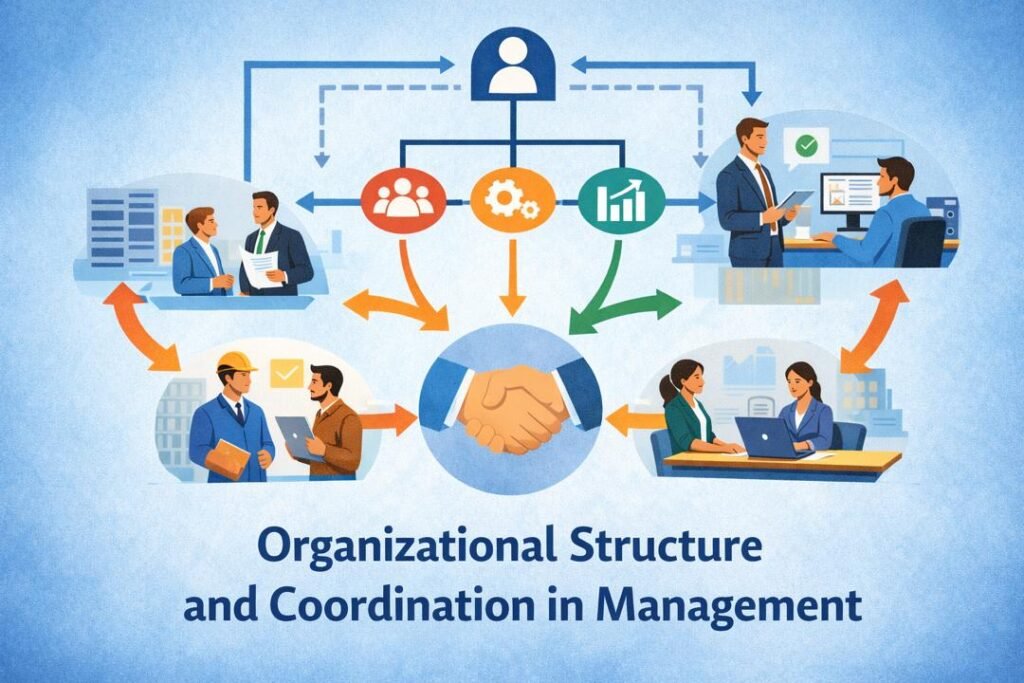
The coordination can be defined as the synchronization of individual and departmental activities in achieving organizational objectives. The organizing function establishes mechanisms which enable coordination.
Organizational Co-ordination Tool
- Clear reporting lines
- Standard operating procedures
- Established channels of communication
- Cross-functional teams
Combining the latter, organizations will guarantee alignment of activities and will use resources effectively.
Organizational and Operational Efficiency
Operational efficiency is the ability to produce maximum output and input minimum. This can be assisted by organizing which helps by:
- Eliminating role ambiguity
- Lessening repetition of work.
- Optimal allocation of resources.
When organizational structures are not well designed, the inefficiencies will be manifested by delays, conflicts, and squandered resources.
Modern Organizing Technology
In modern organizations, digital technology assists in organizing through:
- Enabling virtual teams
- Streamlining workflows
- Improving communication
Nonetheless, technology has to be in line with organizational structure so as to realize the best benefits.
Challenges in Organizing
Organizing has a number of difficulties, although it is a significant issue:
- Resistance to change
- Poor communication
- Inadequate delegation
- Over centralization
Structures should be constantly reviewed and changed by the managers so as to stay receptive to internal and external change.
Conclusion
Organizational success is core to the organizing role played by management. Organizing function of management involves the definition of roles, determination of authority and responsibility and the division of activities through departmentalization which creates a frame which promotes productivity, coordination and accountability.
An effective organizational structure facilitates teamwork, defines expectations, and enables resources to get used effectively. With a business environment becoming more complicated and fluid, managers should no longer consider organizing as a process that is carried out once, but rather as a process that is constantly changing according to the organization demands.
Finally, organizations where the emphasis is on effective organizing are in a better position to accomplish their objectives and adjust to change, as well as remain successful in the long term.
Get more well researched information about Organization success through structure and team work here.