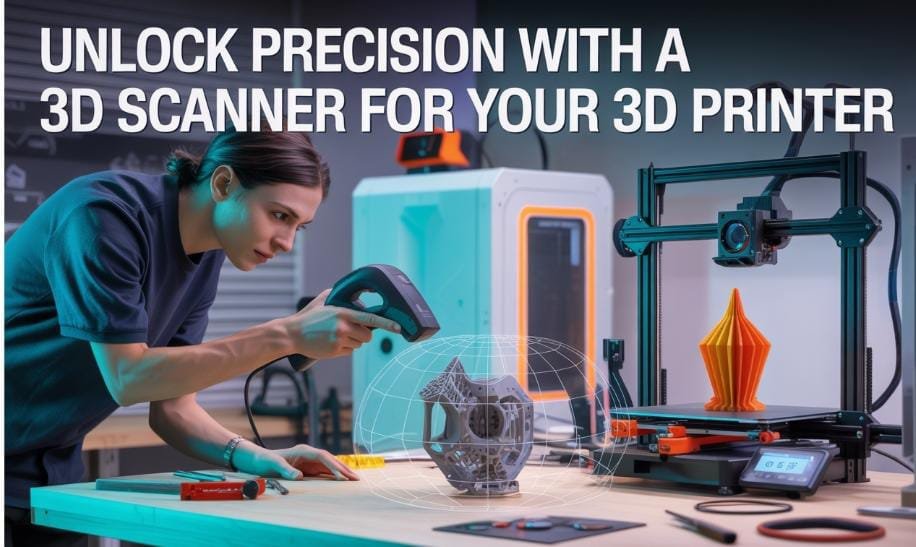
3D printing has changed the way makers build, fix, and create. What once required expensive manufacturing tools can now be done on a desk, in a workshop, or even at home. Yet, despite how powerful 3D printers have become, many makers still face the same challenge.
Getting accurate digital models.
That’s where a 3D scanner for 3D printer workflows becomes essential. Instead of guessing measurements or struggling with complex modeling software, scanning allows you to capture real objects and turn them into printable files with speed and accuracy.
For today’s makers, precision is no longer optional. It’s the difference between a successful print and wasted time.
The Problem with Starting from Scratch Every Time
Many makers rely on manual 3D modeling. While this works, it can be slow and frustrating, especially when you’re trying to recreate an existing object.
Think about common scenarios:
- A broken plastic clip
- A missing mechanical part
- A tool handle that needs a better grip
- A custom-fit accessory
Rebuilding these items from zero means measuring, modeling, adjusting, and testing again and again.
A scanner changes that process completely.
Instead of designing what you think the object looks like, you capture what it actually looks like.
What a 3D Scanner Adds to Your 3D Printing Setup
A 3D printer scanner bridges the gap between the physical and digital worlds.
You scan an object.
You edit the digital file if needed.
You print it.
That simple workflow opens up new creative and practical possibilities. Makers can move faster, experiment more freely, and achieve better results with fewer failed prints.
Modern scanning solutions are designed to integrate smoothly with common 3D printing software, making the transition from scan to print straightforward—even for beginners.
Precision That Improves Print Success
Precision is one of the biggest reasons makers adopt scanning technology.
Small dimensional errors can ruin a print. A part that’s off by even a millimeter might not fit, function, or assemble properly. Scanning reduces these risks by capturing exact shapes and surface details.
Companies like Revopoint focus on delivering high-accuracy scanning while keeping the tools accessible. Their scanners are built to capture fine details, edges, and curves that matter in functional prints.
When your model starts with accurate data, your printer can do its job more effectively.
Faster Prototyping and Iteration
Makers thrive on iteration.
You print a part.
Test it.
Adjust it.
Print again.
With scanning, this loop becomes much faster. You can scan a physical prototype, refine the design digitally, and reprint without redoing everything from scratch.
This approach encourages creativity. You’re more likely to try new ideas when changes are easy and mistakes aren’t costly.
For product designers, hobbyists, and small workshops, this speed can make a huge difference.
Perfect for Repairs, Mods, and Upgrades
One of the most practical uses of a 3D scanner for 3D printer setups is repair work.
Replacement parts are often hard to find, discontinued, or expensive. With scanning, you can capture the original part, strengthen weak areas, and print a better version.
This is especially useful for:
- Home appliances
- Tools and fixtures
- Automotive components
- Custom hardware
Scanning turns your 3D printer into a problem-solving machine, not just a creative tool.
Custom Fit and Personalization Made Easy
Customization is where scanning truly shines.
A 3D printer scanner allows makers to design parts that fit real-world objects or people perfectly. Instead of working with standard sizes, you can create designs based on exact shapes.
This is valuable for:
- Ergonomic grips
- Wearable accessories
- Custom mounts and brackets
- Artistic and decorative projects
Revopoint’s scanning solutions are designed to support these real-world use cases, making customization more accessible to everyday makers.
Easy to Use, Even for Beginners
In the past, scanning technology felt complicated and intimidating. That’s no longer the case.
Modern scanners are designed with user-friendly software, clear interfaces, and smooth workflows. You don’t need advanced engineering skills to get started.
Many makers find that scanning actually reduces the learning curve of 3D printing. Instead of mastering complex modeling techniques right away, you can begin by scanning and modifying existing objects.
This makes scanning a great entry point for beginners and students.
Compact Tools for Modern Workspaces
Not every maker has a large workshop.
Today’s scanners are compact, lightweight, and easy to store. You can scan on a desk, in a garage, or even on-site when needed. This flexibility fits perfectly with modern maker lifestyles.
Revopoint emphasizes portability and workflow compatibility, ensuring that scanning tools adapt to how makers actually work—not the other way around.
Final Thoughts
3D printing is no longer just about printing shapes. It’s about solving real problems, creating better designs, and working smarter.
A 3D scanner for 3D printer workflows gives makers the precision they need to do exactly that. Combined with a reliable 3D printer scanner, it transforms how ideas move from the physical world to digital files—and back again.
For makers who value accuracy, speed, and creativity, scanning isn’t an upgrade anymore.
It’s a necessity.