Introduction
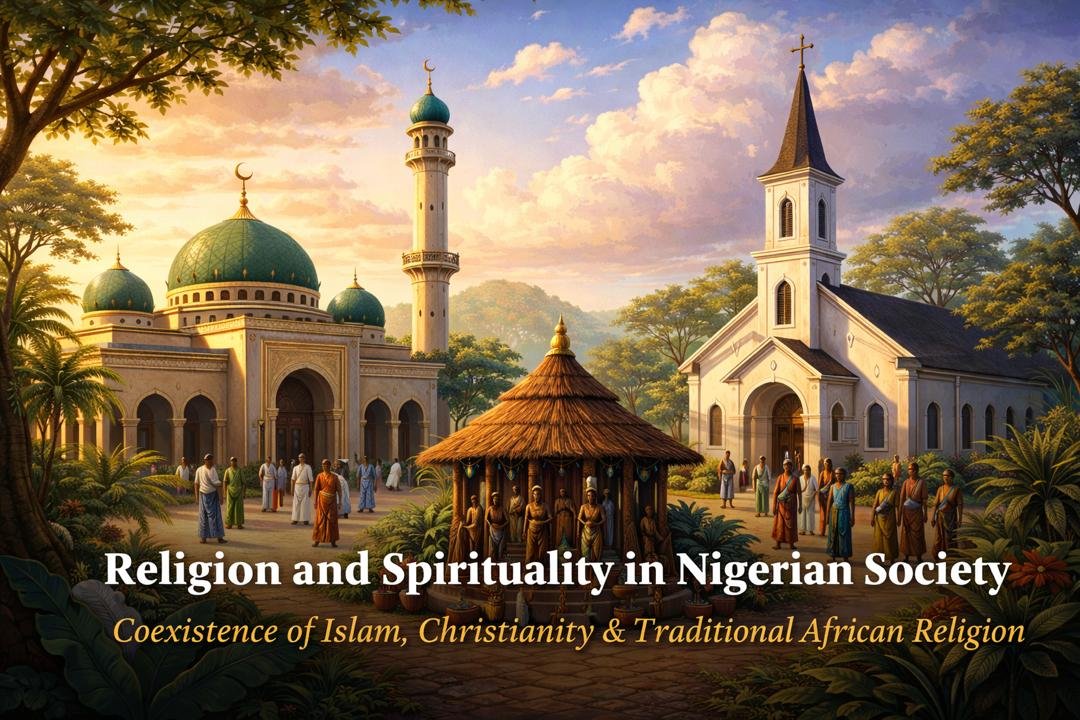
Nigeria is a religiously diverse nation, as it is among the most diverse nations globally, boasting of a rich traditional African religion, Christianity and Islam. Religion and spirituality in Nigerian society belief systems are coexisting in the same geographical area and in many cases in the same family, which influences the social behavior, cultural perception, moral qualities and self-identity. Religion in Nigeria is not a personal issue but a main course in the governance system, education, celebrations, conflict resolution, and interpersonal relationship.
However, despite some tensions, Nigeria has evolved a complicated mechanism of religious co-existence, in which tolerance, cultural adaptation, and religious awareness are practiced within the normal lives of the people. Since the worship of the ancient races in rural areas, and to-day, the worship of Christians on Sundays and Muslims on Fridays, spirituality has been a potent element in shaping the mode of thought, morals, and societal organizations.
This article will look into how the traditional religion, Christianity, and Islam lived together in Nigeria and how these are related to day to day life, morality and social interactions. It further examines the contribution of religion towards the national identity and cultural continuation with particular focus on the place of spirituality in developing the Nigerian identity.
An Overview of the Nigerian Religious Diversity
Nigeria is the most populous state in Africa and there is a population of over 200 million as well as about 250 ethnical groups. Its religion is largely divided as:
- Traditional African Religion (ATR)
- Christianity
- Islam
In the northern part, Islam is prevalent in most parts of the area, Christianity is mostly found in the southern part and the traditional religious practices exist in all the ethnic groups, mostly mixed with either the Christianity or the Islamic religion.
These religions are not independent of each other as they tend to overlap. Nigerians are highly religious in church or mosque, yet they respect the traditional practices of the past like the ancestral rites, naming ceremonies and the community festivals. This intermingling shows the way Nigeria has been practicing unique religious coexistence.
The Nigerian society is traditional in terms of Religion.
Beliefs and Practices
The oldest belief in Nigeria which is known as Traditional African Religion (ATR) differs among ethnic groups of the Yoruba, Igbo, Hausa, Tiv and Urhobo. Nonetheless, the following aspects are shared:
- Belief in a Supreme Being
- Veneration of ancestors
- Idolatry of deities or gods
- Rituals, sacrifice and festivals.
- Close relationship with nature and morals.
Conventional religion focuses on community life, geriatric respect, honesty, and closeness to the spiritual world. Good actions are thought to be a blessing whereas evil is a curse.
Social and Cultural Influences
Influences by traditional religion:
- Wedding ceremonies and bride price
- Naming ceremonies
- Elderly and diviner conflict resolution
- The New Yam Festival and Osun-Osogbo Festival and the Egungun Festival among others.
Many of the cultural practices based on the traditional religion are still respected and practiced even by Christians and Muslims and this demonstrates the extent to which these ideas are deeply rooted in the Nigerian society.
Christianity in Nigeria
Historical Background
Christianity was brought to Nigeria in the 15th century by European missionaries and was later spread to the region during the colonial government. Christians are now the largest in Nigeria with denominations such as:
- Catholicism
- Anglicanism
- Pentecostalism
- The Charismatic and Evangelical churches
Influence on Daily Life
Christianity has had much influence in the society of Nigeria in the following aspects:
- Education – Nigeria has many of the oldest schools as well as universities that were established by missionaries.
- Healthcare – Mission hospitals are still important in rural and urban.
- Morality – The stress on honesty, love, forgiveness and charity.
- Lifestyle – Church attendance, prayer-meetings, and fasting are among the key aspects of many Nigerians.
The influences of Pentecostal Christianity especially in the Nigerian contemporary culture stand in the gospel music, media, fashion and motivational preaching.
Islam in Nigerian Society
Historical Roots
In Nigeria, Islam infiltrated as early as 11th century via trans-Saharan trade and Islamic scholarship, especially in the north regions. It then took a strong root with the Sokoto Caliphate in the 19th century.
Religious influence and Social influence
Social life in Islam is influenced in numerous aspects:
- Prayers and fasting (Ramadan) every day
- Muslim schooling (Quranic schools)
- Modesty in dressing
- Charity (Zakat)
- Marriage and family set-up
Discipline, humility, and welfare of the community is stressed in Islamic values. In most of the northern states, the Sharia law affects the civil and personal issues, and it strengthens the moral behavior and religious practice.

Tolerance and Coexistence of religions in Nigeria
Regardless of the differences, Nigerians have devised peace coexistence methods. Interfaith relationships exist at work place, schools and neighborhood. It is not unusual to find:
- Largely, families that include Christians and Muslims
- Friends go to each other on religious festivals.
- Similar cultural ideals that prevail over religious disparities
Mutual respect and understanding are the common practice in religious tolerance despite the domination of a certain religion in a region. People of various religions are often united by national events and the community projects.
There have however been some issues like religious extremism and political interference in religion that have threatened peaceful coexistence. Nevertheless, there are numerous Nigerians who advocate the interfaith dialogue, peace building, and unity.
Adaptation to Culture and Religious Syncretism
Religious syncretism- the combination of the traditional beliefs with Christianity or Islam is one of the distinguishing characteristics of the Nigerian spirituality.
Examples include:
- Christians address traditional healers
- Muslims celebrating religious holidays
- Rites of culture conducted in conjunction with church or mosque weddings
- Spiritual defense and fate despite religious affiliation
This flexibility indicates that religion in Nigeria is not fixed but flexible and is changing with the realities of culture without abandoning the essence of spirituality.
The Identity of Spirituality in the Development of the Nigerian identity
The Nigerians are based on spirituality. It determines the way individuals think, behave, and interact with others and also understanding of life. Spirituality is not an independent phenomenon among the day to day activities of many Nigerians, it is life itself.
Moral Compass
Spiritual beliefs inform ethical conduct where an individual lives honestly, respectful, kind and responsible. Morality is perceived as guided by God whether in Christian teachings, Islamic teachings or even the traditional ethics.
Sense of Purpose and Hope
When suffering, Nigerians tend to resort to praying, fasting, or spiritual consultation. Faith gives emotional strength, endurance, and hopes when there is a challenge to economies and uncertainty.
Community and Belonging
Religions bring about cohesiveness and social solidarity. Churches, mosques and shrines are the places where people meet to engage in social interaction, charity and solving collective problems.
Identity and Worldview
Religion and spirituality in Nigerian society defines the way success, failure, illness and destiny are perceived. A lot of people consider spiritual powers as determinants of the outcome of life, which contributes to a worldview of faith as a part of daily decision-making.
National Character
All these values such as hospitality, respect to the elderly, communal living, and strong families ties are fundamental Nigerian values which are deeply embedded in the spiritual teachings passed over generations. Therefore, it is impossible to overestimate the importance of spirituality in the formation of the Nigerian identity. It affects the ways of thinking, social conventions, and national awareness.
Social Interaction and Religion in Nigeria
Religion is powerful influence on the social interaction of the Nigerians:
- People tend to greet each other with religious phrases (God bless you, Alhamdulillah)
- Religious ceremonies are used to signify major life events like birth, marriage and death
- The religious involvement is sometimes associated with social status
- Religious leaders are a source of moral authority and respect
Relationships between the religions, although delicate at times, are becoming more usual and are evidenced by increased tolerance and openness to other cultures.
Conclusion
The Nigerian society has religion and spirituality intricately interwoven. Nigeria has created a distinctive spiritual environment identified by plurality, versatility, and strength as a result of the co-existence of classical religion, Christianity, and Islam. These ideologies influence morality, social relations, culture and nationalism.
Nevertheless, religious tolerance is one of the key aspects of Nigerian life that ensures the ability of various religions to co-exist and impact each other in a positive way. This amalgamation of ancient and contemporary religions is an indication of a community that appreciates its culture as well as development. The bottom line is that spirituality continues to dominate the lives of the Nigerians, including the worldviews, the reinforcement of the community and what it means to be a Nigerian in a culturally diverse and spiritually rich country.
Furthermore, the continued relevance of religion and spirituality in Nigerian society highlights the need for mutual respect, dialogue, and understanding among people of different faiths. As Nigeria continues to develop socially, politically, and economically, maintaining religious harmony will remain essential for national unity and sustainable growth. By embracing tolerance and appreciating its diverse spiritual heritage, Nigeria can foster peace, strengthen social cohesion, and preserve the cultural values that define its identity in an increasingly globalized world.
Get more well researched information about Religion in Nigeria Society here