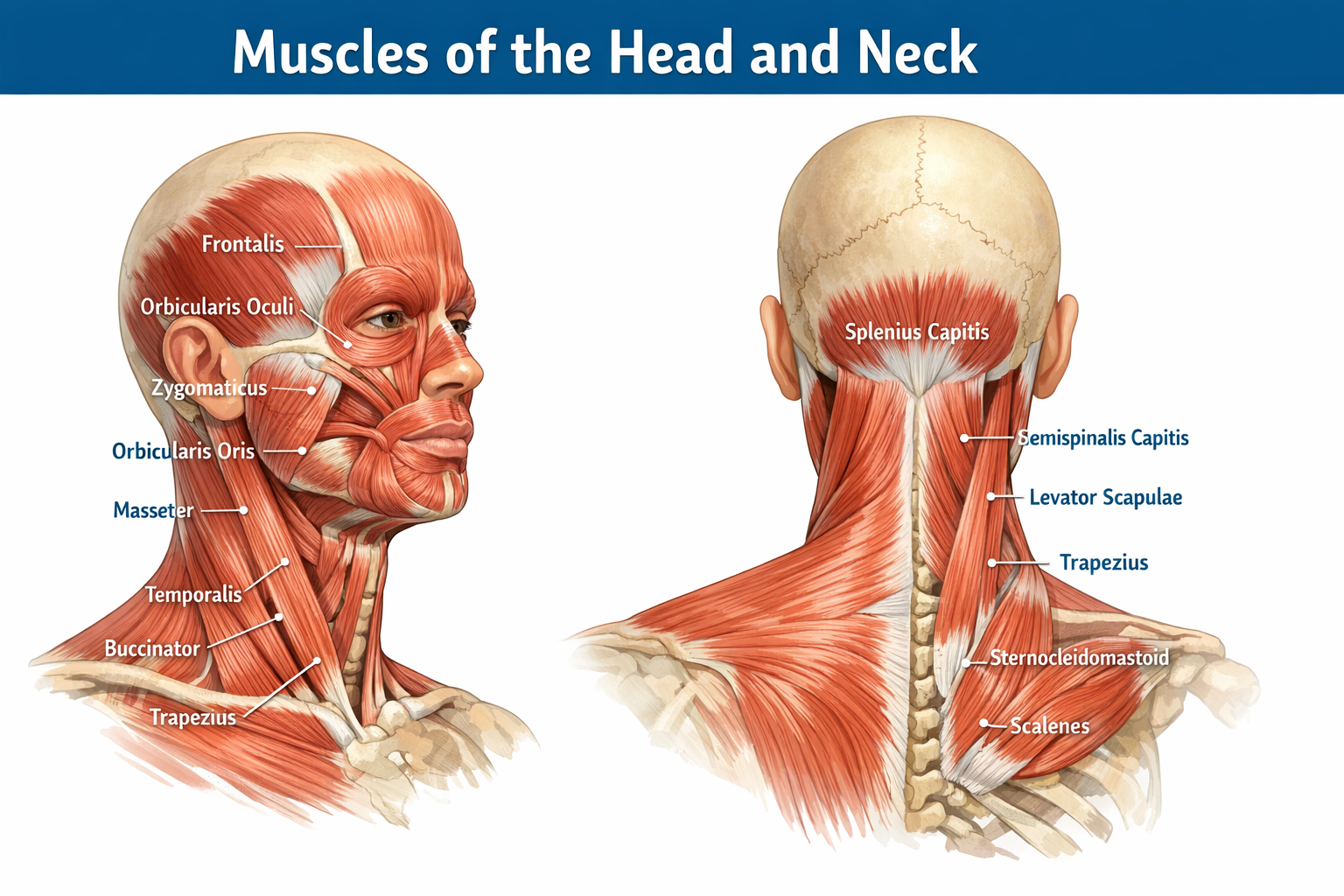
The neck muscles and the head muscles are very crucial in human anatomy since they enable us to perform several important roles such as chewing, speaking, expression of emotions, and posture. These muscles may be classified into different large categories according to their purpose: muscles of facial expression, muscles of mastication, and muscles, which move the neck. Knowledge of these muscles does not only mean having a clue into the way these muscles are structured but also knowing the role they do play in our daily experiences.
Facial Expression Muscles
These are facial muscles or the mimetic muscles that are unique in that they do not become attached to the bone, but they attach themselves to the skin. The intricate motions of this anatomical feature make facial expressions very diverse as they can be expressed by smiling and frowning, as well as surprise and anger. Facial nerve (cranial nerve VII) innervates the muscles of the face mostly.
Major Facial Muscles
- Frontalis
The frontalis muscle that is found on the forehead is the one that raises the eyebrows and wrinkles the forehead. This gesture gives out impressions like surprise or curiosity.
- Orbicularis Oculi
It is a circular muscle which covers the eye and allows the eyelid to close, to blink, and to squint. It also helps in the expression of such emotions as joy or distress.
- Zygomaticus Major and Minor
These are the muscles which run across the cheekbone to the corners of the mouth. They are involved in the act of smiling by raising the lips high and out.
- Orbicularis Oris
The orbicularis oris which surrounds the mouth enables movements of the lips which include puckering, kissing, and speaking. It plays a major role in non-verbal communication and articulation.
- Buccinator
The buccinator is found on the cheek and assists in the bulging of the cheeks against the teeth in the course of chewing to ensure that food in the mouth does not collect in the mouth cavity. It helps blow and whistle as well.
- Depressor Anguli Oris
This muscle pulls corners of the mouth downwards thus creating facial expressions of sadness or discontent.
- Platysma
This is occasionally classified as a neck muscle but the platysma is spread out into the lower face, where it helps in making an expression of fear or tension, by drawing the lower lip and the skin in the neck down.
Functional Significance
Facial muscles enable human beings to express themselves non-verbally and socialize. To provide an example, a minor smile will give the zygomaticus major, orbicularis oculi, and frowning will use the depressor anguli oris and corrugator supercilii. Other than expression, these muscles aid in talking by modulating the movements of the mouth and regulating the lips, which has a direct relationship with phonetics.
Muscles of Mastication
Chewing or mastication is a complicated process that involves strong and accurate movements. Masticating muscles mostly help in the movement of the mandible and effective processing of food. The mandibular branch of the trigeminal nerve (cranial nerve V3) serves these muscles.
Great Muscles of Mastication
- Masseter
Masseter is among the strongest muscles when compared to its size. It raises the mandible, and this helps in the strong clenching of the jaw needed in biting and grinding food.
- Temporalis
The temporalis muscle is found on the side of the skull and helps in raising the mandible as well as retracting it. It has a fan-like shape, which gives it an opportunity to control during the chewing.
- Medial Pterygoid
This muscle acts in collaboration with the masseter, which helps in raising the mandible and grinding the food sideways, which is essential in the full breakdown of food.
- Lateral Pterygoid
Lateral pterygoid helps in the opening of the jaw, the outward protrusion of the mandible, and the lateral movements. The complex chewing motions and articulation of speech need it.
Functional Significance
Mastication plays an important role in digestion as food becomes broken and the surface area enlarged as a result of digestion. The concerted effort of the four major muscles of mastication is what allows the jaw to move both up and down and left and right to enable the human being to chew various food textures. Moreover, the indirect benefit of mastication is in the facial development and the health of the teeth.
Muscles of Neck Movement
The neck has muscles which support the head, aid in movement and also aid in posture. These are muscles that play a vital role in such functions as swallowing, breathing, and head positioning. The different cranial and spinal nerves are known to innervate them based on their location and their functions.
To gain a detailed observation of the muscles involved in the movement of the neck, this is a comprehensive guide to the muscles.
Major Neck Muscles
- Sternocleidomastoid (SCM)
The SCM is a large, dark muscle which runs along the sterna and clavicles to the mastoid process of the temporal bone. It supports the flexion, rotation and lateral bending of the head. The SCM muscles flex the neck forward when both are contracting.
- Trapezius (Upper Fibers)
The fibers of upper trapezius muscles help to straighten the neck, raise the level of the scapula. They also play a role of tilting and rotating the head.
- Scalene Muscles (Posterior, Middle, anterior)
These are the deep muscles located at the lateral part of the neck which takes part in flexion and lateral bending. They also raise the two frontal ribs on deep breathing, which facilitates lunging.
- Levator Scapulae
This muscle attaches the cervical vertebrae to the scapula and raises the scapula and aids in the lateral flexion of the neck.
- Splenius Capitol and Splenius Cervicis.
The muscles are the posterior neck muscles and extend, are able to rotate, and also laterally bend the neck along with the head, and they assist in posture and head stabilization.
Functional Significance
Neck muscles are essential in the day-to-day activities such as head movement such as looking around, nodding, and head posture. They apply synergy and balance the weight of the head, cervical protection, and accurate head movements during operations such as driving, reading, or sports involvement. The inability of the neck muscles to work well may cause tightness, pain, or bad posture.
Co-ordination of Head and Neck Muscles in Daily activities
Muscles of the head and neck do not work separately. They collaborate in order to seamlessly conduct daily tasks.
Chewing and Speaking
Chewing entails the use of the mastication muscles with the help of some muscles of the face such as the buccinator and the orbicularis oris that aids in driving food and creating a bolus. Speaking involves the perfect movement of orbicularis oris, tongue, jaw, and depressors and elevators. Even the neck muscles play an insidious role of stabilizing the head and jaw when making articulation.
Facial Expression and Communication
Facial expression is a very complex activity. The emotive expressions of smiling, frowning, or surprise, consist of the specific movements of the muscles, with many of them acting upon the underlying bones of the skull and bringing about visible changes in the face. As an example, the zygomaticus major, coupled with the orbicularis oculi produces a true smile, and the corrugator supercilii frowns the brow when one is worried or focused.
Posture and Neck Stability
Muscles of the neck play a part in both statical and movement postures. The muscles such as the SCM, the trapezius and the splenius capitis are important in proper positioning of the cervical spine. This helps to maintain the balance of the head as to decrease the chances of strain or injury when moving.
Functional Synergy
In daily activities, the head, face and neck muscles may be activated at the same time. For example:
- Dining at the table engages the mastication muscles, facial muscles to move the food, and the neck muscles in order to position the head.
- Activation of jaw, lips and tongue muscles occurs in talking or singing and the neck muscles are used to provide stability and alignment.
- Emotional expression depends on the facial muscles to act and the slight involvement of the neck to give support to the head positioning.
This integration means that it is crucial to learn the anatomy and the functionality of these muscles in a real-life scenario.
Usual Problems to the Head and Neck Muscles
Dysfunction of the muscles of the head or neck can be widespread. Some common issues include:
- Temporomandibular Joint (TMJ) Disorders
Excess or disbalance of mastication muscles may cause TMJ pain, clicking or chewing problems.
- Neck Strain and Tension
Neck muscles can either be weak or overstrained to create tension headaches, stiffness or poor posture.
- Facial Muscle Weakness
Some of the things that can affect expression, oral competence, and speech include injury or nerve damage e.g. due to facial nerve palsy.
- Postural Imbalances
The bad functioning of neck muscles may result in forward head position that could impact on shoulder and upper back position.
These problems can be corrected by means of physical therapy, specific exercises, and some ergonomic changes to recover the normal functioning of muscles.
Conclusion
Muscles of the head and neck play an imperative role in numerous functions such as chewing, speaking, expressing feelings and posture. The non-verbal communication is allowed by the facial muscles, the efficient food processing is guaranteed by the mastication ones, and the head is moved and stabilized with the help of the neck muscles.
Having knowledge of the way these muscles work as a team, we may learn to value the great level of coordination that is needed in even the simplest everyday tasks. This is not only informative to the practice of medicine, dentistry and physical therapy, but it also highlights the significance of muscle health in the overall functional well-being.


This is super helpful, thank you!