Search visibility has shifted from a matter of placement to a matter of perception. While traditional rankings still influence discovery, they no longer control how brands are presented when users rely on AI-generated answers for guidance.
As professionals, educators, and business decision-makers increasingly consult tools like ChatGPT, Gemini, Claude, and Copilot, Generative Engine Optimization (GEO) has become an essential extension of search strategy. The objective is not simply to appear, but to be understood-ensuring AI systems accurately recognize, contextualize, and recommend a brand.
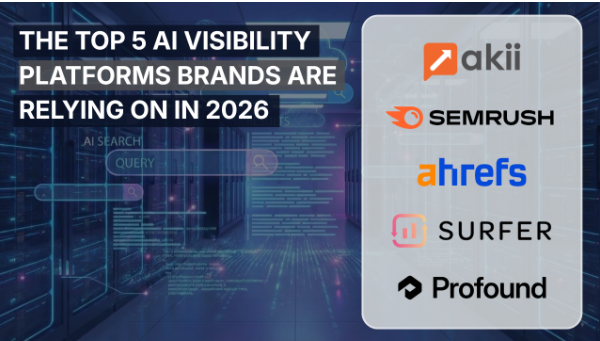
The following five platforms illustrate how organizations are adapting to this new visibility landscape as AI-driven search continues to mature.
1. Akii: Purpose-Built for AI Visibility Optimization
Akii was developed specifically to address how AI systems interpret and reference brands, rather than adapting legacy SEO frameworks to conversational interfaces.
Its core focus is on a widening gap: organizations that perform well in traditional search often fail to appear in AI-generated recommendations. Akii identifies this gap and provides structured tools to close it.
- Primary Strategy
Identify and correct discrepancies between organic search performance and AI citation frequency. - Standout Capability
AI Engage enables brands to supply structured, authoritative context that improves how AI systems understand and describe them, helping correct outdated or inaccurate representations. - Key Asset
A free AI Visibility Score that evaluates how multiple major language models reference and contextualize a brand. - Best For
Small to mid-sized organizations and growing businesses seeking clearer insight into their AI-facing presence.
2. Semrush: The All-in-One Marketing Control Center
Semrush has expanded its established marketing platform to include AI visibility insights, extending its role into the GEO era.
Rather than treating AI optimization as a separate initiative, Semrush integrates these signals into its broader SEO, PPC, and content workflows.
- Primary Strategy
Unified monitoring that aligns keyword rankings with AI Overview and conversational visibility metrics. - Standout Capability
Semrush Copilot flags content losing effectiveness because it is not aligned with AI summarization patterns. - Key Asset
AI Ad Tracker, which monitors paid brand mentions inside conversational search platforms. - Best For
Marketing teams and agencies managing complex, multi-channel campaigns.
3. Ahrefs: Entity and Competitor Intelligence at Scale
Ahrefs approaches AI visibility through authority modeling and entity relationships rather than content volume alone.
Its tools help teams understand why AI systems trust certain sources and brands when forming recommendations.
- Primary Strategy
Analyze and replicate competitor authority signals embedded in AI knowledge graphs. - Standout Capability
Brand Radar revealing how AI models categorize and position a brand. - Key Asset
Citation Gap Analysis highlighting trusted domains competitors benefit from. - Best For
Advanced SEO teams and analysts focused on competitive intelligence and authority development.
4. Surfer AI: Content Built for AI Parsing
Surfer AI focuses on structuring content in a way that AI systems can easily extract, summarize, and reuse.
The platform treats AI models as structured readers rather than human visitors.
- Primary Strategy
Create content optimized for extraction and factual clarity. - Standout Capability
GEO Mode prioritizing semantic completeness over keyword repetition. - Key Asset
Snippet Predictor identifying content sections most likely to surface in AI-generated answers. - Best For
Content-heavy teams, publishers, and niche site operators.
5. Profound: Enterprise-Level AI Brand Intelligence
Profound operates at a macro level, focusing on how AI systems perceive brands across regions and industries.
Rather than optimizing individual pages, it measures large-scale AI-driven brand representation.
- Primary Strategy
Measure global share of voice across AI-generated conversations. - Standout Capability
Conversation Explorer providing access to real AI interaction contexts. - Key Asset
Global Sentiment Heatmap tracking perception shifts by geography and model. - Best For
Enterprise and multinational organizations with complex reporting requirements.
Comparison: Choosing the Right GEO Platform
| Tool | Best Used For | Difficulty | Price Tier |
| Akii | Diagnosing and correcting AI visibility gaps | Beginner-friendly | Mid-tier |
| Semrush | Unified SEO and AI monitoring | Moderate | Professional |
| Ahrefs | Competitive AI authority intelligence | Advanced | Professional |
| Surfer AI | AI-optimized content creation | Beginner-friendly | Entry-level |
| Profound | Enterprise AI brand perception measurement | Complex | Premium |
Final Perspective
AI-driven discovery has redefined what it means to be visible. AI systems do not simply retrieve information-they interpret credibility, relevance, and trust.
The platforms above reflect different strategies for influencing those interpretations. From direct brand correction to large-scale perception analysis, success in AI search now depends on intentional, engineered visibility.